
 FA+
FA+ Shop
Shop


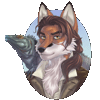
Shaw mac Áedán
by LeChevalier
Traditional Artist
15 years ago
Shaw mac Áedán, son of Áedán mac Gabráin. With his father being the king of Dál Riata in the late sixth century a.c., Shaw grew up without the problems the normal peasants had to deal with. Yet, his family were mostly constantly at war with the nearby kingdoms of Scotia, which made Shaw both a skilled warrior and an epicurean, knowing his life can be over in a week.
Not only his natural abilities as a wolf made Shaw a terrifying fighter, but also a well hidden secret only he and his parents share: His father is not Áedán, but Nodens, the god of war, hunting, healing and the sea. Shaw's divine origins blessed him with inhuman stamina and strength, as he will demonstrate in this picture. To defeat him is very difficult, though not impossible - he is strong like a couple of oxen, yet not the most smartest brain in Britannia, and strategy is mostly foreign to him.
Trough some complications, hsi father died a mysterious death and Shaw had to escape the new ruler of Dál Riata, the Northumbrian king Aethelfrith.
He seeks for adventure since them and finds a lot.I made this character up to have a tough guy who is mostly in a light hearted mood for everything and just wants to enjoy life. Too, I like the idea of an unwashed, muscle bound young Scots-warrior ;)
I have a version without body hair, which I will post in my sketch-folder: http://www.furaffinity.net/view/4338947/ You decide which looks better. Oh, and I am totally out of practice, so I copied a head of a commission I ordered from deviantart. To keep things honest here.
Inspired by Paul Telfer's Hercules. http://worldwidebodybuilders.blogsp.....telfer-in.html
Not only his natural abilities as a wolf made Shaw a terrifying fighter, but also a well hidden secret only he and his parents share: His father is not Áedán, but Nodens, the god of war, hunting, healing and the sea. Shaw's divine origins blessed him with inhuman stamina and strength, as he will demonstrate in this picture. To defeat him is very difficult, though not impossible - he is strong like a couple of oxen, yet not the most smartest brain in Britannia, and strategy is mostly foreign to him.
Trough some complications, hsi father died a mysterious death and Shaw had to escape the new ruler of Dál Riata, the Northumbrian king Aethelfrith.
He seeks for adventure since them and finds a lot.I made this character up to have a tough guy who is mostly in a light hearted mood for everything and just wants to enjoy life. Too, I like the idea of an unwashed, muscle bound young Scots-warrior ;)
I have a version without body hair, which I will post in my sketch-folder: http://www.furaffinity.net/view/4338947/ You decide which looks better. Oh, and I am totally out of practice, so I copied a head of a commission I ordered from deviantart. To keep things honest here.
Inspired by Paul Telfer's Hercules. http://worldwidebodybuilders.blogsp.....telfer-in.html
701
Views
45
Comments
41
Favorites
General
Rating
Category
Sub-Category
Species
Resolution
File Size
Artwork (Traditional)
Muscle
Wolf
686 x 1020
253.6 kB

Awesome wolf here to put it simply.
and that's a leather sleeve with a branded design, not a tattoo
Knee-length waist kilts didn't really exist until the late 18th century. They were a redesign of the Scottish kilt for its reintroduction after it had been banned for decades by the British government as a perceived symbol of Scottish rebellion. Before that, kilts had evolved from long cloaks that were belted to fasten them in place, but those are only certain to date back to the 16th century.
Dal Riata, on the other hand, was much longer ago - 6th to 7th century, located in what are now County Antrim, Ireland and the Inner Hebrides of what is now Scotland. The rest of what is now Scotland was home to the Picts (a separate semi-Celtic people), the Brythons (an Old Welsh-speaking people in Strathclyde) and the Northumbrian Angles (ancestors of the modern Lowland Scots). Scandinavians had not yet arrived. At this time, there was no difference between Irish Gaels and Scottish Gaels, as the Gaels of Dal Riata were recent colonists from Ireland.
However, they were still "Scots" - the term "Scoti" after which Scotland was later named actually applied to all Gaelic peoples, including those who lived in Ireland, and even those Gaels of 100% Irish origin who had traveled to mainland Europe (mostly Celtic Christian monks). The original "Scotia" was the area of Ulster from where Dal Riata originally expanded, and later was refashioned as the Latin name for what is now Scotland (previously also "Caledonia" or "Albania"). It doesn't seem like the Gaels ever spent much time calling themselves Scoti - Gaels in both Ireland and Scotland refer to their peoples as Gaels, and the Gaelic name for Scotland is "Alba". It seems that historically, the practice of naming "Scotland" was made by Scottish Lowlanders. At first, the Lowlanders were the combined descendants of Northumbria and Strathclyde who spoke a form of Middle English they called "Inglis", while all Gaels were still called Scots. Later, the Lowlanders appropriated the term "Scots" for themselves, and started calling all Gaels "Erse" (Irish).
However, I get the more down-to-earth impression that it's simply just fun to watch guys jump on trampolines with kilts and no undies. :3 But it's fun to ramble. X3
BUT I knew that they had long, coat-like kilts. Yet, I decided to use a simple one - in this picture - so one can see his abdomen better
......does any of that make sense?
And I'm an ethnic Galwegian (people of Galloway), though this is purely in a diaspora sense as I was born and raised in the tropical Pacific islands and I've never been to Europe. X3 Galloway is also traditionally a Gaelic region in what is now Scotland (distinct from the Highlands and Hebrides which are also traditionally Gaelic), but Galloway was settled from Ireland en masse at a much later time (like during the 13th century), settling among an already-present Brythonic and Northumbrian population. (To make this history more complicated, the Gaelic settlers of Galloway were not themselves of Gaelic ancestry - they were the descendants of Scandinavians that had settled the coasts of Ireland centuries before who had completely assimilated into Irish Gaelic culture.) Galloway remained mostly Gaelic-speaking until about the 17th century, when it became majority Scots (Anglic) speaking, and is now mostly English-speaking. Gaelic culture remains in much of Scotland as a substratum, while only a minority (mainly in Highland and the Hebrides) actually speak Gaelic.
I ramble very easily, so I'll try to wrap this comment up. I have an affinity for much of Gaelic culture in both Scotland and Ireland (as well as in the Isle of Man), but I prefer to avoid favoring one or the other (especially given Galloway's historically transitional position between the two), and I especially avoid taking a personal stance in the historical conflicts that helped cement the ultimate separation of Scottish and Irish culture (like Protestants vs. Catholics, religious wars, etc.). And I love ancient Gaelic myth and lore full of brawny, burly warrior fags. :D *senses
I will certainly try to keep Shaw more to the historical facts, as I see gladly that at least someone is deeply interested in this subject. :) Oh, and tell your pal that Shaw is from the Highlands, which explains his gorgeousness. I have been in Ireland (http://www.furaffinity.net/view/2697542/) and was surprised indeed everyone was smaller than me (1.95 m)
So, a genetic Celt in the Pacific... May I ask on which Isle? ^.^
Yes, I'd believe a Highlander being taller and hotter. Though in Irish myth, demographics were claimed to be different from today - more people, men and women alike, were taller and larger. (Not entirely sure this is historically accurate, since ancient Irish people may have had the same wet dreams about big strong guys that people have today with necessarily being big and strong themselves.) Throughout Ireland's recorded history there has been some kind of ethnic melting pot (like Celts + pre-Celts), but the gene pool of today is certainly different from the gene pool of the past, as Ireland has since been heavily settled by other visitors (Norse-Gaels, Hiberno-Normans, Anglo-Irish, Ulster Scots, Poles, and various other Ethnic groups in Ireland). Ireland is still perfectly Irish no matter who birthed you, but you're unlikely to meet big buff guys. But could there have been big buff guys in ancient times? Possibly - the Highlanders came from somewhere. Though modern Scottish Highlanders are primarily a mix of three sources: Gaels, Picts and Norse. Irish Gaels are primarily a mix of Gaels, Norse, Cruithne (probably also Picts) and Normans. Not so different. There are various theories on the origins of the vaguely-defined Black Irish, which range from as ancient as the mythical Fir Bolg to the theory that survivors of the Spanish Armada settled in Ireland. But sometimes you just can't come up with a clear explanation of why people start to look different over time - gene pools fluctuate in Ireland and Scotland just like they do everywhere in the world. The ancient Gaels also observed this by distinguishing the Fingals (Norwegian Norse = "fair strangers" = Fionnghall, plural Fionnghaill) from the Dougals/Doyles (Danish Norse = "dark strangers" = Dubhghall, plural Dubhghaill), in reference to the observation that Danes tended to have darker hair than Norwegians. Ultimately these superficial traits are mostly biologically meaningless (just like the artificial human construct of "race"), though I do agree that big guys tend to be just-as-superficially hotter than tiny guys.
Which isle am I from? Born on O'ahu, raised on Kwajalein until I was a teenager. But now I'm stuck in North America......in the Great Basin. >_< I miss the rain! ;.;
Very, very awesome picture.
The Old Irish form is Segda, which was probably pronounced /ˈɕɛɣðˠə/. This name has evolved forms in both modern Irish Gaelic and modern Scottish Gaelic, as well as anglicized spellings.
The modern Irish form is Séaghdha, pronounced /ɕeː/. It has a simplified alternative spelling, Sé (same pronunciation). Its anglicized form is usually Shea ("shay").
The modern Scottish form is Seaghdh. I'm not as certain about its pronunciation (since I actually know less about Scottish Gaelic than about Irish Gaelic - that's lopsided, I know), but I think it's something like /ʃaɣ/. Its anglicized form seems to usually be Shaw.
I don't know anything about the Manx form. I don't even know if there is one.
As an example: The name Kevin is now common all over Europe, but it is an anglicized spelling of Modern Irish Caoimhghin, simplified spelling Caoimhín. It evolved from Middle Irish Caoimhghín, which evolved from Old Irish Cóemgein or Cóemgen, meaning "kind birth" (compare Eugene = "good birth"). It is latinized as Coemgenus. But it was specifically the English spelling "Kevin" that spread to other countries. All things considered, which spelling est la plus naturelle en français? Kevin, n'est-ce pas?