
 FA+
FA+ Shop
Shop
334
Views
Views
19
Favorites
Favorites
Category
All / All
Species Jackal
Size 1700 x 1074
File Size 2.58 MB
Report this content
More from Siber


Listed in Folders


For a while now, I’ve been thinking of creating a character that better represents me. I’ve had a somewhat tenuous relationship with Siber, the Bonded Jackal. He represented me, but didn’t at the same time. He was just a character in a story that I have a lot of fun writing about. I felt that he was more of a mask, if anything else. I never really thought of him truly as my fursona.
My personal experiences and my personality never really was represented well in his character, looking back at it. I wanted something that represented me better: the quiet, caring person that I am, my drive to learn more and more about the things that I care about, and my love for great storytelling.
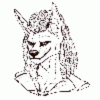
So now, I reveal my truesona: The Worldwalker. Thanks to the wonderful Kirena-Kaya, I was able to flesh this sona out to the fullest extent, and for that, I am forever grateful.
Art done by the always amazing Kirena-Kaya . Her original post can be found here.
Siber, the Worldwalker, belongs to me, Siber
Siber
Version for the fur patterns can be found here.
Name: Siber
Alias: The Worldwalker
Species: Golden Jackal
Gender: Male
Height: 6’0”
Temperament: Calm, Introspective, Precise
Traits:
Hums music when alone or focused.
Writes constantly, even in places he’s not supposed to.
Disappears without warning, returns with quiet eyes.
Siber was never a hero. Not the type to swing a sword with banners unfurling in his wake. Or shout prophecy into the teeth of tyranny. Or stamp his name in marble for all the world to see.
He was the type to listen.
To the silence between the words. To the half-stories told in breathless whispers. To the echoes of entire worlds, calling back to something they themselves have forgotten.
He learned to walk between those worlds, not through power, but through understanding. By walking the streets, reading the histories, and living the weight of a story, not as entertainment, but as experience, the lines between them blurred, and when they blurred enough, he simply stepped through.
No portal. No burst of light. Just understanding. Just belonging.
Each world leaves something behind in him. Not trophies, or prizes, or platitudes, but signifiers. A robe to remember the laughter among stars. A lotus to remind him of identity. A journal to hold unspoken words. A revolver that speaks in endings. A ribbon to carry weight.
He weaves them together, not into armor, but into a story. He wears this story when the silence of the here and now becomes too loud.
The first doorway opened up for him amidst a ruin of stars. A universe of sunken golden ages, orphaned moons, and people too ready to wear legend as armor. Most came to it to fight. Siber came to listen.
He learned the world the way you might learn a song: one piece at a time. Weapon notes, terminal scraps, mission whispers that spoke of older and stranger things. He walked the empty plazas and rusted cosmodromes, reading the space between each burst of gunfire. The more he knew, the closer the world around him brought him, not as a player, but as a witness. And one night, late between a strike and a sunrise, the world let him in.
He was never a champion there. He wasn’t a name on the Tower, wasn’t a banner in Trials. He was the quiet one on the edge of the fireteam: the first to ping a shortcut, the last to leave orbit. He tracked time in raid runs and reset timers, but what he remembers are voices—the laughter that broke tension at 2 a.m., breaths held when a boss finally went down, soft debriefs carried across starfields while ships idled and the music did what words could not.
In that world he learned a lesson that did not need shouting: fate is not found—it is made. Not by spectacle, but by presence. By showing up, again and again, to the same fragments until they became a whole.
The robes came after. Not as a trophy or replica, but as memory made real. Deep steel-blue like skyboxes at dusk, trimmed in muted gold that catches light the way a grin catches on a tired face. They hang long and lived-in, hood down by default—because he has nothing to hide. Their hem remembers raid nights and triumphs; their inner lining still smells like dust, ozone, and midnight screens.
People ask what he won there. He smiles, because the answer is simpler than loot tables. He won a way of seeing. He learned how to hear a story’s heartbeat under the noise, how to trust the rhythm of a team moving as one, how to let a world change without needing to claim it.
When he leaves that universe now, the robes leave with him. They are how he carries the stars without burning, how he keeps the chorus of old friends close when the next world is quiet. They whisper the only inscription he ever kept from that place:
Make your own fate.
The second doorway was all angles and echoes. A universe filled with golden ruins and war machines from a war fought long ago. He learned its language the slow way: movement first, then ritual, then the hush between them where the Void hums like breath.
At first, he survived it. He chose the gear that kept him standing, not what felt like him, a sturdy shell that did its job while he tried to learn the world underneath the noise. He tested shape after shape, tuning and retuning, but nothing felt like it was his.
Then life cut the thread. His door closed and his progress was left stranded. He walked away.
Years later, with a new door and steadier hands, he continued. Siber rebuilt the muscle memory, caught up with the story, and found his own fun in the quiet spaces in between missions.
And then a new shape arrived. One that matched his heartbeat.
Lean. Patient. A hunter’s poise in the moonlight. Movement that spoke in low tones about grace and teeth. About choice and consequence. About being many, and one at once. The gear didn’t ask Siber to force anything. It met him where he stood and sang back. Suddenly, the systems disappeared and turned into flow.
That was the lesson there: mastery is when the mechanism vanishes and only the feeling remains. When you stop piloting, and start belonging.
Siber didn’t leave that world with a weapon. He left with a golden lotus stitched into his robes high between his shoulders, because identity is something you carry even when you can’t see it. It isn’t for show. It’s the quiet proof that he broke, returned, rebuilt, and found the self that moves like music.
It doesn’t shine or ask permission. It simply whispers what he learned by staying long enough to listen:
This is what I am.
The third doorway opened with a conversation.
A city of saints who lied and sinners who told the truth. Crossroads where every answer split the road in two. It was a place where words carried weight, where silence was never indifferent, and where a single choice could bend a fate you hadn’t learned to name yet.
He meant to sample it. He stayed for the nights.
Nights when the screen glow felt like candlelight, when the music softened the edges of the world. Nights spent arguing with persuasion checks while letting the dice fall and the consequences stand. Nights with a very good friend on the other end of the call, both of them saying ‘one more quest’, until dawn began to break.
They didn’t rush. They talked and disagreed. They laughed at failures that turned into legends. They stood for victories that didn’t feel like they won. Somewhere in it all, he understood: the best stories are ones that are shared with friends.
And the best parts of the story come from bending the rules.
They found a multiclass that turned each turn into a speedrun: six seconds, two hundred feet, breaking entire encounters with no game master to stop them. They discovered that the ‘useless cloak’ that created a cloud of smoke on command was the key to endless five-finger discounts.
But not every broken rule went in their favor.
One moment, he was standing. The next, on the ground bleeding out from a powerful strike. His friend figured he’d save him the fastest way he could: by throwing a potion bottle like a prayer. The bottle’s arc caused it to land not next to him, but on his forehead, finishing what the enemy had begun. Speechless, both stared at the screen for just a moment before howling with laughter.
The journal came from this world. It’s leather worn smooth from handling. The corners dented. A strap that creaks when unbound. But inside were neat lines beside messy ones, passages that were overwritten until the ink bled through. Names he can’t bring himself to erase. Maps annotated with reasons rather than routes.
He doesn’t guard it nor share it. It’s not a grimoire, but a mirror. When choices blind his path, he writes until the threads show themselves. When memory blurs, he reads the paths he took with his friend, and remembers why it all mattered.
What he learned there wasn’t how to win arguments, but to let voice shape fate.
The fourth doorway taught him to take stories at face value, and then past it.
Siber went in expecting a story of noise and swagger, but got consequences instead. The first time the leader came back from a job dazed and different, he didn’t chalk it up to a bump on the head the way other tales do. This world didn’t wave injuries away. It kept them. You could see a man lose his footing over weeks, not moments. Plans fray, trust thins, voices turn sharp where it used to be warm. It was the first lesson: this place remembers what it does to you.
Later came the cough. He didn’t clock it as a trope. He followed it back, to a door kicked in early on, to an argument where a man breathed too close. This world drew a line between cause and cost and made him walk it. No melodrama. Just the awful math of breath and time.
And when the rider finally laid down his story, he cried. Not because the ending was loud, but because it was honest. Here was a man who did harm, learned late, and spent what little was left trying to set something right. No absolution. Just the stubborn, human work of atonement, and the music that let you feel it without saying a word.
That is why the Codafire is at his hip. Not as a threat, but as a ritual of respect. Brushed steel with thin gold lines that look like a melody you almost remember, a dark grip carved with a coda. He doesn’t draw it to win, but when a page has already turned—when the moment asks for one last, clear syllable: the closing note that makes the truth sit still.
The fifth doorway appeared as sudden as a flare in fog. Siber opened it out of curiosity and the world met him like a hand to the chest: premise set with a single breath of showing rather than telling, and urgency already in motion. By the time the story really started by falling into disaster, he felt like he knew these characters for hours already, not minutes. The sympathy came first. The ache followed.
The end of the first part of the story did not negotiate. It took the gloves off, took the floor out, and left him with a question that wasn’t rhetorical: What are you going to do about it? He didn’t have an answer, but he kept going anyway.
When the truths broke open after the second part, it felt like the story was over, like the monster was named and the weight was released. An ending rolled in, quiet and generous, building more of the world like an exhale.
And then it wasn’t over. A third part began. Siber closed the doors to the world and walked away for days, because some revelations were meant to be sat with.
When he entered it again to finish the story, he saw the layers. Foreshadowing tucked into casual moments and threads that tied the fiction to the real world with a tenderness that didn’t ask to be noticed. It wasn’t clever for the sake of being clever. It made him dig, not to solve, but to understand.
Siber didn’t leave that world with a victory. He left with a vow.
He found the ribbon afterward—frayed gold cloth, held together with a black wrap with a faded number: 33. He tied it high on his left arm, not to claim a place in a roster he never stood in, but to remember what that story asked of him. To make even when it hurts and to hold space for others when a world tries to erase them.
The ribbon gives him direction, a small weight against his arm that steadies his hand when the next blank page feels too bright. A reminder to see things as they are, and not how he wants them to be.
None of the worlds ever truly belonged to him. He walked them, learned them, carried them—but they were never his. So when the silence grew too heavy, he built one of his own. Aetas. A world stitched together not from trophies, but from truths: the fire of fate made in quiet acts, the patience of mastery, the weight of choices, the honesty of endings, the vow to create anyway.
He called its story The Last of a Dying Breed. Not to stand above the worlds he had walked, but to stand beside them. To add, when everything else was subtracting. To leave behind something worth carrying forward.
And so he walks still—not to find himself in another’s legend, but to remind himself that he belongs in the one he made.
My personal experiences and my personality never really was represented well in his character, looking back at it. I wanted something that represented me better: the quiet, caring person that I am, my drive to learn more and more about the things that I care about, and my love for great storytelling.
So now, I reveal my truesona: The Worldwalker. Thanks to the wonderful Kirena-Kaya, I was able to flesh this sona out to the fullest extent, and for that, I am forever grateful.
Art done by the always amazing
 Kirena-Kaya . Her original post can be found here.
Siber, the Worldwalker, belongs to me,
SiberVersion for the fur patterns can be found here.
Name: Siber
Alias: The Worldwalker
Species: Golden Jackal
Gender: Male
Height: 6’0”
Temperament: Calm, Introspective, Precise
Traits:
Hums music when alone or focused.
Writes constantly, even in places he’s not supposed to.
Disappears without warning, returns with quiet eyes.
Siber was never a hero. Not the type to swing a sword with banners unfurling in his wake. Or shout prophecy into the teeth of tyranny. Or stamp his name in marble for all the world to see.
He was the type to listen.
To the silence between the words. To the half-stories told in breathless whispers. To the echoes of entire worlds, calling back to something they themselves have forgotten.
He learned to walk between those worlds, not through power, but through understanding. By walking the streets, reading the histories, and living the weight of a story, not as entertainment, but as experience, the lines between them blurred, and when they blurred enough, he simply stepped through.
No portal. No burst of light. Just understanding. Just belonging.
Each world leaves something behind in him. Not trophies, or prizes, or platitudes, but signifiers. A robe to remember the laughter among stars. A lotus to remind him of identity. A journal to hold unspoken words. A revolver that speaks in endings. A ribbon to carry weight.
He weaves them together, not into armor, but into a story. He wears this story when the silence of the here and now becomes too loud.
The first doorway opened up for him amidst a ruin of stars. A universe of sunken golden ages, orphaned moons, and people too ready to wear legend as armor. Most came to it to fight. Siber came to listen.
He learned the world the way you might learn a song: one piece at a time. Weapon notes, terminal scraps, mission whispers that spoke of older and stranger things. He walked the empty plazas and rusted cosmodromes, reading the space between each burst of gunfire. The more he knew, the closer the world around him brought him, not as a player, but as a witness. And one night, late between a strike and a sunrise, the world let him in.
He was never a champion there. He wasn’t a name on the Tower, wasn’t a banner in Trials. He was the quiet one on the edge of the fireteam: the first to ping a shortcut, the last to leave orbit. He tracked time in raid runs and reset timers, but what he remembers are voices—the laughter that broke tension at 2 a.m., breaths held when a boss finally went down, soft debriefs carried across starfields while ships idled and the music did what words could not.
In that world he learned a lesson that did not need shouting: fate is not found—it is made. Not by spectacle, but by presence. By showing up, again and again, to the same fragments until they became a whole.
The robes came after. Not as a trophy or replica, but as memory made real. Deep steel-blue like skyboxes at dusk, trimmed in muted gold that catches light the way a grin catches on a tired face. They hang long and lived-in, hood down by default—because he has nothing to hide. Their hem remembers raid nights and triumphs; their inner lining still smells like dust, ozone, and midnight screens.
People ask what he won there. He smiles, because the answer is simpler than loot tables. He won a way of seeing. He learned how to hear a story’s heartbeat under the noise, how to trust the rhythm of a team moving as one, how to let a world change without needing to claim it.
When he leaves that universe now, the robes leave with him. They are how he carries the stars without burning, how he keeps the chorus of old friends close when the next world is quiet. They whisper the only inscription he ever kept from that place:
Make your own fate.
The second doorway was all angles and echoes. A universe filled with golden ruins and war machines from a war fought long ago. He learned its language the slow way: movement first, then ritual, then the hush between them where the Void hums like breath.
At first, he survived it. He chose the gear that kept him standing, not what felt like him, a sturdy shell that did its job while he tried to learn the world underneath the noise. He tested shape after shape, tuning and retuning, but nothing felt like it was his.
Then life cut the thread. His door closed and his progress was left stranded. He walked away.
Years later, with a new door and steadier hands, he continued. Siber rebuilt the muscle memory, caught up with the story, and found his own fun in the quiet spaces in between missions.
And then a new shape arrived. One that matched his heartbeat.
Lean. Patient. A hunter’s poise in the moonlight. Movement that spoke in low tones about grace and teeth. About choice and consequence. About being many, and one at once. The gear didn’t ask Siber to force anything. It met him where he stood and sang back. Suddenly, the systems disappeared and turned into flow.
That was the lesson there: mastery is when the mechanism vanishes and only the feeling remains. When you stop piloting, and start belonging.
Siber didn’t leave that world with a weapon. He left with a golden lotus stitched into his robes high between his shoulders, because identity is something you carry even when you can’t see it. It isn’t for show. It’s the quiet proof that he broke, returned, rebuilt, and found the self that moves like music.
It doesn’t shine or ask permission. It simply whispers what he learned by staying long enough to listen:
This is what I am.
The third doorway opened with a conversation.
A city of saints who lied and sinners who told the truth. Crossroads where every answer split the road in two. It was a place where words carried weight, where silence was never indifferent, and where a single choice could bend a fate you hadn’t learned to name yet.
He meant to sample it. He stayed for the nights.
Nights when the screen glow felt like candlelight, when the music softened the edges of the world. Nights spent arguing with persuasion checks while letting the dice fall and the consequences stand. Nights with a very good friend on the other end of the call, both of them saying ‘one more quest’, until dawn began to break.
They didn’t rush. They talked and disagreed. They laughed at failures that turned into legends. They stood for victories that didn’t feel like they won. Somewhere in it all, he understood: the best stories are ones that are shared with friends.
And the best parts of the story come from bending the rules.
They found a multiclass that turned each turn into a speedrun: six seconds, two hundred feet, breaking entire encounters with no game master to stop them. They discovered that the ‘useless cloak’ that created a cloud of smoke on command was the key to endless five-finger discounts.
But not every broken rule went in their favor.
One moment, he was standing. The next, on the ground bleeding out from a powerful strike. His friend figured he’d save him the fastest way he could: by throwing a potion bottle like a prayer. The bottle’s arc caused it to land not next to him, but on his forehead, finishing what the enemy had begun. Speechless, both stared at the screen for just a moment before howling with laughter.
The journal came from this world. It’s leather worn smooth from handling. The corners dented. A strap that creaks when unbound. But inside were neat lines beside messy ones, passages that were overwritten until the ink bled through. Names he can’t bring himself to erase. Maps annotated with reasons rather than routes.
He doesn’t guard it nor share it. It’s not a grimoire, but a mirror. When choices blind his path, he writes until the threads show themselves. When memory blurs, he reads the paths he took with his friend, and remembers why it all mattered.
What he learned there wasn’t how to win arguments, but to let voice shape fate.
The fourth doorway taught him to take stories at face value, and then past it.
Siber went in expecting a story of noise and swagger, but got consequences instead. The first time the leader came back from a job dazed and different, he didn’t chalk it up to a bump on the head the way other tales do. This world didn’t wave injuries away. It kept them. You could see a man lose his footing over weeks, not moments. Plans fray, trust thins, voices turn sharp where it used to be warm. It was the first lesson: this place remembers what it does to you.
Later came the cough. He didn’t clock it as a trope. He followed it back, to a door kicked in early on, to an argument where a man breathed too close. This world drew a line between cause and cost and made him walk it. No melodrama. Just the awful math of breath and time.
And when the rider finally laid down his story, he cried. Not because the ending was loud, but because it was honest. Here was a man who did harm, learned late, and spent what little was left trying to set something right. No absolution. Just the stubborn, human work of atonement, and the music that let you feel it without saying a word.
That is why the Codafire is at his hip. Not as a threat, but as a ritual of respect. Brushed steel with thin gold lines that look like a melody you almost remember, a dark grip carved with a coda. He doesn’t draw it to win, but when a page has already turned—when the moment asks for one last, clear syllable: the closing note that makes the truth sit still.
The fifth doorway appeared as sudden as a flare in fog. Siber opened it out of curiosity and the world met him like a hand to the chest: premise set with a single breath of showing rather than telling, and urgency already in motion. By the time the story really started by falling into disaster, he felt like he knew these characters for hours already, not minutes. The sympathy came first. The ache followed.
The end of the first part of the story did not negotiate. It took the gloves off, took the floor out, and left him with a question that wasn’t rhetorical: What are you going to do about it? He didn’t have an answer, but he kept going anyway.
When the truths broke open after the second part, it felt like the story was over, like the monster was named and the weight was released. An ending rolled in, quiet and generous, building more of the world like an exhale.
And then it wasn’t over. A third part began. Siber closed the doors to the world and walked away for days, because some revelations were meant to be sat with.
When he entered it again to finish the story, he saw the layers. Foreshadowing tucked into casual moments and threads that tied the fiction to the real world with a tenderness that didn’t ask to be noticed. It wasn’t clever for the sake of being clever. It made him dig, not to solve, but to understand.
Siber didn’t leave that world with a victory. He left with a vow.
He found the ribbon afterward—frayed gold cloth, held together with a black wrap with a faded number: 33. He tied it high on his left arm, not to claim a place in a roster he never stood in, but to remember what that story asked of him. To make even when it hurts and to hold space for others when a world tries to erase them.
The ribbon gives him direction, a small weight against his arm that steadies his hand when the next blank page feels too bright. A reminder to see things as they are, and not how he wants them to be.
None of the worlds ever truly belonged to him. He walked them, learned them, carried them—but they were never his. So when the silence grew too heavy, he built one of his own. Aetas. A world stitched together not from trophies, but from truths: the fire of fate made in quiet acts, the patience of mastery, the weight of choices, the honesty of endings, the vow to create anyway.
He called its story The Last of a Dying Breed. Not to stand above the worlds he had walked, but to stand beside them. To add, when everything else was subtracting. To leave behind something worth carrying forward.
And so he walks still—not to find himself in another’s legend, but to remind himself that he belongs in the one he made.
Category All / All
Species Jackal
Size 1700 x 1074px
File Size 2.58 MB
Listed in Folders


Comments