
 FA+
FA+ Shop
Shop
508
Views
Views
2
Favorites
Favorites
Category
Artwork (Digital) / General Furry Art
Species Alien (Other)
Size 1920 x 1920
File Size 235.2 kB
Report this content
More from Pyrodarknessanny


Listed in Folders


anatomical sketches Antenna types
not specifically something that is locked to the Alate AU.
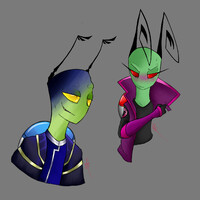
I just wanted to have a play with some different anatomical features for the Irkens based off of real world animals.
so here we have 4 unique antenna types , and I may further develop these examples in to OC's latter.
Brexa:
female , reproductive status not known at this time.
possible sub race.
phenotype characteristics.
antenna based off of radar beetles with well defined segmentation and thick feathering of the tips.
the antenna are adapted to compensate the senses in low light conditions having more receptors for sent, sound , vibrations and electromagnetic waves.
pale skin and eyes caused by lack of pigmentation. subject is nocturnal .
eyesight is ok in dark environments but poor in bright environments.
relying heavily on the antenna for navigation of the world around them.
Sino :
male , reproductive status not known.
phenotype characteristics
Antenna are based off of the Alate AU model for reproductive males. being the standard irken antenna but with the tips feathered for better sense of smell / pheromone detection.
Sino's antenna shape re the result of intensive grooming and maintenance , with a focus on symmetry the frequent grooming has thinned and stretched the stems , the tips are likely to be dockored or "trimmed" to keep them even.
these antenna are more sensitive to electromagnetic fields than other irkens due to a thinning of the protective outer layer from being so heavily groomed.
Fen:
female , reproductive status not known.
phenotype characteristics
antenna are based off of moths.
the delicate feathering of the tips creates an enormous surface area that is extremely sensitive to scent particles.
sense of hearing is also enhanced but can be easily overwhelmed if tuning is off.
the volume of the feathering also cause interference for detecting electromagnetic fields "fuzzying" the signal causing a form proximity blindness to nearby objects.
darker skin pigment indicates high levels of dat light activity with UV exposure.
Virt :
male , reproductive status unknown.
phenotype characteristics
the antenna in this case are based off of honey bees.
the antenna are segmented but the outward appearance is smooth with a clubbed tip.
these antenna are thicker than the standard irken model making them more robust whilst increasing the surface area.
the sense are of equal values as this antenna type is not highly specialised.
the eye shape is slightly more convex than other irken types giving greater visual depth than the average irken.
I just wanted to have a play with some different anatomical features for the Irkens based off of real world animals.
so here we have 4 unique antenna types , and I may further develop these examples in to OC's latter.
Brexa:
female , reproductive status not known at this time.
possible sub race.
phenotype characteristics.
antenna based off of radar beetles with well defined segmentation and thick feathering of the tips.
the antenna are adapted to compensate the senses in low light conditions having more receptors for sent, sound , vibrations and electromagnetic waves.
pale skin and eyes caused by lack of pigmentation. subject is nocturnal .
eyesight is ok in dark environments but poor in bright environments.
relying heavily on the antenna for navigation of the world around them.
Sino :
male , reproductive status not known.
phenotype characteristics
Antenna are based off of the Alate AU model for reproductive males. being the standard irken antenna but with the tips feathered for better sense of smell / pheromone detection.
Sino's antenna shape re the result of intensive grooming and maintenance , with a focus on symmetry the frequent grooming has thinned and stretched the stems , the tips are likely to be dockored or "trimmed" to keep them even.
these antenna are more sensitive to electromagnetic fields than other irkens due to a thinning of the protective outer layer from being so heavily groomed.
Fen:
female , reproductive status not known.
phenotype characteristics
antenna are based off of moths.
the delicate feathering of the tips creates an enormous surface area that is extremely sensitive to scent particles.
sense of hearing is also enhanced but can be easily overwhelmed if tuning is off.
the volume of the feathering also cause interference for detecting electromagnetic fields "fuzzying" the signal causing a form proximity blindness to nearby objects.
darker skin pigment indicates high levels of dat light activity with UV exposure.
Virt :
male , reproductive status unknown.
phenotype characteristics
the antenna in this case are based off of honey bees.
the antenna are segmented but the outward appearance is smooth with a clubbed tip.
these antenna are thicker than the standard irken model making them more robust whilst increasing the surface area.
the sense are of equal values as this antenna type is not highly specialised.
the eye shape is slightly more convex than other irken types giving greater visual depth than the average irken.
Category Artwork (Digital) / General Furry Art
Species Alien (Other)
Size 1920 x 1920px
File Size 235.2 kB

Comments