
 FA+
FA+ Shop
Shop
596
Views
Views
14
Favorites
Favorites
Category
Artwork (Digital) / Miscellaneous
Species Unspecified / Any
Size 1024 x 768
File Size 132.2 kB
Report this content
More from MadPlumber






Nintendo Entertainment System AutoCAD Model (Part 1)
Thank you very much for visiting. Advanced criticism and professional advice are strongly encouraged.
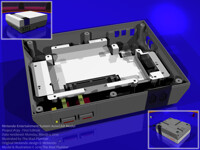
The image featured in this submission is a render of an AutoCAD solid model that I had illustrated. The model resembles the 1985 Nintendo Entertainment System, an 8-bit gaming console which hosted titles such as Super Mario Bros. and The Legend of Zelda. An NES game console featured a slot for loading a single game cartridge, two ports for plugging in game controllers, and various nodes for outputting images to a user’s television set.
Despite being an accounting major in college, I ended up falling into the career of the AutoCAD draftsman. I was introduced to the drafting software as early as my junior high years. The earliest edition of the software that I worked with was AutoCAD R13. I quickly built a proficiency in the software, especially its three-dimensional and solid-modeling aspects.
What is a solid model? The definition of a solid model varies from software to software, but probably the most universal definition of a solid model is a drawing that has volume. In video games, character models and scenery are made up of vertices and polygonal faces. If you were to slice a video game character in half, you would see that the character is hollow. If you were to slice a solid model in half, you would slice through solid material and thus not see a hollow shape.
Illustrating the Nintendo Entertainment System was going to be a very complex task. A console is made up of various components and it was my intention to illustrate them all. AutoCAD features the ability to include separate drawing files into others as XREFs, or external references. XREFs are comparable to BLOCKs, except that the data pertaining to the XREF is contained in its separate file. Separating the components into their own drawing files has its many advantages.
However, now I needed to manage many files and reduce clutter. Further development of the model was put on hold until I could complete a working version of my Sub Project Database Template (Project #334), a Microsoft Access database that I designed to separate sub projects into their own folders and record the labor I put into each one.
With the Sub Project Database put into action, I was able to better organize my XREFs. Some of the sub projects direct to singular parts while other sub projects direct to assemblies of various part files. I could even create assemblies of assemblies.
What I really wish I had at my disposal was the original manufacturing blueprints for the Nintendo Entertainment System; my work might have gone so much faster. The technique I used for constructing the various parts of this model was taking apart and measuring an actual Nintendo. I measured parts in centimeters, figuring that the model might have originally being designed in metric measurements and that it was much easier to input data as tenths of a centimeter as opposed to sixteenths of an inch.
This rendering is a first edition. There is much more work that needs to be done over time. I wanted to relax the time that I am investing in this project so that I can move onto other projects. I also wanted to reach a certain point that I can include renderings of this model in my portfolio. The organization that I employed will allow me to easily make modifications to the model at hand for future editions.
There is more complexity than meets the eye in this rendering. Tomorrow, I will post the second part of my first edition renderings which illustrates the advantages of using separate files and XREFs.
Again, thank you for the visit and have a wonderful day.
PROJECT #139
The image featured in this submission is a render of an AutoCAD solid model that I had illustrated. The model resembles the 1985 Nintendo Entertainment System, an 8-bit gaming console which hosted titles such as Super Mario Bros. and The Legend of Zelda. An NES game console featured a slot for loading a single game cartridge, two ports for plugging in game controllers, and various nodes for outputting images to a user’s television set.
Despite being an accounting major in college, I ended up falling into the career of the AutoCAD draftsman. I was introduced to the drafting software as early as my junior high years. The earliest edition of the software that I worked with was AutoCAD R13. I quickly built a proficiency in the software, especially its three-dimensional and solid-modeling aspects.
What is a solid model? The definition of a solid model varies from software to software, but probably the most universal definition of a solid model is a drawing that has volume. In video games, character models and scenery are made up of vertices and polygonal faces. If you were to slice a video game character in half, you would see that the character is hollow. If you were to slice a solid model in half, you would slice through solid material and thus not see a hollow shape.
Illustrating the Nintendo Entertainment System was going to be a very complex task. A console is made up of various components and it was my intention to illustrate them all. AutoCAD features the ability to include separate drawing files into others as XREFs, or external references. XREFs are comparable to BLOCKs, except that the data pertaining to the XREF is contained in its separate file. Separating the components into their own drawing files has its many advantages.
However, now I needed to manage many files and reduce clutter. Further development of the model was put on hold until I could complete a working version of my Sub Project Database Template (Project #334), a Microsoft Access database that I designed to separate sub projects into their own folders and record the labor I put into each one.
With the Sub Project Database put into action, I was able to better organize my XREFs. Some of the sub projects direct to singular parts while other sub projects direct to assemblies of various part files. I could even create assemblies of assemblies.
What I really wish I had at my disposal was the original manufacturing blueprints for the Nintendo Entertainment System; my work might have gone so much faster. The technique I used for constructing the various parts of this model was taking apart and measuring an actual Nintendo. I measured parts in centimeters, figuring that the model might have originally being designed in metric measurements and that it was much easier to input data as tenths of a centimeter as opposed to sixteenths of an inch.
This rendering is a first edition. There is much more work that needs to be done over time. I wanted to relax the time that I am investing in this project so that I can move onto other projects. I also wanted to reach a certain point that I can include renderings of this model in my portfolio. The organization that I employed will allow me to easily make modifications to the model at hand for future editions.
There is more complexity than meets the eye in this rendering. Tomorrow, I will post the second part of my first edition renderings which illustrates the advantages of using separate files and XREFs.
Again, thank you for the visit and have a wonderful day.
PROJECT #139
Category Artwork (Digital) / Miscellaneous
Species Unspecified / Any
Size 1024 x 768px
File Size 132.2 kB







Comments