
 FA+
FA+ Shop
Shop
7081
Views
Views
103
Favorites
Favorites
Category
Other / Tutorials
Species Exotic (Other)
Size 1364 x 700
File Size 409.7 kB
Report this content
★
More from VinVulpis


Listed in Folders

How to Hurt-Box
I see this sort of thing done on quite a number of MUGEN characters and I figured I'd make a thing about it. I posted this on twitter, but figured I'd post it around also.
When making a characters get-hit animations, the hurt-boxes should stay consistent with the base pose from which the get-hit animation is based on. (Standing, crouching, in-air)
When you make you hitboxes pull away in attempt to be accurate to the animation, this can cause combos to drop that would otherwise be consistent from character to character. The same also applies to a character guarding animations.
Even in the air and in falling states, these hurtboxes should stay a consistent shape, centered on the character's center of mass. They should not change to cover the character from frame to frame.
Something unfortunate is that KungFu Man, the default example character for MUGEN, gets this concept wrong as well. Not so much on the ground, but in the air for sure and I think this kind of contributes to this misunderstanding of how to hurt-box.
There are some games that handle hut-boxes not so well. Like Smash Bros. As much as I love that game, I dislike the way it handles the hurt-boxes, binding them to the character modles, rather than making them an independent entity, which creates a lot of match-up specific shenanigans at times. Even Street Fighter 3 also did frame-by-frame hurt-boxes also and it causes some weird interactions in certain match-ups.
It's generally a good idea to not be so accurate to the character's movements from frame to frame. You don't need to cover every pixel nor do you need to worry about boxes running off of the sprites a bit. You generally want the SIMPLEST and FEWEST POSSIBLE boxes to represent your character's body.
This is all ideal for keeping balancing easy and match-ups more consistent.
Places:
FurAffinity | InkBunny | Weasyl | Deviantart | Twitter
Buy Me a Coffee! (Ko-Fi Tip Jar)
Buy A Button!
https://www.vinvulpis.com/
Posted using PostyBirb
When making a characters get-hit animations, the hurt-boxes should stay consistent with the base pose from which the get-hit animation is based on. (Standing, crouching, in-air)
When you make you hitboxes pull away in attempt to be accurate to the animation, this can cause combos to drop that would otherwise be consistent from character to character. The same also applies to a character guarding animations.
Even in the air and in falling states, these hurtboxes should stay a consistent shape, centered on the character's center of mass. They should not change to cover the character from frame to frame.
Something unfortunate is that KungFu Man, the default example character for MUGEN, gets this concept wrong as well. Not so much on the ground, but in the air for sure and I think this kind of contributes to this misunderstanding of how to hurt-box.
There are some games that handle hut-boxes not so well. Like Smash Bros. As much as I love that game, I dislike the way it handles the hurt-boxes, binding them to the character modles, rather than making them an independent entity, which creates a lot of match-up specific shenanigans at times. Even Street Fighter 3 also did frame-by-frame hurt-boxes also and it causes some weird interactions in certain match-ups.
It's generally a good idea to not be so accurate to the character's movements from frame to frame. You don't need to cover every pixel nor do you need to worry about boxes running off of the sprites a bit. You generally want the SIMPLEST and FEWEST POSSIBLE boxes to represent your character's body.
This is all ideal for keeping balancing easy and match-ups more consistent.
Places:
FurAffinity | InkBunny | Weasyl | Deviantart | Twitter
Buy Me a Coffee! (Ko-Fi Tip Jar)
Buy A Button!
https://www.vinvulpis.com/
Posted using PostyBirb
Category Other / Tutorials
Species Exotic (Other)
Size 1364 x 700px
File Size 409.7 kB

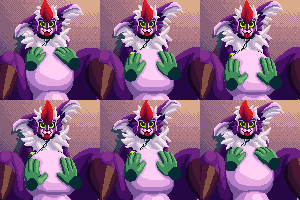
Tell that to Oro in 3rd strike, who's juggles work on almost every character except Hugo, unless he's got Hugo in the corner. OF ALL CHARACTERS. Hahah.
Since hurtboxes in that game follow the sprite super closely, his edges swing wildly as his huge body turns and some of Oro's juggle follow-ups whiff against him.
Since hurtboxes in that game follow the sprite super closely, his edges swing wildly as his huge body turns and some of Oro's juggle follow-ups whiff against him.



I think of of my personal favorites of subtle, but significant imbalance has to be Lucario by Moku.
I swear this dude's blockstun on his jab is like 12 frames for just...no reason. So you can get jab-locked into a grab or just chipped out.
Or Rock Volnutt and his 18,924,787 special attacks, unlimited combos, and just...HE BEAT PRE-PATCHED RONALD AAAA
I swear this dude's blockstun on his jab is like 12 frames for just...no reason. So you can get jab-locked into a grab or just chipped out.
Or Rock Volnutt and his 18,924,787 special attacks, unlimited combos, and just...HE BEAT PRE-PATCHED RONALD AAAA
I do like some instances of characters that are clearly unbalanced, but have a fun gimmick to them, mainly as foes to fight against. A good challenge that is reasonably overpowered but might have a weakness in some way. I love to fight Omega Tiger Woods by The_None. He's overpowered as fuck, but is a huge target and cannot block. Plus, anytime he's knocked into the air, it's always a hard knock-down and he can't tech recover at all, so he's very weak to juggle setups that can otherwise be escaped with a tech or other option if the attack causes an auto-recover in the air. It's a fun gimmick to fight and test things out against.
The only thing I dislike about OTW is the super that drops bombs everywhere. They are unblockable and he can score a Full Life win from it if you get caught in it. Having screen zoom allows me to try to outrun the center of destruction though. It's only a one bar super, like all his other supers too. If it were are least a 2 bar I'd not mind it so much. I suppose I cooooould edit it. Hahah. But I haven't, I can usually beat him how he is with Gejhi, mostly thanks to the mobility I have built into my system.
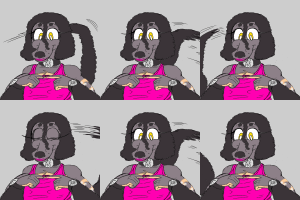
This happens in 3D too, with it's hit spheres. Over in Tekken and Calibur land, Eddy and Maxi in particular have wide, horziontal idle-dances that will cause them to sometimes be off-axis enough when hit by strings that followups won't align properly (or, conversely, they'll try to avoid something with a stepin a part of thier idle animation that would cause them to get hit whent hey normally wouldn't have had they just been in the center like a normal character.)


I was having issues with Wolverine's hitboxes in his hurt states because the original author left some hitboxes out, making him able to break free from combos when he shouldn't have. It's important to keep the hurtboxes right where they're at to make it balanced. This is a good point to bring up here. I'm trying to balance the fighters I have so they can be combo'd properly. Even though my self-insert is quite small, he can be combo'd with moves that usually hit the middle or legs of a normal fighter but can be air combo'd fine since I placed his hurt boxes around where an average fighter's hurtbox would be.
I'm a little guilty on the matter myself because I usually don't alter hitboxes/hurt boxes of fighters unless there's too many in a single frame.
I'm a little guilty on the matter myself because I usually don't alter hitboxes/hurt boxes of fighters unless there's too many in a single frame.

That depends on how you want to design that character. You can chose not to give the weapons hurtboxes, or just retracted hurtboxes, but then you have to balance the character around having disjointed attack boxes. Think Sword Fighters in Smash.
Gejhi here, has disjointed boxes for certain moves. His Air slash (air attack 2) is a good example. The disjointed attack boxes are represented by the dark energy slash effect that appears in front of him, but has no hurtbox on that area. only about half of his arm length does. It's a Poking tool in the air that lets him maintain a certain distance if he's not ready to go in. The draw backs to the attack are that it has landing lag when done close to the ground, and has a longer startup. The active hitbox starts at frame 13 currently. An additional note is that I gave this attack's hitdef a projectile attribute. So it can also be used to slap away enemy projectiles.
For his Phantom Kick, his lower shin and foot have no hurtbox on the first active attack frame of the attack. Similarly, his main anti-air and launcher tool (up attack 2) has no hurtboxes from his chest up on the first active frame.
Gejhi here, has disjointed boxes for certain moves. His Air slash (air attack 2) is a good example. The disjointed attack boxes are represented by the dark energy slash effect that appears in front of him, but has no hurtbox on that area. only about half of his arm length does. It's a Poking tool in the air that lets him maintain a certain distance if he's not ready to go in. The draw backs to the attack are that it has landing lag when done close to the ground, and has a longer startup. The active hitbox starts at frame 13 currently. An additional note is that I gave this attack's hitdef a projectile attribute. So it can also be used to slap away enemy projectiles.
For his Phantom Kick, his lower shin and foot have no hurtbox on the first active attack frame of the attack. Similarly, his main anti-air and launcher tool (up attack 2) has no hurtboxes from his chest up on the first active frame.


I can't help but got curiose.
Why should they not follow frame by frame? (I havent played Mugen with may why I ask so dumbly questions now).
Does it maybe have to do with diffrent sized characters? And that uninque hitboxes may lead to very weird gameplay, where one character kinda can't really hit the other because their hitboxes are like "out of default shape" ?
Sorry for asking silly, but I could not help and feel curiose about this.
Why should they not follow frame by frame? (I havent played Mugen with may why I ask so dumbly questions now).
Does it maybe have to do with diffrent sized characters? And that uninque hitboxes may lead to very weird gameplay, where one character kinda can't really hit the other because their hitboxes are like "out of default shape" ?
Sorry for asking silly, but I could not help and feel curiose about this.
To explain with an example, lets say a standard chain combo of 1, 2, 3 attacks. (Like a punch punch kick)
The 1,2,3 hits most foes, but one or two characters, suddenly have a upper hitbox jerk back and attack 2 misses, the combo is dropped and the target gets out for free, also, it prevent the combo from following up is HIT CONFIRMS are required for the cancel chain. So now in that match up, you character cannot do an essential combo, breaking the match-up in the targets favor, all because of the character's size and the way his hit-animation looks.
This is a particular issue when you have characters of different sizes, and it's not always in the smaller character's favor. In an above example I gave, Oro Vs Hugo in Street FIghter III: 3rd Strike, Oro has juggle combos that completely miss against Hugo, the largest character in the game. Since he's so big, his body causes push-back while his head and leg ends are moving at a much faster rate than a smaller character, so his body mass mixed with a much bigger tumbling hitbox structure makes Oro's preferred follow-up completely miss, unless he has Hugo in the corner.
This is why it's important to have the boxes be as consistent as possible. In general, there are a lot of examples where "lying" about the hitboxes compared to the animation is important for balancing purposes. The get-hit animation is just one example.
The 1,2,3 hits most foes, but one or two characters, suddenly have a upper hitbox jerk back and attack 2 misses, the combo is dropped and the target gets out for free, also, it prevent the combo from following up is HIT CONFIRMS are required for the cancel chain. So now in that match up, you character cannot do an essential combo, breaking the match-up in the targets favor, all because of the character's size and the way his hit-animation looks.
This is a particular issue when you have characters of different sizes, and it's not always in the smaller character's favor. In an above example I gave, Oro Vs Hugo in Street FIghter III: 3rd Strike, Oro has juggle combos that completely miss against Hugo, the largest character in the game. Since he's so big, his body causes push-back while his head and leg ends are moving at a much faster rate than a smaller character, so his body mass mixed with a much bigger tumbling hitbox structure makes Oro's preferred follow-up completely miss, unless he has Hugo in the corner.
This is why it's important to have the boxes be as consistent as possible. In general, there are a lot of examples where "lying" about the hitboxes compared to the animation is important for balancing purposes. The get-hit animation is just one example.
Well the default example character (and mascot), KungFu Man, is probably what most newbies look at. I know that's what I did years ago. And surprisingly he gets this wrong as I mentioned in the description. It's not so bad on the ground, but in the air his boxes tumble with him, and that's a big no-no.
Luckily my two first characters from year ago have simple enough boxes that I've not ran into any issue, but I made the same mistake until my recent work, when I started understanding fighting games more and researching design theories and such.
At some point for kicks, I plan to re-release the "legacy" characters from years ago with bug fixes and some adjustments, one of them being to tweek the hitboxes.
Luckily my two first characters from year ago have simple enough boxes that I've not ran into any issue, but I made the same mistake until my recent work, when I started understanding fighting games more and researching design theories and such.
At some point for kicks, I plan to re-release the "legacy" characters from years ago with bug fixes and some adjustments, one of them being to tweek the hitboxes.

Yeah, I use that tag for a lot of my attacks. Attacks that advance position in particular need this tag. Gejhi without them could infinity a foe in the corner.
On that notion, I have many things at play in attempt to prevent infinities, the ultimate fail-safe being that when the damage-dampener hits a certain point, it forces the combo to drop and causes a hard knock-down on the target. Luckily, I've not yet been able to hit that limit myself, in testing.
On that notion, I have many things at play in attempt to prevent infinities, the ultimate fail-safe being that when the damage-dampener hits a certain point, it forces the combo to drop and causes a hard knock-down on the target. Luckily, I've not yet been able to hit that limit myself, in testing.
I've been trying so hard myself to make the fighters in my VSD project infinite-free even though I gave all the fighters a liedown time of only 20-30 ticks so they're not as susceptible to OTG combos as the average fighter and I made sure the AI get back on their feet ASAP when they hit the ground.
In MvC2, they had that ultimate fail-safe where when you continuously combo the opponent after like maybe 40-50 hits not counting hyper combos, they'll suddenly go into a dizzy spin in the air, breaking free from the combo and coming right back down to the fight.
The corner-infinite may also have something to do with the hitpausetime and the ground.hittime/air.hittime. I have set my Hard attacks to an amount, enough for the opponent to recover and block the next attack if I don't combo from a Hard attack.
In MvC2, they had that ultimate fail-safe where when you continuously combo the opponent after like maybe 40-50 hits not counting hyper combos, they'll suddenly go into a dizzy spin in the air, breaking free from the combo and coming right back down to the fight.
The corner-infinite may also have something to do with the hitpausetime and the ground.hittime/air.hittime. I have set my Hard attacks to an amount, enough for the opponent to recover and block the next attack if I don't combo from a Hard attack.
I like OTG gimmicks and I have plenty of moves designed to at least tack on a small amount of extra damage of the foe decides to stay down too long, but nothing horrendous. I am however torn on how much of it I would keep, or if I'd change the function of these attacks. I suppose it might be a character variation I could work on. The counter mechanic to this sort of thing is to have special reversal properties to moves on wake-up though.

A lot of fighting games in particular follow this principle. This keeps things consistent, particularly for combos. Get-hit frames are also typicly very breif and exaggerated to communicate that a character was hit, but the boxes move very little or not at all so that canceled follow-ups will work from character to character. I understand where you're coming from though.
https://www.youtube.com/watch?v=IwRSu05xcz8 As a recent example.
https://www.youtube.com/watch?v=IwRSu05xcz8 As a recent example.
Sorry for the double post.
The same idea also applies to attack boxes. Plenty of moves have boxes bigger than the physical space the animation implies, so that moves again, hit more consistently. In that video, plenty of Kyo's punches have much bigger Y-axis or height rather than just being the thickness of his arm.
Smash bros uses the character models as a binding for the hurt "bubbles" which does cause combos to drop in certain match-ups. The way that Smash works around that idea, is by making the attack boxes WAY bigger in a lot of cases. Snake's up-tilt is a good example of this.
Understanding hit/hurtboxes is part of gettin into and understanding fighting games, after some exposure to interactions, you just know what to expect without even thinking about it.
The same idea also applies to attack boxes. Plenty of moves have boxes bigger than the physical space the animation implies, so that moves again, hit more consistently. In that video, plenty of Kyo's punches have much bigger Y-axis or height rather than just being the thickness of his arm.
Smash bros uses the character models as a binding for the hurt "bubbles" which does cause combos to drop in certain match-ups. The way that Smash works around that idea, is by making the attack boxes WAY bigger in a lot of cases. Snake's up-tilt is a good example of this.
Understanding hit/hurtboxes is part of gettin into and understanding fighting games, after some exposure to interactions, you just know what to expect without even thinking about it.

Thanks so much for this explanation, I've strugled with this in the past too as a fellow mugen creator.
however i don't find this as black and white, is more like "a design choice" sometimes. while i understand the need of combo strings and feasible followups after certain hits, it has to do more with the intended gameplay for everyspecific proyect and not a "general guideline", some fighting games or characters may not be based on combo strings but in footsies, punishing and singular blows; the same apply for games that use the diferent hitboxes as a way to offer a Rock-papper-scisor system in wich you can counter certain characters or strategies with another (in a game where characters like dalshim doesn't have an acurate hitbox on their long kick and punches, but everyine has the same hitboxes and speed animation, he's a beast... in a game where dhalsim has hitboxes on his legs and arms while punching/kicking, or if his kick/punch animations have a longer recovery time, you have to be a little more strategic instead of having a plain adventage).
It all depends on the type of gameplay you want. While some people may get enraged at "why i can't pull this combo, when I already conected the first blow?", there are others that get as full of frustration and rage when they missed a hit, even when the hit animation completelly impacted the other player's animation. There are answers for both sitations, but you can't solve both problems at the same time, unless you code somekind of character repositioning or hitbox fix after a combo starter... a lot of mugen characters (for example) force p2 position and/or animation to something that works with their combo, throw or special move needs (it hgappens a lot in Mortal kombat characers and kof characers to make the animations, position/distance and/or hitboxes match the next hit on the line).
is a sensible subject, but is indeed something that needs to be adressed, at least at the early design stages of the system mechanics of a game or character. Sadly, this is mugen, and since every creator is following their own tastes, sources and perception of what's right we will always find a lot of missmatching stuff, specially when adapting charcters from pre-existing games or game styles. u.u
however i don't find this as black and white, is more like "a design choice" sometimes. while i understand the need of combo strings and feasible followups after certain hits, it has to do more with the intended gameplay for everyspecific proyect and not a "general guideline", some fighting games or characters may not be based on combo strings but in footsies, punishing and singular blows; the same apply for games that use the diferent hitboxes as a way to offer a Rock-papper-scisor system in wich you can counter certain characters or strategies with another (in a game where characters like dalshim doesn't have an acurate hitbox on their long kick and punches, but everyine has the same hitboxes and speed animation, he's a beast... in a game where dhalsim has hitboxes on his legs and arms while punching/kicking, or if his kick/punch animations have a longer recovery time, you have to be a little more strategic instead of having a plain adventage).
It all depends on the type of gameplay you want. While some people may get enraged at "why i can't pull this combo, when I already conected the first blow?", there are others that get as full of frustration and rage when they missed a hit, even when the hit animation completelly impacted the other player's animation. There are answers for both sitations, but you can't solve both problems at the same time, unless you code somekind of character repositioning or hitbox fix after a combo starter... a lot of mugen characters (for example) force p2 position and/or animation to something that works with their combo, throw or special move needs (it hgappens a lot in Mortal kombat characers and kof characers to make the animations, position/distance and/or hitboxes match the next hit on the line).
is a sensible subject, but is indeed something that needs to be adressed, at least at the early design stages of the system mechanics of a game or character. Sadly, this is mugen, and since every creator is following their own tastes, sources and perception of what's right we will always find a lot of missmatching stuff, specially when adapting charcters from pre-existing games or game styles. u.u
It's fine for hurtboxes to change with almost every animation. I'm speaking specifically of get-hit animation hurt-boxes staying consistent. almost all of my animations have frame-to-frame changes in the boxes (depending on the animation and type.) My idle standing box doesn't change at all for this character, even though he has a slight bounce. The hurt-boxes for it cover the average position over the total loop. During my attacks, they all change to cover the animation, but the get-hit animation's boxes stay consistent. It'd be kind of silly to not have the hurtboxes not-change at all over all the animations.
A thing about Dahlsim that I'm aware of, at least in SFIV, is that a lot of his stretchy moves had hurtboxes extend out BEFORE the attack box was active, so well timed moves can beat his range. This was done with a lot of moves in that game to make them "lower priority" so to speak, because that game didn't have a priority attribute. There was either boxes, or no boxes.
In 3S, you could beat a shoryuken by just crouch punching on their start-up, because those moves had lower hurt-boxes and only top-half invincibility until their feet leave the ground.
I'm well aware of stuff like that.
I like to resist using things that snap the opponent into a desired position, because that ruins the dynamic of certain combos at certain spacing. You're not gonna follow-up the same way after a poke that you would after hitting them up close. If they're too far away, you can't follow up the same way, or at all. I only save this for throws, or moves that are absolutely supposed to connect fully, like Ryo's Zan-Retsu-Ken from KoF. In a similar fashion, I use a snap for Gejhi's super move. If the first box hits, the opponent is snapped right in front of him with a y-pos of 0.
A thing about Dahlsim that I'm aware of, at least in SFIV, is that a lot of his stretchy moves had hurtboxes extend out BEFORE the attack box was active, so well timed moves can beat his range. This was done with a lot of moves in that game to make them "lower priority" so to speak, because that game didn't have a priority attribute. There was either boxes, or no boxes.
In 3S, you could beat a shoryuken by just crouch punching on their start-up, because those moves had lower hurt-boxes and only top-half invincibility until their feet leave the ground.
I'm well aware of stuff like that.
I like to resist using things that snap the opponent into a desired position, because that ruins the dynamic of certain combos at certain spacing. You're not gonna follow-up the same way after a poke that you would after hitting them up close. If they're too far away, you can't follow up the same way, or at all. I only save this for throws, or moves that are absolutely supposed to connect fully, like Ryo's Zan-Retsu-Ken from KoF. In a similar fashion, I use a snap for Gejhi's super move. If the first box hits, the opponent is snapped right in front of him with a y-pos of 0.
oh you're right. XD... I missunderstood the whole thing (I'd like to use the "english is not my native languaje" card, but i should have put more attention into that part).
Yep. "being hit" animations should stay the same or almost the same, it will be a nightmare if not. XD
Yep. "being hit" animations should stay the same or almost the same, it will be a nightmare if not. XD


On the topic of Smash Bros., you might like Super Smash Flash 2. That's a 2D game, so it can handle hitboxes more like a traditional fighter.
The vanilla game doesn't have a hitbox display toggle (because the developers got tired of younger players not understanding what goes into hitboxes and demanding characters that they lose against be nerfed, using hitbox screenshots as justification), but mods exist that can change that.
It can't handle them perfectly, though, because of the same reason there isn't a toggle. Younger players complain when an attack hits them but not the sprite.
One thing I'm curious about with the core game is if the effect that stages like Flat Zone and Hanenbow have on hitboxes would theoretically make the experience better or worse. I've thought before
The vanilla game doesn't have a hitbox display toggle (because the developers got tired of younger players not understanding what goes into hitboxes and demanding characters that they lose against be nerfed, using hitbox screenshots as justification), but mods exist that can change that.
It can't handle them perfectly, though, because of the same reason there isn't a toggle. Younger players complain when an attack hits them but not the sprite.
One thing I'm curious about with the core game is if the effect that stages like Flat Zone and Hanenbow have on hitboxes would theoretically make the experience better or worse. I've thought before
(Edit window expired.)
I've thought before about whether that effect should be applied to hitbubbles on all stages, or the reverse in having the 2D effect affect the models but not the hitbubbles for consistency's sake. I thought it was odd hearing that the Ω and BF versions of those stages had that problem and couldn't be chosen in tournaments because of it. The question is whether the 3D or 2D hitbubbles are better suited for the game.
I've thought before about whether that effect should be applied to hitbubbles on all stages, or the reverse in having the 2D effect affect the models but not the hitbubbles for consistency's sake. I thought it was odd hearing that the Ω and BF versions of those stages had that problem and couldn't be chosen in tournaments because of it. The question is whether the 3D or 2D hitbubbles are better suited for the game.


Dunno if anyone ever mentioned it already,
but I think the habit or even the preference for this comes from playing the old Mortal Kombat games,
where there weren't exactly hitboxes, but the damage was dealt if the sprites were touching.
I've heard even SkullGirls does this? But I haven't truly played it enough to get that feeling from it. lol
but I think the habit or even the preference for this comes from playing the old Mortal Kombat games,
where there weren't exactly hitboxes, but the damage was dealt if the sprites were touching.
I've heard even SkullGirls does this? But I haven't truly played it enough to get that feeling from it. lol
Certain games do "precise" stype hitboxes, which I generally don't prefer because it creates problems that are match-up specific in some cases. Street Fighter 3 did this, and certain matchups have weird interactions because of it. The Hugo vs Oro matchup is a notable example, how Oro can't do his juggle against Hugo, unless i nthe corner, because of the way his huge body sprites move, tilting his hitboxes out of the way too quickly for Oro to follow up like his can against the rest of the cast. Also like how Ryu can Shin Shoryuken Dudley after a forward throw. Hahah.
This problem is very apparent in smash, with juggles because very inconsistent with some match-ups because the hit-boxes are BOUND to the modles and the 3D space still effects them. Marth/Lucina can completely miss hitting a dizzy Piranha Plant because it leans towards the camera during it. Goofy shit, hahah.
And yeah, I think Skull Girls does the precise thing too, but I'm not well versed in that game to know what issues it may or may not create.
I generally prefer this method of keeping hitboxes appoximate on the character's mass and making sure to not move them during hit-animations and keeping them consistent during air-based hit/fall animations. This helps interactions stay consistent from character to character, making character size the only variable to worry about in match-ups.
This problem is very apparent in smash, with juggles because very inconsistent with some match-ups because the hit-boxes are BOUND to the modles and the 3D space still effects them. Marth/Lucina can completely miss hitting a dizzy Piranha Plant because it leans towards the camera during it. Goofy shit, hahah.
And yeah, I think Skull Girls does the precise thing too, but I'm not well versed in that game to know what issues it may or may not create.
I generally prefer this method of keeping hitboxes appoximate on the character's mass and making sure to not move them during hit-animations and keeping them consistent during air-based hit/fall animations. This helps interactions stay consistent from character to character, making character size the only variable to worry about in match-ups.


Comments