
 FA+
FA+ Shop
Shop
1435
Views
Views
10
Favorites
Favorites
Category
Designs / Miscellaneous
Species Unspecified / Any
Size 1024 x 1280
File Size 98.8 kB
Report this content
More from Blacktail_F-A


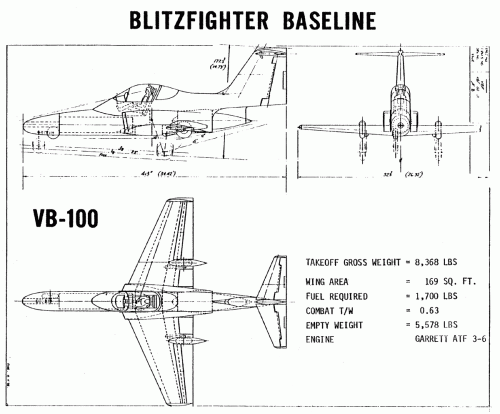
Those of you who already know US military service politics are either cringing, or grinning devilishly at this image.
For those who do not, the significance of a US Army-operated Blitzfighter cannot be overstated. There are five reasons for this.
First, the USAF took-away the US Army's fixed-wing combat aircraft in the 1947 Key West Agreement, and since then almost exclusively developed aircraft unsuitable for Close Air Support. This was NOT part of that agreement, and many ugly incidents involving fighter jets that can't flow low or slow enough to provide CAS --- either missing their targets, killing US Army troops instead, or both --- are burned into the Army's institutional memory.
Second, the USAF sought to control ALL fixed-wing air operations. The rationale was to remove any possible challenges from the other services to it's budget, philosophies, and modus operandi. The notion of the Army using aircraft other than helicopters is an anathema to the USAF. They have a long and sordid history of abusing the Key West Agreement to strong-arm aircraft away from the Army (The F-5A Tiger II, OV-1 Mohawk, O-2 Skymaster, CV-2 Caribou, AH-56 Cheyenne, S-67 Blackhawk --- despite the latter two being helicopters with wings --- and just recently, the C-27J Spartan). The (Br)asshats in Blue running the show are OCD with a vengeance about keeping the Army from using anything with wings, to the detriment of the US military's overall combat potential.
Third, as you may remember from the description of my VB-100 Blitzfighter schematic, the USAF (Br)asshats despise the Blitzfighter with a passion. They hate it because it's inexpensive, and won't move cash fast enough, to enough contractors or enough Congressional districts. They hate it because it's not supersonic. They hate it because it flies low. They hate it because it has no sensors. They hate it because it's built around a gun. They hate it because it uses no missiles. They hate it because of the large numbers that would fill the sky, robbing the smaller fighter pilot force of the image of being "the few, the proud" that they project. But most of all, they hate it because it's cost-effectiveness sheds light on the vacancy of good judgement in USAF policy planning, and all those involved in it.
Fourth (and this is the most important of all), the Key West Agreement has a fascinating loophole. It turns out that the language of the document allows the US Army to operate armed fixed-wing weighing less than 10000lbs. Recall that the Maximum Take-Off Weight of the VB-100 Blitzfighter is only 8368lbs. This makes it obvious why this fact was never mentioned in the Blitzfighter debate --- it would expose this loophole to Congress, the media, and the public, who would force the USAF to own-up to their own agreement, and let the Army have Blitzfighters. Words cannot stress the extent of the catastrophe this would be for the (Br)asshats, in terms of face, power, prestige, budget, and the likelihood of getting promoted again, or transferred to a favorable post and/or command.
But most of all, it's REALLY funny that the USAF is so utterly terrified of an aircraft weighing 8500lbs, with a 500mph top speed and a 300-mile range, armed only with a gun. XD
For those who do not, the significance of a US Army-operated Blitzfighter cannot be overstated. There are five reasons for this.
First, the USAF took-away the US Army's fixed-wing combat aircraft in the 1947 Key West Agreement, and since then almost exclusively developed aircraft unsuitable for Close Air Support. This was NOT part of that agreement, and many ugly incidents involving fighter jets that can't flow low or slow enough to provide CAS --- either missing their targets, killing US Army troops instead, or both --- are burned into the Army's institutional memory.
Second, the USAF sought to control ALL fixed-wing air operations. The rationale was to remove any possible challenges from the other services to it's budget, philosophies, and modus operandi. The notion of the Army using aircraft other than helicopters is an anathema to the USAF. They have a long and sordid history of abusing the Key West Agreement to strong-arm aircraft away from the Army (The F-5A Tiger II, OV-1 Mohawk, O-2 Skymaster, CV-2 Caribou, AH-56 Cheyenne, S-67 Blackhawk --- despite the latter two being helicopters with wings --- and just recently, the C-27J Spartan). The (Br)asshats in Blue running the show are OCD with a vengeance about keeping the Army from using anything with wings, to the detriment of the US military's overall combat potential.
Third, as you may remember from the description of my VB-100 Blitzfighter schematic, the USAF (Br)asshats despise the Blitzfighter with a passion. They hate it because it's inexpensive, and won't move cash fast enough, to enough contractors or enough Congressional districts. They hate it because it's not supersonic. They hate it because it flies low. They hate it because it has no sensors. They hate it because it's built around a gun. They hate it because it uses no missiles. They hate it because of the large numbers that would fill the sky, robbing the smaller fighter pilot force of the image of being "the few, the proud" that they project. But most of all, they hate it because it's cost-effectiveness sheds light on the vacancy of good judgement in USAF policy planning, and all those involved in it.
Fourth (and this is the most important of all), the Key West Agreement has a fascinating loophole. It turns out that the language of the document allows the US Army to operate armed fixed-wing weighing less than 10000lbs. Recall that the Maximum Take-Off Weight of the VB-100 Blitzfighter is only 8368lbs. This makes it obvious why this fact was never mentioned in the Blitzfighter debate --- it would expose this loophole to Congress, the media, and the public, who would force the USAF to own-up to their own agreement, and let the Army have Blitzfighters. Words cannot stress the extent of the catastrophe this would be for the (Br)asshats, in terms of face, power, prestige, budget, and the likelihood of getting promoted again, or transferred to a favorable post and/or command.
But most of all, it's REALLY funny that the USAF is so utterly terrified of an aircraft weighing 8500lbs, with a 500mph top speed and a 300-mile range, armed only with a gun. XD
Category Designs / Miscellaneous
Species Unspecified / Any
Size 1024 x 1280px
File Size 98.8 kB

Damn straight!
Caution: These videos are rated "A" for A-10!;
http://www.youtube.com/watch?v=riqu8hmPHd0
http://www.youtube.com/watch?v=crqSrQ9CA0Q
http://www.youtube.com/watch?v=oY4lPylx6D4
http://www.youtube.com/watch?v=kKRt2DYMvdU
http://www.youtube.com/watch?v=FtYD_zL1GQM
http://www.youtube.com/watch?v=S3oZP2tEbH4
http://www.youtube.com/watch?v=sALiuWg_I1k
http://www.youtube.com/watch?v=NBXrogB8L08
http://www.youtube.com/watch?v=dKQpg58BbGg
Caution: These videos are rated "A" for A-10!;
http://www.youtube.com/watch?v=riqu8hmPHd0
http://www.youtube.com/watch?v=crqSrQ9CA0Q
http://www.youtube.com/watch?v=oY4lPylx6D4
http://www.youtube.com/watch?v=kKRt2DYMvdU
http://www.youtube.com/watch?v=FtYD_zL1GQM
http://www.youtube.com/watch?v=S3oZP2tEbH4
http://www.youtube.com/watch?v=sALiuWg_I1k
http://www.youtube.com/watch?v=NBXrogB8L08
http://www.youtube.com/watch?v=dKQpg58BbGg
The Blitzfighter is more of the same, except that the gun is a smaller GAU-13 (it fires the same ammo), and it's built around the weapon.
However, it uses ONLY this gun --- as conceived, it will accept no other weapons. This wasn't so much to actually focus on using just one weapon, as using the USAF (Br)asshat's inevitable hostility toward the design to publicly expose their contempt for simplicity. And THAT sure as hell worked.
See the description of my previous submission (a blank form of the above schematic) for all the juicy details!
However, it uses ONLY this gun --- as conceived, it will accept no other weapons. This wasn't so much to actually focus on using just one weapon, as using the USAF (Br)asshat's inevitable hostility toward the design to publicly expose their contempt for simplicity. And THAT sure as hell worked.
See the description of my previous submission (a blank form of the above schematic) for all the juicy details!

Hmm, it looks kinda strange imho.
But I guess it wasn't pretty bad at what it had been designed for: fly in, shoot something on the ground, and get out before they know what hit them.
Personally I'd have added a few ASMs and maybe a few bomblets though. Nothingagainst the GAU-13, but being able to do some splash damage during a fly-by is a nice gimmick.
But I guess it wasn't pretty bad at what it had been designed for: fly in, shoot something on the ground, and get out before they know what hit them.
Personally I'd have added a few ASMs and maybe a few bomblets though. Nothingagainst the GAU-13, but being able to do some splash damage during a fly-by is a nice gimmick.
The weapon I see being most effective on this aircraft are rocket pods, like the 70mm Hydra-70 series.
Have a look at this; http://www.youtube.com/watch?v=cdHjqVqOoVE&feature=related
...and THIS; http://www.youtube.com/watch?v=AZtYmjybtHU
The 127mm Zuni rockets would be handy too, if any are still around; http://www.youtube.com/watch?v=nt6XcsZf_F0
Have a look at this; http://www.youtube.com/watch?v=cdHjqVqOoVE&feature=related
...and THIS; http://www.youtube.com/watch?v=AZtYmjybtHU
The 127mm Zuni rockets would be handy too, if any are still around; http://www.youtube.com/watch?v=nt6XcsZf_F0
It's interesting that you mention the Stuka, because the most famous pilot of that aircraft was interviewed by the USAF's A-X Program staff, and his input shaped much of that program.
The aircraft candidate selected to meet the A-X requirement was none other than the A-10 --- which, in turn, is the aircraft the Blitzfighter was meant to be a follow-up to. XD
The aircraft candidate selected to meet the A-X requirement was none other than the A-10 --- which, in turn, is the aircraft the Blitzfighter was meant to be a follow-up to. XD



Uh, how about no? No sensors alone would make this more of a liabillity rather than an asset. Small size also prevents overhead for growth. No protective measures means this thing will get shot down in any situation where there´s even a remotely effective IADS present (many threat nations now have those.). The A-10 already has to carry external pods to allow it to throw more than dumb bombs and TV guided missles, and with such a small airframe, you could into the payload pretty badly. Slow speed also isn´t helpful especially during egress and target approach (which is where the Su-25/39 is superior to the A-10)
Plus, why complicate the aquisition and logistical processes by adding planes to the Army arsenal. It´s more than planes, you need pilot training programs, you need airbases, you need shelters and mobile sustainment elements. The air force already has all of those in place already.
If the Army needs a close support aircraft, they need to find a way to let their troops talk to the Airforce CAS better. The soviets have had such a system in place since at least the 70s, I don´t understand why it seems to be such a problem for the US military. Instead, there is lots of inter service animosity and infighting instead of cooperation.
That and bad political decisions, such as cancelling the F-22 over the JSF, but that´s a different story.
Neat pic, too. I never knew about this plane... learn something every day.
Plus, why complicate the aquisition and logistical processes by adding planes to the Army arsenal. It´s more than planes, you need pilot training programs, you need airbases, you need shelters and mobile sustainment elements. The air force already has all of those in place already.
If the Army needs a close support aircraft, they need to find a way to let their troops talk to the Airforce CAS better. The soviets have had such a system in place since at least the 70s, I don´t understand why it seems to be such a problem for the US military. Instead, there is lots of inter service animosity and infighting instead of cooperation.
That and bad political decisions, such as cancelling the F-22 over the JSF, but that´s a different story.
Neat pic, too. I never knew about this plane... learn something every day.
Also: I apologize for coming across as abrasive. I´ve just met some people last year who were involved in air related problems in afghanistan, and sensors were involved in those cases. Eyeballing everything, especially in a cluttered battlefield is a recipe for disaster, I think.
Again, sorry, wasn´t meant to be so harsh. :X
Again, sorry, wasn´t meant to be so harsh. :X
No problem --- trust me, this isn't the *most* abrasive comment I've had on this concept, let alone ever. I've been on the internet for almost 10 years now
I will address the points you raised, however.
"No sensors alone would make this more of a liabillity rather than an asset."
It's important to realize that for aircraft, this means IR imaging or radar.
The first doesn't work on an active battlefield, because it can't distinguish live targets from dead ones, they can't distinguish explosions from muzzle flashes, they can't discern a fresh shell crater from a tank, they don't work at all in hot and/or humid weather or thick smoke, and also because the aircraft that passed by before them will have showered the area with flares to defeat MANPADS (which clutter the environment even more). The second doesn't work because of interference from ground clutter, vegetation, wreckage unconformities in the terrain below, and the ambient electronic noise inherent to modern battlefields --- nor can it tell a live target from a dead one.
These facts presented themselves in the Combat Lancer missions in Vietnam, the development of the Maverick missile, and the development of the Mark II Avionics Suite used on the disastrous F-111D "Dog".
These experiences entailed the development of a ground attack aircraft that doesn't use these sensors.
Finally, note that the A-10 has no such integral sensors either, which didn't prevent it from destroying more ground targets than any other aircraft in Operation Desert Storm, but *did* contribute greatly to it's 97%+ OER (which was the highest of any Coalition fixed-wing combatant). The A-10 alone kocked-out 987 MBTs, 926 other artillery pieces, 501 APCs, 1106 Trucks, 249 C&C Vehicles, 112 Military Structures, 96 Radar Sites, 72 Bunkers, 50 AAA Sites, 28 Command Posts, 51 Scud Missiles, 11 FROG Rockets, 9 SAM Sites, 8 Fuel Tanks, and 10 Parked Fighters. The A-10s also shot-down 2 Helicopters in ODS, despite having to use gunfire, and having no radar, HUDs, nor even air-to-air gunnery sights. They also fired over 1 MILLION 30mm rounds, which is how they destroyed most of these targets, which further vindicates the Blitzfighter concept.
"Small size also prevents overhead for growth."
There's also little to be accomplished in growth; the Blitzfighter has all the tools it needs for the job, and the job it was built for is better than the one the USAF (Br)asshats perferred. It's small size keeps it's costs low, and it's reliability, maintainability, and availability extremely high --- to say nothing of stealth and ability to avoid being hit.
"No protective measures means this thing will get shot down in any situation where there´s even a remotely effective IADS present (many threat nations now have those.)."
The same was said of the A-10, yet the number shot-down in combat since it's entry into service over 40 years and 10+ air wars ago can be counted on the fingers of one hand. With more speed, more maneuverability, and a much smaller size, the Blitzfighter would be hit less-often than an A-10 in the same environment, would survive *at least* as well.
As for ECMs themselves, they failed so often that dispensing with them entirely in favor of greater speed, maneuverability, and a smaller size ends up having the same net effect --- the only difference is, you won't bankrupt yourself if you follow the latter approach.
Chaff, Flares, and Jammers were employed extensively in the Vietnam War, but US aircraft losses were still appallingly-high (fully half of the F-105 Thunderchiefs ever built were shot-down over Vietnam). Rather than flying a mission profile that makes them a factor, it's more logical to fly one that doesn't --- and that's what the Blitzfighter was for.
"The A-10 already has to carry external pods to allow it to throw more than dumb bombs and TV guided missles, and with such a small airframe, you [cut] into the payload pretty badly."
That's moving farther and farther in the wrong direction. As stated above, ECMs seldom work correctly, the most effective targeting system is the human eye, and the most effective weapons are the simplest ones.
Cost-Size-Complexity Spiral 101. Complexity, unreliability, high cost, high weight, and large size = fail. Simplicity, reliability, low cost, low weight, and small size = success. The more you encourage success or failure, the more of one or the other you'll receive. There is no middle ground between success or failure; a stalemate is still an inability to get the job done.
"Slow speed also isn´t helpful especially during egress and target approach (which is where the Su-25/39 is superior to the A-10)."
That assumes you're flying high enough to give the enemy an oppourtunity to get a shot at you. The Blitzfighter's primary mission profile was to attack at tree-top altitudes, which all ground fire and AAA are extremely ineffective against, and all SAMs are completely useless against --- period.
Altitude is the factor in an aircraft's likelihood of being hit on a modern battlefield, not speed. Speed is not a factor for modern weaponry, but surprise is; when you fly at the altitudes fighter pilots call "Cherubs", no early warning measures work.
That only covers your first paragraph, but the response was long enough that I'll have to cover the rest later.
I will address the points you raised, however.
"No sensors alone would make this more of a liabillity rather than an asset."
It's important to realize that for aircraft, this means IR imaging or radar.
The first doesn't work on an active battlefield, because it can't distinguish live targets from dead ones, they can't distinguish explosions from muzzle flashes, they can't discern a fresh shell crater from a tank, they don't work at all in hot and/or humid weather or thick smoke, and also because the aircraft that passed by before them will have showered the area with flares to defeat MANPADS (which clutter the environment even more). The second doesn't work because of interference from ground clutter, vegetation, wreckage unconformities in the terrain below, and the ambient electronic noise inherent to modern battlefields --- nor can it tell a live target from a dead one.
These facts presented themselves in the Combat Lancer missions in Vietnam, the development of the Maverick missile, and the development of the Mark II Avionics Suite used on the disastrous F-111D "Dog".
These experiences entailed the development of a ground attack aircraft that doesn't use these sensors.
Finally, note that the A-10 has no such integral sensors either, which didn't prevent it from destroying more ground targets than any other aircraft in Operation Desert Storm, but *did* contribute greatly to it's 97%+ OER (which was the highest of any Coalition fixed-wing combatant). The A-10 alone kocked-out 987 MBTs, 926 other artillery pieces, 501 APCs, 1106 Trucks, 249 C&C Vehicles, 112 Military Structures, 96 Radar Sites, 72 Bunkers, 50 AAA Sites, 28 Command Posts, 51 Scud Missiles, 11 FROG Rockets, 9 SAM Sites, 8 Fuel Tanks, and 10 Parked Fighters. The A-10s also shot-down 2 Helicopters in ODS, despite having to use gunfire, and having no radar, HUDs, nor even air-to-air gunnery sights. They also fired over 1 MILLION 30mm rounds, which is how they destroyed most of these targets, which further vindicates the Blitzfighter concept.
"Small size also prevents overhead for growth."
There's also little to be accomplished in growth; the Blitzfighter has all the tools it needs for the job, and the job it was built for is better than the one the USAF (Br)asshats perferred. It's small size keeps it's costs low, and it's reliability, maintainability, and availability extremely high --- to say nothing of stealth and ability to avoid being hit.
"No protective measures means this thing will get shot down in any situation where there´s even a remotely effective IADS present (many threat nations now have those.)."
The same was said of the A-10, yet the number shot-down in combat since it's entry into service over 40 years and 10+ air wars ago can be counted on the fingers of one hand. With more speed, more maneuverability, and a much smaller size, the Blitzfighter would be hit less-often than an A-10 in the same environment, would survive *at least* as well.
As for ECMs themselves, they failed so often that dispensing with them entirely in favor of greater speed, maneuverability, and a smaller size ends up having the same net effect --- the only difference is, you won't bankrupt yourself if you follow the latter approach.
Chaff, Flares, and Jammers were employed extensively in the Vietnam War, but US aircraft losses were still appallingly-high (fully half of the F-105 Thunderchiefs ever built were shot-down over Vietnam). Rather than flying a mission profile that makes them a factor, it's more logical to fly one that doesn't --- and that's what the Blitzfighter was for.
"The A-10 already has to carry external pods to allow it to throw more than dumb bombs and TV guided missles, and with such a small airframe, you [cut] into the payload pretty badly."
That's moving farther and farther in the wrong direction. As stated above, ECMs seldom work correctly, the most effective targeting system is the human eye, and the most effective weapons are the simplest ones.
Cost-Size-Complexity Spiral 101. Complexity, unreliability, high cost, high weight, and large size = fail. Simplicity, reliability, low cost, low weight, and small size = success. The more you encourage success or failure, the more of one or the other you'll receive. There is no middle ground between success or failure; a stalemate is still an inability to get the job done.
"Slow speed also isn´t helpful especially during egress and target approach (which is where the Su-25/39 is superior to the A-10)."
That assumes you're flying high enough to give the enemy an oppourtunity to get a shot at you. The Blitzfighter's primary mission profile was to attack at tree-top altitudes, which all ground fire and AAA are extremely ineffective against, and all SAMs are completely useless against --- period.
Altitude is the factor in an aircraft's likelihood of being hit on a modern battlefield, not speed. Speed is not a factor for modern weaponry, but surprise is; when you fly at the altitudes fighter pilots call "Cherubs", no early warning measures work.
That only covers your first paragraph, but the response was long enough that I'll have to cover the rest later.

The Blitzfighter condenses everything that made the A-10 down into the most simplified and compact version possible, and in doing so it reversed the cost-size-complexity vortex that erodes or even outright destroys the viability of most warplanes over time. It's the same answer to the A-10 that the F-16 was to the F-15.
Radar is already omitted from the A-10, and the combat results have proven that it's missiles aren't worth much.
The A-10 was hand-picked by the Coalition leadership during Desert Storm as the primary launch platform for the AGM-65 Maverick, because it was deemed the only Coalition warplane that stood a good chance of getting within Maverick range, firing, and living to tell about it. As a result, the A-10 launched more than 90% of all Mavericks used in ODS, over 7,000 missiles.
Having destroyed 987 tanks, 926 artillery pieces, 501 APCs, 1,106 trucks, 249 command vehicles, and 9 SAM launchers (the only targets they destroyed that emit enough heat for the Maverick to lock onto them), it's immediately obvious just from these numbers that they didn't score 7,000 kills for 7,000 launches, and with almost 1 million 30mm shells fired (100 rounds per strafing run, so almost 10,000 individual strafing runs), it's pretty clear that the GAU-8 Avenger carried a lot of the Maverick's slack. A-10s also destroyed 112 military structures, 96 radar sites, 50 AAA sites, 28 command posts, 51 SCUD launchers, 11 FROG launchers, 8 fuel tanks, and 10 parked aircraft --- targets the IIR Maverick can't lock-onto (A-10s didn't use EO or laser guided Mavericks), but which the GAU-8 is more than suitable against, and they also shot-down 2 helicopters with gunfire, despite not having sights meant for engaging airborne targets.
The A-10 was hand-picked by the Coalition leadership during Desert Storm as the primary launch platform for the AGM-65 Maverick, because it was deemed the only Coalition warplane that stood a good chance of getting within Maverick range, firing, and living to tell about it. As a result, the A-10 launched more than 90% of all Mavericks used in ODS, over 7,000 missiles.
Having destroyed 987 tanks, 926 artillery pieces, 501 APCs, 1,106 trucks, 249 command vehicles, and 9 SAM launchers (the only targets they destroyed that emit enough heat for the Maverick to lock onto them), it's immediately obvious just from these numbers that they didn't score 7,000 kills for 7,000 launches, and with almost 1 million 30mm shells fired (100 rounds per strafing run, so almost 10,000 individual strafing runs), it's pretty clear that the GAU-8 Avenger carried a lot of the Maverick's slack. A-10s also destroyed 112 military structures, 96 radar sites, 50 AAA sites, 28 command posts, 51 SCUD launchers, 11 FROG launchers, 8 fuel tanks, and 10 parked aircraft --- targets the IIR Maverick can't lock-onto (A-10s didn't use EO or laser guided Mavericks), but which the GAU-8 is more than suitable against, and they also shot-down 2 helicopters with gunfire, despite not having sights meant for engaging airborne targets.

There's a much better reason why the military hasn't ordered any of these: it's SHIT. The A-10 is already bad. This would be even worse. The most this could kill is unarmored trucks. Although without sensors, of any sorts, you'd have a hard time even telling if it WAS a truck. What we need is an F-111 that has stealth capabilities and precision munitions, ie Mavericks and Hellfires(or better yet, loitering munitions), and maybe some aim-9x mraams for self defense. It doesn't NEED a gun. You CAN'T kill a tank with a gun. That's why A-10s fly a medium altitude now and use mavericks. Which many other aircraft can use. Furthermore, whilest I'm sure that it frustrates some people in the army that they need to rely on airstrikes sometimes... they already have something much better... it's called an Apache.
This is one of the worst aircraft designs ever conceived. Akin to a crop duster with a rotary canon strapped to it with ratchet straps and bungie cords, and thank GOD it doesn't exist...
Next thing you'll tell me is that the M113 is better than the M1128 striker...
This is one of the worst aircraft designs ever conceived. Akin to a crop duster with a rotary canon strapped to it with ratchet straps and bungie cords, and thank GOD it doesn't exist...
Next thing you'll tell me is that the M113 is better than the M1128 striker...

The Blitzfighters (there were several proposed designs; I chose this one, because it looked the least bizarre) were designed as a mish-mash of existing aircraft components, so that as little as possible R&D was required to build them, and so that only surplus and commercially available parts would be used. It's no accident that this aircraft was projected to cost only $2 Million to construct. The existing aircraft parts are a lot more obvious from LTV's own blueprint for the VB-100;
https://www.secretprojects.co.uk/da.....f8eca57160.jpg
https://www.secretprojects.co.uk/da.....f8eca57160.jpg

Comments