
 FA+
FA+ Shop
Shop
1295
Views
Views
6
Favorites
Favorites
Category
Designs / Miscellaneous
Species Unspecified / Any
Size 1024 x 1280
File Size 89.5 kB
Report this content
More from Blacktail_F-A


The VB-100 was a design concept created by the LTV Vought Company, to meet the specifications of a proposed Light Attacker for the USAF. There were several other variations of the design, but the VB-100 seems to have been the best one.
Now, you're probably looking at this thing (or it's stats below) and wondering, "Why?". Specifically, what does the USAF need this thing for, when it has the A-10 and all those really fast jets with Maverick missiles?
The short answer is, the USAF "leadership" HATED the A-10 with a passion (they still do), and pulled every stop to try to get rid of them all ASAP. And those fast jets with $100000 missiles? They don't work. Yes, I say that in the PRESENT TENSE, and it's as true today as it was in the early 1980s --- read about the 100's of tanks that NATO claimed to have destroyed in Kosovo, that were soon after revealed to be only 14.
The long answer is, the Blitzfighter (sometimes referred to erroneously as the “Mudfighter”) was conceived as a solution to two rather daunting problems. The first was that all of it's new-fangled jets --- intended to perform 24-hour, all-weather "Interdiction" missions at extraordinary speeds, altitudes, and ranges, while costing an extraordinary amount of money to buy, maintain, operate, and arm --- were in fact *weakening* the USAF. The USAF was also further divorcing itself (through these aircraft) from it's decades-old promise to provide the US Army with Close Air Support.
Part of the legacy of this was that the Army developed the AH-64 Apache, to do their *own* Close Air Support. This threw the USAF into a panic, because a new program authorized for one service means that another service loses the money that goes into this new program there was no fooling anyone as to which of the services was going to have their budget cut to pay for the Apaches.
This resulted in the USAF suddenly reversing their decades-long policy of denying effective CAS for the Army, in the form of the sudden new "A-X" requirement, which resulted in the A-10 Thunderbolt II. In other words, the A-10 came to be ONLY as one of many of "The Games Generals Play", to wrestle money away from the Army, and get one over on them at the same time. Now you know why they've been trying to get rid of it ever since --- it outlived it's "usefulness".
That said, here's the scoop on the guy who devised this thing.
The Blitzfighter concept itself was pioneered by maverick Colonel James G. Burton (remember him from "The Pentagon Wars"? He spent a half a decade battling the Army to force them to perform the Full-Up Live Fire Testing on the M2 Bradley that they had previously PROMISED to do --- under a legally-biding contract, no less!). Burton was a student of Colonel John Boyd, whose book "Aerial Attack Study" was LITERALLY the basis of *every* fighter combat tactic used since the 1960s, re-designed the F-X project's objectives into those that spawned the F-15 Eagle, co-designed the "Energy-Maneuverability" Theory alongside a mathematician, and whose associates --- Pierre Sprey, Winslow Wheeler, Col. Everest Riccioni --- devised the requirements that resulted both the LWF and A-X... which resulted in the F-16 and the A-10.
This was to pool of imagination and ideas from which Burton drew his inspiration for the Blitzfighter.
The problem the USAF faced as follows --- in Burton's own words, from his book "The Pentagon Wars: Reformers Challenge the Old Guard";
"...the intelligence community was claiming that the Soviets had adopted the German blitzkrieg tactics from World War II and would swiftly and easily "blitz" western Europe if war broke out. (It is no coincidence that the intelligence community began using the term blitzkrieg after Boyd's briefing became popular.) The Soviets, according to intelligence reports, had a tremendous advantage in numbers of tanks and infantrymen at their disposal. When these superior numbers were combined with blitzkrieg tactics, the Soviets were portrayed as being almost unbeatable. Exaggerating a threat to justify new wonder weapons was, and still is, a common practice.
The Air Force's answer to this bloated Soviet threat was a new fighter-bomber called the Enhanced Tactical Fighter, a proposed night all-weather interdiction aircraft. In the view of the Air Force, the word enhanced referred to the new technologies planned for the plane. In my view, it referred to the costs. This plane was being designed to destroy Soviet tanks deep behind enemy lines and destroy them before they could get to the front and exploit any breakthroughs that would occur (night, all-weather interdiction). The price was a mere $50 million per airplane.
As it happened, I was putting together my proposal for a new airplane at that time (March 1978). My proposal was exactly the opposite of the $50 million plane. I prepared an advocacy briefing that called for the development of a small, simple, lethal, and relatively cheap airplane that would be designed solely for close support of the ground troops who would be engaged with Soviet tanks and armor. Because the intelligence community was making such a big deal about how difficult it would be to stop the Soviet blitzkrieg, I named this airplane the "Blitzfighter". Rather catchy, I thought.
Everything about my proposal, including the plane that would be used, was diametrically opposed to the prevailing philosophy relating to the new wonder weapons of the Air Force. I wanted an airplane in the 5,000- to10,000-pound class (one-tenth the weight of the Enhanced Tactical Fighter), one smaller than any combat airplane in the inventory (one-fourth the size of the A-10), and one that cost less than $2 million. At this price, we could flood the battlefield with swarms of airplanes."
Starting to see the genius behind this design? There's more...
"The airplane would be designed around a four-barrel version of the same cannon that was in production on the A-10, which used a seven-barreled cannon that fired shells costing only $13 apiece. This was a far cry from the guided missiles on the Enhanced Tactical Fighter that cost several hundred thousand apiece. The Blitzfighter would have no high-tech bells and whistles and no wonder weapons. Essentially, it would contain the engine (an existing commercial one), a pilot, a titanium-armored bathtub for the pilot to sit in, a few flight instruments, a radio for the pilot to talk to the ground troops, and a cannon for killing tanks. Nothing more - no radars, infrared sensors, guided missiles, or any of that high-prided junk being installed on every other airplane - was needed.
With the ability to operate from grass fields, the Blitzfighter did not demand fixed, expensive airfields that would probably cease to exist ten minutes after a war started. Squadrons of Blitzfighters would pack up, move from pasture to pasture overnight and follow the flow of battle. Pilots would receive only verbal orders that identified the main points of their effort and left the details of execution to them, a notion that was consistent with Boyd's theories. The plan was in direct contrast to the standard practice of using excruciatingly detailed orders published by higher headquarters for each mission. The orders dictated how much fuel went on board, which weapons were loaded on which wing, the exact route that would be flown to the exact target that had been assigned, and even when the pilot would be allowed to relieve himself. Such rigid orders did not always match up to what was happening in a fast-moving situation.
Finally, the Blitzfighter would be operated at treetop level so that pilots could use their eyeballs to find tanks that were trying to hide. To survive at this level, the plane had to be extremely agile and dart, twist, turn, accelerate, and decelerate far better than any airplane we had."
Then-Lt. Col. Burton got into a heated argument with USAF General Toomay (who believed that only the most complex and expensive technology would prevail) over this proposal, but Toomay actually gave Burton permission to make a formal request for the USAF's Design Bureau at Wright Patterson to evaluate the concept. Their reply was that it would work.
The USAF brass, however, didn't like the Blitzfighter at all, and they poured all their malice into suppressing it. Burton was undaunted, however, and John Boyd encouraged him to in his own words, "Make them work for it".
In June of 1978, Burton sure as hell did "Make them work for it". He was present during a briefing in which Brig. Gen. Richard "Dick" Phillips (and he IS a dick, as you'll soon see) tried to sell the Enhanced Tactical Fighter to Dr. Jack Martin, the Air Force Assistant Secretary for Research, Development. Brig. Gen. Phillips and his associates presented *deliberately* falsified numbers on the ETF to Dr. Martin, and Col. Burton called him on it. Dr. Martin made a few phone calls on the spot to check the numbers, and verified that Col. Burton's numbers were correct --- and that Brig. Gen. Phillip's numbers were a lie.
Afterwards, Phillips met with Burton in the Pentagon hallway outside Dr. Martin's office, and congratulated him for his good stewardship of the US taxpayer's dollars;
"Needless to say, General Phillips was not happy with me. I was soon braced up against the wall of the "E" ring. With his forefinger pounding my breastbone like a jackhammer, and his nose about one inch from mine, he let me know that I was dog mean and that several other generals would have a feast when I came back into the "blue suit" Air Force.
Then, the paranoia surfaced: "You're not going to ram that F___ing Blitzfighter down our throats like your friends did the F-16!" They were still smarting over that coup."
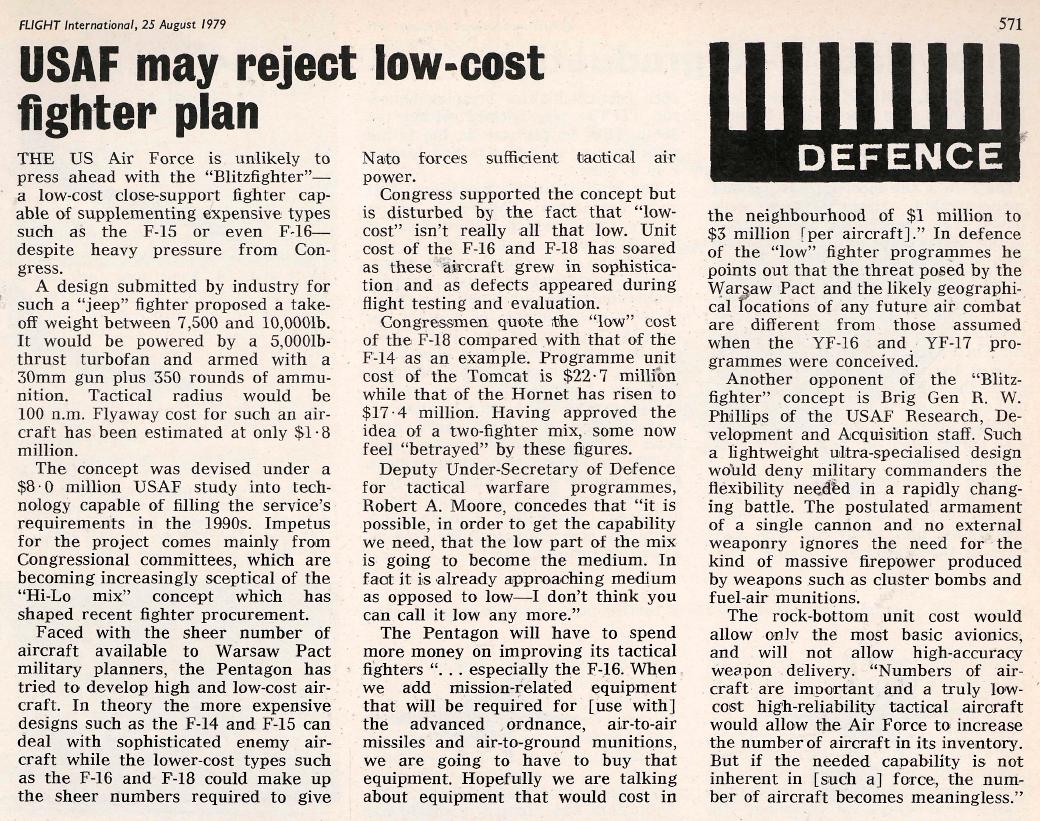
The dick named General Phillips had even more vitriol to pour over the Blitzfighter over the following years, as you can see on Page 571 of the 25 August 1979 issue of Flight International;
http://www.combatreform.org/Image1658.jpg
The Blitzfighter kept popping-up again and again throughout the early 1980s, and every time it did, the (Br)asshats freaked-out all over the place. Though predictably, the Blitzfighter was never even prototyped, and the ETF project was resurrected by the (Br)asshats and eventually put into service.
The result was the $100 Million F-15E Strike Eagle that costs $44000 per flight hour, drops $50000 guided bombs and launches $1000000 Maverick missiles onto targets that don't affect the flow of the battle, in the "Interdiction" role --- which has never had any effect whatsoever on the outcome of any war it was ever used in. It was also the only variant of the F-15 Eagle to ever sustain losses in battle.
The ammunition the $2 Million Blitzfighter would have fired costs only $17/round.
The rest of the Blitzfighter story is here, in Col. James G. Burton's own words (to go straight to the excerpts from Burton's book, enter "Colonel James G. Burton USAF, on the Blitzfighter" into the Find command. There schematics for the other Blitzfighter proposals here as well);
http://www.combatreform.org/killerbees.htm
Finally, here are the specs on the Blitzfighter.
===== VB-100 Blitzfighter Data =====
Role: Attacker
Unit Price: $2 Million
Crew: 1
Size(LxWxH): 34.4x27x14.8ft
Wing Area: 169ft2
Empty Weight: 5578lbs
Internal Fuel: 1700lbs
Payload: ~525lbs
Max. T/O Weight: 8368lbs
Wing Loading (at Max. T/O Weight): 49.58
T/W Ratio: 0.90
Fuel Fraction: 30%
Range: ~300 miles
Ceiling: ~30000ft
Cruise Speed: ~300mph
Top Speed: ~500mph
Climb Rate: ~8500ft/min
Initial Turn Rate: ~25 degrees/sec
Continuous Turn Rate: ~15 degrees/sec
Max. G-Load: +7/-3
Sensors: None
Scan Range: N/A
Look Down: No
Shoot Down: No
Propulsion: 1x Garrett ATF 3-6 Turbofan w/ 5050lbs Military Thrust
Fuel Consumption: 0.44lbs/hour/hour of thrust
Thrust Vectoring: None
Weapon Stations: 1x GAU-13/A 30mm autocannon w/350rds
ECMs: None
FBW: None
RCS: ~15ft3
Stealth: No
Tailhook: None
Catapult Hitch: None
Drag Chute: None
AAR: None
Other: Ballistic Glass Bubble Canopy proofed against 23mm shells, Zero-Zero Ejection Seat, Armored Fuselage, Armored Cockpit, Armored Self-Sealing Fuel Cells, Spall Liners, Hardened and Redundant Control Surfaces, Landing Gear auto-releases upon Hydraulic Failure, STOL Capability, Rough Runway Capability
Now, you're probably looking at this thing (or it's stats below) and wondering, "Why?". Specifically, what does the USAF need this thing for, when it has the A-10 and all those really fast jets with Maverick missiles?
The short answer is, the USAF "leadership" HATED the A-10 with a passion (they still do), and pulled every stop to try to get rid of them all ASAP. And those fast jets with $100000 missiles? They don't work. Yes, I say that in the PRESENT TENSE, and it's as true today as it was in the early 1980s --- read about the 100's of tanks that NATO claimed to have destroyed in Kosovo, that were soon after revealed to be only 14.
The long answer is, the Blitzfighter (sometimes referred to erroneously as the “Mudfighter”) was conceived as a solution to two rather daunting problems. The first was that all of it's new-fangled jets --- intended to perform 24-hour, all-weather "Interdiction" missions at extraordinary speeds, altitudes, and ranges, while costing an extraordinary amount of money to buy, maintain, operate, and arm --- were in fact *weakening* the USAF. The USAF was also further divorcing itself (through these aircraft) from it's decades-old promise to provide the US Army with Close Air Support.
Part of the legacy of this was that the Army developed the AH-64 Apache, to do their *own* Close Air Support. This threw the USAF into a panic, because a new program authorized for one service means that another service loses the money that goes into this new program there was no fooling anyone as to which of the services was going to have their budget cut to pay for the Apaches.
This resulted in the USAF suddenly reversing their decades-long policy of denying effective CAS for the Army, in the form of the sudden new "A-X" requirement, which resulted in the A-10 Thunderbolt II. In other words, the A-10 came to be ONLY as one of many of "The Games Generals Play", to wrestle money away from the Army, and get one over on them at the same time. Now you know why they've been trying to get rid of it ever since --- it outlived it's "usefulness".
That said, here's the scoop on the guy who devised this thing.
The Blitzfighter concept itself was pioneered by maverick Colonel James G. Burton (remember him from "The Pentagon Wars"? He spent a half a decade battling the Army to force them to perform the Full-Up Live Fire Testing on the M2 Bradley that they had previously PROMISED to do --- under a legally-biding contract, no less!). Burton was a student of Colonel John Boyd, whose book "Aerial Attack Study" was LITERALLY the basis of *every* fighter combat tactic used since the 1960s, re-designed the F-X project's objectives into those that spawned the F-15 Eagle, co-designed the "Energy-Maneuverability" Theory alongside a mathematician, and whose associates --- Pierre Sprey, Winslow Wheeler, Col. Everest Riccioni --- devised the requirements that resulted both the LWF and A-X... which resulted in the F-16 and the A-10.
This was to pool of imagination and ideas from which Burton drew his inspiration for the Blitzfighter.
The problem the USAF faced as follows --- in Burton's own words, from his book "The Pentagon Wars: Reformers Challenge the Old Guard";
"...the intelligence community was claiming that the Soviets had adopted the German blitzkrieg tactics from World War II and would swiftly and easily "blitz" western Europe if war broke out. (It is no coincidence that the intelligence community began using the term blitzkrieg after Boyd's briefing became popular.) The Soviets, according to intelligence reports, had a tremendous advantage in numbers of tanks and infantrymen at their disposal. When these superior numbers were combined with blitzkrieg tactics, the Soviets were portrayed as being almost unbeatable. Exaggerating a threat to justify new wonder weapons was, and still is, a common practice.
The Air Force's answer to this bloated Soviet threat was a new fighter-bomber called the Enhanced Tactical Fighter, a proposed night all-weather interdiction aircraft. In the view of the Air Force, the word enhanced referred to the new technologies planned for the plane. In my view, it referred to the costs. This plane was being designed to destroy Soviet tanks deep behind enemy lines and destroy them before they could get to the front and exploit any breakthroughs that would occur (night, all-weather interdiction). The price was a mere $50 million per airplane.
As it happened, I was putting together my proposal for a new airplane at that time (March 1978). My proposal was exactly the opposite of the $50 million plane. I prepared an advocacy briefing that called for the development of a small, simple, lethal, and relatively cheap airplane that would be designed solely for close support of the ground troops who would be engaged with Soviet tanks and armor. Because the intelligence community was making such a big deal about how difficult it would be to stop the Soviet blitzkrieg, I named this airplane the "Blitzfighter". Rather catchy, I thought.
Everything about my proposal, including the plane that would be used, was diametrically opposed to the prevailing philosophy relating to the new wonder weapons of the Air Force. I wanted an airplane in the 5,000- to10,000-pound class (one-tenth the weight of the Enhanced Tactical Fighter), one smaller than any combat airplane in the inventory (one-fourth the size of the A-10), and one that cost less than $2 million. At this price, we could flood the battlefield with swarms of airplanes."
Starting to see the genius behind this design? There's more...
"The airplane would be designed around a four-barrel version of the same cannon that was in production on the A-10, which used a seven-barreled cannon that fired shells costing only $13 apiece. This was a far cry from the guided missiles on the Enhanced Tactical Fighter that cost several hundred thousand apiece. The Blitzfighter would have no high-tech bells and whistles and no wonder weapons. Essentially, it would contain the engine (an existing commercial one), a pilot, a titanium-armored bathtub for the pilot to sit in, a few flight instruments, a radio for the pilot to talk to the ground troops, and a cannon for killing tanks. Nothing more - no radars, infrared sensors, guided missiles, or any of that high-prided junk being installed on every other airplane - was needed.
With the ability to operate from grass fields, the Blitzfighter did not demand fixed, expensive airfields that would probably cease to exist ten minutes after a war started. Squadrons of Blitzfighters would pack up, move from pasture to pasture overnight and follow the flow of battle. Pilots would receive only verbal orders that identified the main points of their effort and left the details of execution to them, a notion that was consistent with Boyd's theories. The plan was in direct contrast to the standard practice of using excruciatingly detailed orders published by higher headquarters for each mission. The orders dictated how much fuel went on board, which weapons were loaded on which wing, the exact route that would be flown to the exact target that had been assigned, and even when the pilot would be allowed to relieve himself. Such rigid orders did not always match up to what was happening in a fast-moving situation.
Finally, the Blitzfighter would be operated at treetop level so that pilots could use their eyeballs to find tanks that were trying to hide. To survive at this level, the plane had to be extremely agile and dart, twist, turn, accelerate, and decelerate far better than any airplane we had."
Then-Lt. Col. Burton got into a heated argument with USAF General Toomay (who believed that only the most complex and expensive technology would prevail) over this proposal, but Toomay actually gave Burton permission to make a formal request for the USAF's Design Bureau at Wright Patterson to evaluate the concept. Their reply was that it would work.
The USAF brass, however, didn't like the Blitzfighter at all, and they poured all their malice into suppressing it. Burton was undaunted, however, and John Boyd encouraged him to in his own words, "Make them work for it".
In June of 1978, Burton sure as hell did "Make them work for it". He was present during a briefing in which Brig. Gen. Richard "Dick" Phillips (and he IS a dick, as you'll soon see) tried to sell the Enhanced Tactical Fighter to Dr. Jack Martin, the Air Force Assistant Secretary for Research, Development. Brig. Gen. Phillips and his associates presented *deliberately* falsified numbers on the ETF to Dr. Martin, and Col. Burton called him on it. Dr. Martin made a few phone calls on the spot to check the numbers, and verified that Col. Burton's numbers were correct --- and that Brig. Gen. Phillip's numbers were a lie.
Afterwards, Phillips met with Burton in the Pentagon hallway outside Dr. Martin's office, and congratulated him for his good stewardship of the US taxpayer's dollars;
"Needless to say, General Phillips was not happy with me. I was soon braced up against the wall of the "E" ring. With his forefinger pounding my breastbone like a jackhammer, and his nose about one inch from mine, he let me know that I was dog mean and that several other generals would have a feast when I came back into the "blue suit" Air Force.
Then, the paranoia surfaced: "You're not going to ram that F___ing Blitzfighter down our throats like your friends did the F-16!" They were still smarting over that coup."
The dick named General Phillips had even more vitriol to pour over the Blitzfighter over the following years, as you can see on Page 571 of the 25 August 1979 issue of Flight International;
http://www.combatreform.org/Image1658.jpg
The Blitzfighter kept popping-up again and again throughout the early 1980s, and every time it did, the (Br)asshats freaked-out all over the place. Though predictably, the Blitzfighter was never even prototyped, and the ETF project was resurrected by the (Br)asshats and eventually put into service.
The result was the $100 Million F-15E Strike Eagle that costs $44000 per flight hour, drops $50000 guided bombs and launches $1000000 Maverick missiles onto targets that don't affect the flow of the battle, in the "Interdiction" role --- which has never had any effect whatsoever on the outcome of any war it was ever used in. It was also the only variant of the F-15 Eagle to ever sustain losses in battle.
The ammunition the $2 Million Blitzfighter would have fired costs only $17/round.
The rest of the Blitzfighter story is here, in Col. James G. Burton's own words (to go straight to the excerpts from Burton's book, enter "Colonel James G. Burton USAF, on the Blitzfighter" into the Find command. There schematics for the other Blitzfighter proposals here as well);
http://www.combatreform.org/killerbees.htm
Finally, here are the specs on the Blitzfighter.
===== VB-100 Blitzfighter Data =====
Role: Attacker
Unit Price: $2 Million
Crew: 1
Size(LxWxH): 34.4x27x14.8ft
Wing Area: 169ft2
Empty Weight: 5578lbs
Internal Fuel: 1700lbs
Payload: ~525lbs
Max. T/O Weight: 8368lbs
Wing Loading (at Max. T/O Weight): 49.58
T/W Ratio: 0.90
Fuel Fraction: 30%
Range: ~300 miles
Ceiling: ~30000ft
Cruise Speed: ~300mph
Top Speed: ~500mph
Climb Rate: ~8500ft/min
Initial Turn Rate: ~25 degrees/sec
Continuous Turn Rate: ~15 degrees/sec
Max. G-Load: +7/-3
Sensors: None
Scan Range: N/A
Look Down: No
Shoot Down: No
Propulsion: 1x Garrett ATF 3-6 Turbofan w/ 5050lbs Military Thrust
Fuel Consumption: 0.44lbs/hour/hour of thrust
Thrust Vectoring: None
Weapon Stations: 1x GAU-13/A 30mm autocannon w/350rds
ECMs: None
FBW: None
RCS: ~15ft3
Stealth: No
Tailhook: None
Catapult Hitch: None
Drag Chute: None
AAR: None
Other: Ballistic Glass Bubble Canopy proofed against 23mm shells, Zero-Zero Ejection Seat, Armored Fuselage, Armored Cockpit, Armored Self-Sealing Fuel Cells, Spall Liners, Hardened and Redundant Control Surfaces, Landing Gear auto-releases upon Hydraulic Failure, STOL Capability, Rough Runway Capability
Category Designs / Miscellaneous
Species Unspecified / Any
Size 1024 x 1280px
File Size 89.5 kB



I don't know about that --- it fires the same ammo as the A-10 (at about half the rate-of-fire), and that stuff makes a REAL impression on whatever it hits.
Caution: These videos are rated "A" for A-10!;
http://www.youtube.com/watch?v=riqu8hmPHd0
http://www.youtube.com/watch?v=crqSrQ9CA0Q
http://www.youtube.com/watch?v=oY4lPylx6D4
http://www.youtube.com/watch?v=kKRt2DYMvdU
http://www.youtube.com/watch?v=FtYD_zL1GQM
http://www.youtube.com/watch?v=S3oZP2tEbH4
http://www.youtube.com/watch?v=sALiuWg_I1k
http://www.youtube.com/watch?v=NBXrogB8L08
http://www.youtube.com/watch?v=dKQpg58BbGg
Caution: These videos are rated "A" for A-10!;
http://www.youtube.com/watch?v=riqu8hmPHd0
http://www.youtube.com/watch?v=crqSrQ9CA0Q
http://www.youtube.com/watch?v=oY4lPylx6D4
http://www.youtube.com/watch?v=kKRt2DYMvdU
http://www.youtube.com/watch?v=FtYD_zL1GQM
http://www.youtube.com/watch?v=S3oZP2tEbH4
http://www.youtube.com/watch?v=sALiuWg_I1k
http://www.youtube.com/watch?v=NBXrogB8L08
http://www.youtube.com/watch?v=dKQpg58BbGg


Thank god that you're just an ignorant armchair general on the internet who knows NOTHING about combat. The Maverick isn't useless. It's VERY good. Burton was a jaded idiot who was reassigned so people didn't have to listen to his rambling. And the pentagon wars is ENTIRELY FICTION. This is the dream of a deluded idiot who thinks that aircraft design peaked in about, oh, 1965. He lives in a lala land where things like cell phones and drones don't exist.
A few things you got wrong: a 30mm gau-8a round costs around 65$ per round. At 70 rounds per second, that will add up QUICK. Even at 35 rounds per second, completely taking away the idea that this would add to your flight path and attack time, making you WAY more vulnerable. It has a MASSIVE RCS making it vulnerable to sam sites, BUT THATS OK! Because it has no chaff or flares. Plus you seem to forget that anti-air cannons exist. It costs as much to empty this gun as two of those "useless" maverick missiles. Which by the way? They WORK. REALLY well. Ukraine is proving right now that missiles and drones are AMAZING at taking out tanks. If that wasn't true, then it wouldn't be in service with THIRTY countries and used in SIX wars.
The F-15E? It's VERY good at it's job. SO good that it managed to get an air to air kill WITH A BOMB. It HAS gotten combat losses to ground fire, mainly because it was tasked with what was widely considered the HARDEST air to ground mission of the war, chosen to take out a site protected by multiple SAM batteries. Despite this, we lost four
F-15Es, the same amount of A-10s. However, both of these aircraft are now severely outdated, and will likely be replaced by the F-35, thank GOD, our soldiers don't have to get CAS from someone equipped with a slide rule and a ZX spectrum.
Also, the Maverick has a wide price band. It can cost as little as 17k. And finally, the Acenger autocannon is USELESS, please stop saying it's good, it's inaccurate, expensive, complicated, and can't even penetrate an M-60, much less a T-72, T-80, or T-90... provided their armor isn't cardboard, like in Ukraine...
A few things you got wrong: a 30mm gau-8a round costs around 65$ per round. At 70 rounds per second, that will add up QUICK. Even at 35 rounds per second, completely taking away the idea that this would add to your flight path and attack time, making you WAY more vulnerable. It has a MASSIVE RCS making it vulnerable to sam sites, BUT THATS OK! Because it has no chaff or flares. Plus you seem to forget that anti-air cannons exist. It costs as much to empty this gun as two of those "useless" maverick missiles. Which by the way? They WORK. REALLY well. Ukraine is proving right now that missiles and drones are AMAZING at taking out tanks. If that wasn't true, then it wouldn't be in service with THIRTY countries and used in SIX wars.
The F-15E? It's VERY good at it's job. SO good that it managed to get an air to air kill WITH A BOMB. It HAS gotten combat losses to ground fire, mainly because it was tasked with what was widely considered the HARDEST air to ground mission of the war, chosen to take out a site protected by multiple SAM batteries. Despite this, we lost four
F-15Es, the same amount of A-10s. However, both of these aircraft are now severely outdated, and will likely be replaced by the F-35, thank GOD, our soldiers don't have to get CAS from someone equipped with a slide rule and a ZX spectrum.
Also, the Maverick has a wide price band. It can cost as little as 17k. And finally, the Acenger autocannon is USELESS, please stop saying it's good, it's inaccurate, expensive, complicated, and can't even penetrate an M-60, much less a T-72, T-80, or T-90... provided their armor isn't cardboard, like in Ukraine...

It would be even more valuable today than even during the cold war, given that most of the work in air-to-ground combat is still done with unguided ordnance and strafing runs.
You'll also notice that as the complexity and cost of the average combat aircraft increases in air forces worldwide, their inventories decrease; something the Blitzfighter would have gotten ahead of. This was first brought to public awareness in the early 1980s by Norman Augustine.
Augustine was the Secretary of the Army under Gerald R. Ford and Jimmy Carter, and was a high-ranking official in the aviation industry both before and after his government career. In 1984, he published what are known as Augustine's Laws of Military Procurement, a set of several-dozen truisms of the military procurement system's innate failings;
https://en.wikipedia.org/wiki/Augustine%27s_laws
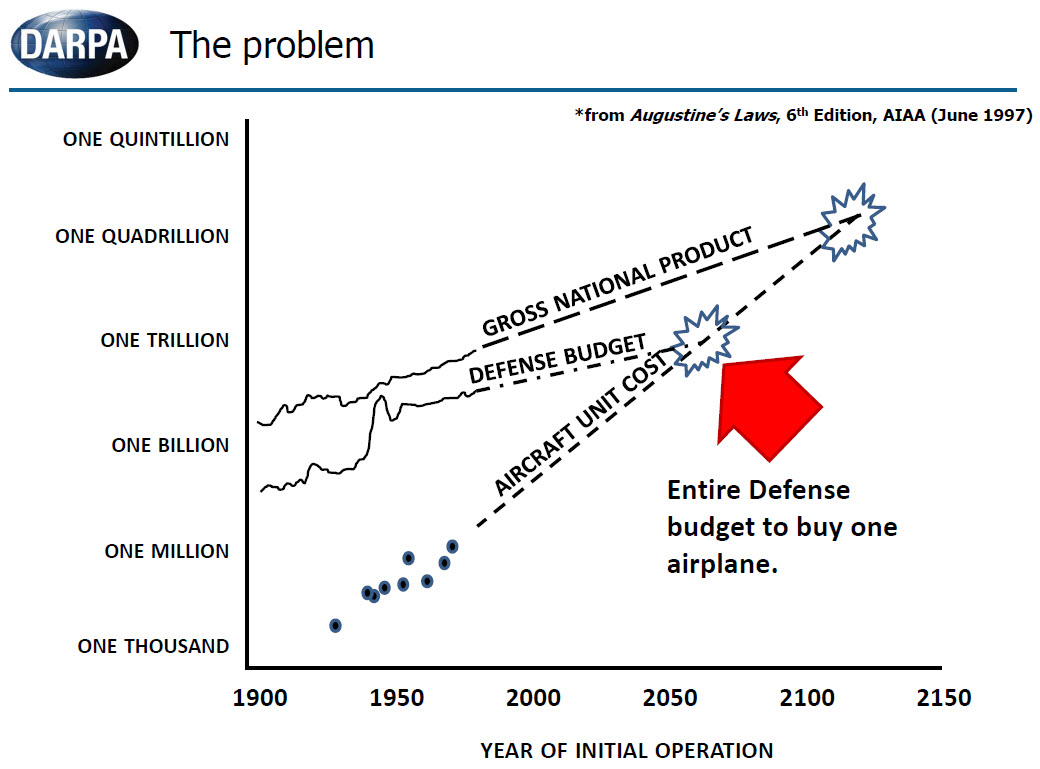
The most famous and oft-cited is the 16th Law, which predicts that "In the year 2054, the entire defense budget will purchase just one aircraft. This aircraft will have to be shared by the Air Force and Navy 3-1/2 days each per week except for leap year, when it will be made available to the Marines for the extra day".
There were a number of books, magazines, and other publications in the 1980s and early 1990s that included a graph chart which accompanied the 16th law. A low-quality scan of that image was posted on Reddit, but a better image (updated for 1997) can be seen here;
https://blogfiles.pstatic.net/20130.....21_problem.jpg
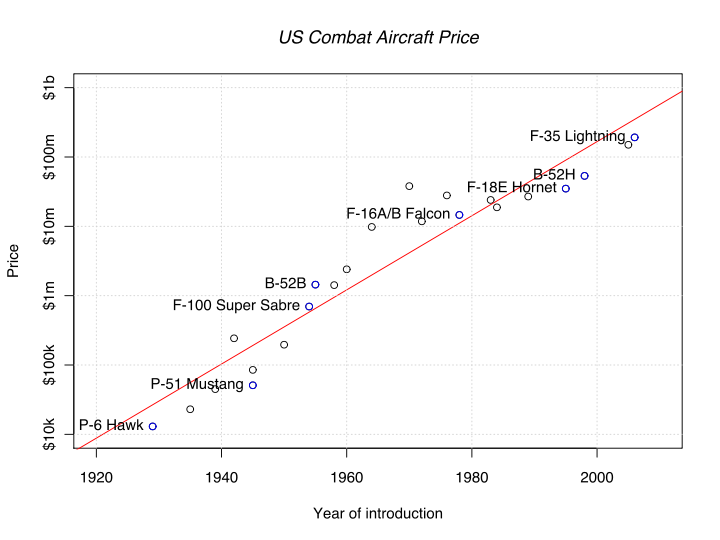
Here's one from 2014, that includes current aircraft;
https://cdn.arstechnica.net/wp-cont.....s_law.svg_.png
You'll also notice that as the complexity and cost of the average combat aircraft increases in air forces worldwide, their inventories decrease; something the Blitzfighter would have gotten ahead of. This was first brought to public awareness in the early 1980s by Norman Augustine.
Augustine was the Secretary of the Army under Gerald R. Ford and Jimmy Carter, and was a high-ranking official in the aviation industry both before and after his government career. In 1984, he published what are known as Augustine's Laws of Military Procurement, a set of several-dozen truisms of the military procurement system's innate failings;
https://en.wikipedia.org/wiki/Augustine%27s_laws
The most famous and oft-cited is the 16th Law, which predicts that "In the year 2054, the entire defense budget will purchase just one aircraft. This aircraft will have to be shared by the Air Force and Navy 3-1/2 days each per week except for leap year, when it will be made available to the Marines for the extra day".
There were a number of books, magazines, and other publications in the 1980s and early 1990s that included a graph chart which accompanied the 16th law. A low-quality scan of that image was posted on Reddit, but a better image (updated for 1997) can be seen here;
https://blogfiles.pstatic.net/20130.....21_problem.jpg
Here's one from 2014, that includes current aircraft;
https://cdn.arstechnica.net/wp-cont.....s_law.svg_.png

Comments