
 FA+
FA+ Shop
Shop
433
Views
Views
7
Favorites
Favorites
Category
Artwork (Traditional) / General Furry Art
Species Dinosaur
Size 478 x 1280
File Size 98.4 kB
Report this content
More from Exdraghunt


Listed in Folders


Drew this partially to vent a little bit on problems I always see with pterosaur drawings, partially to help out people who want to draw pterosaurs themselves.
On wings and wing fingers: Pterosaurs have 3 fingers, then one very long 4th finger that holds up the wing. In the actual animal, they lost the thumb, and the pinkie is the elongated finger. For anthros, I like to give the poor guys a thumb. :3 Still 3 fingers though.
Realistically, pterosaurs had freakishly long wrists, and a bone called the pteroid that held up the propatagium, or forwing. (I spelled it wrong in the picture, herp. That's what I get for drawing in class)
With the feet, pterosaurs were plantigrade. I understand digitigrade is fun, but I've seen people get after artists for drawing plantigrade creatures digitigrade, so why do it here?
Also, everyone seems to love Pteranodon longiceps , the pterosaur you ALWAYS see in cartoons/movies/TV shows. But really, there's more than just Pteranodon, pterosaurs got reeaaally weird. So do a little research, Wiki pterosaurs and check out some stuff.
Final note, on finding good references. I always reccomend Mark Witton (here http://www.flickr.com/photos/markwitton/ and here http://www.markwitton.com/#/palaeoart/4552742753) as well as Paleoartists like Luis Rey. Don't just Google image search 'pterosaur', you end up with a bunch of really weird stuff.
Pterosaur heads on the bottom are, from left to right, top to bottom Pteranodon, Thalassodromeus, dsungaripterus, Caulkicephalus, Rhamphorhynchus, Darwinapterus, and Anurognathus.
Anywho, this is what I do with my class time. :d No wonder I have so much homework.
On wings and wing fingers: Pterosaurs have 3 fingers, then one very long 4th finger that holds up the wing. In the actual animal, they lost the thumb, and the pinkie is the elongated finger. For anthros, I like to give the poor guys a thumb. :3 Still 3 fingers though.
Realistically, pterosaurs had freakishly long wrists, and a bone called the pteroid that held up the propatagium, or forwing. (I spelled it wrong in the picture, herp. That's what I get for drawing in class)
With the feet, pterosaurs were plantigrade. I understand digitigrade is fun, but I've seen people get after artists for drawing plantigrade creatures digitigrade, so why do it here?
Also, everyone seems to love Pteranodon longiceps , the pterosaur you ALWAYS see in cartoons/movies/TV shows. But really, there's more than just Pteranodon, pterosaurs got reeaaally weird. So do a little research, Wiki pterosaurs and check out some stuff.
Final note, on finding good references. I always reccomend Mark Witton (here http://www.flickr.com/photos/markwitton/ and here http://www.markwitton.com/#/palaeoart/4552742753) as well as Paleoartists like Luis Rey. Don't just Google image search 'pterosaur', you end up with a bunch of really weird stuff.
Pterosaur heads on the bottom are, from left to right, top to bottom Pteranodon, Thalassodromeus, dsungaripterus, Caulkicephalus, Rhamphorhynchus, Darwinapterus, and Anurognathus.
Anywho, this is what I do with my class time. :d No wonder I have so much homework.
Category Artwork (Traditional) / General Furry Art
Species Dinosaur
Size 478 x 1280px
File Size 98.4 kB
Listed in Folders

With the real animals, pterosaurs actually had very similar general body plans, discounting things like head shape and neck length. We know that they were plantigrade due to the discovery of fossil footprints left by pterodactyloid Pterosaurs showing how they walked quadrupedally. (more info can be found here. http://pterosaur.net/terrestrial_locomotion.php and here http://archosaurmusings.wordpress.c.....-two-legs-bad/ )
Rhamphorhynchoids most certainly walked differently then their more advanced cousins, but due to their sprawling hindlimbs with legs linked by a rear membrane, I didn't really address them here, due to the fact that in an Anthro their five toes and uropatagium would have almost no purpose. (we rarely see anthro bats with rear membranes either. ) However, looking at skeletal reconstructions, it seems unlikely that their feet were digitigrade either considering how long and widely spaced their toes were.
That said, I didn't draw this to crush anyone's enthusiasm or imagination. I made this reference partly out of boredom, partly because these are some of my pet peeves, and partly so that people who want to portray realistic pterosaurs could have an easy to understand reference without having to search through piles of paleobiology papers. I'm certainly not claiming to be the end-all-be-all when it comes to pterosaurs, which is why I linked to the website of the great Mark Witton and mentioned Luis Rey as well.
Rhamphorhynchoids most certainly walked differently then their more advanced cousins, but due to their sprawling hindlimbs with legs linked by a rear membrane, I didn't really address them here, due to the fact that in an Anthro their five toes and uropatagium would have almost no purpose. (we rarely see anthro bats with rear membranes either. ) However, looking at skeletal reconstructions, it seems unlikely that their feet were digitigrade either considering how long and widely spaced their toes were.
That said, I didn't draw this to crush anyone's enthusiasm or imagination. I made this reference partly out of boredom, partly because these are some of my pet peeves, and partly so that people who want to portray realistic pterosaurs could have an easy to understand reference without having to search through piles of paleobiology papers. I'm certainly not claiming to be the end-all-be-all when it comes to pterosaurs, which is why I linked to the website of the great Mark Witton and mentioned Luis Rey as well.

I have a hard time believing ALL pterosaurs were plantigrade after reading this when researching for my pterosaur guy. http://pterosaurheresies.wordpress......pedal-or-both/
Interesting site, though I find that many of the author's claims are at odds with the opinions of the larger scientific community. I'll also admit that I've seen the author of that blog get into lengthy arguments with other paleontologists on various other blogs, and is rather infamous for supporting incredibly odd theories. (this blog post covers the history behind David Peters odd theories, even if it reads a bit like a grudge post http://paleoking.blogspot.com/2011/.....id-peters.html )
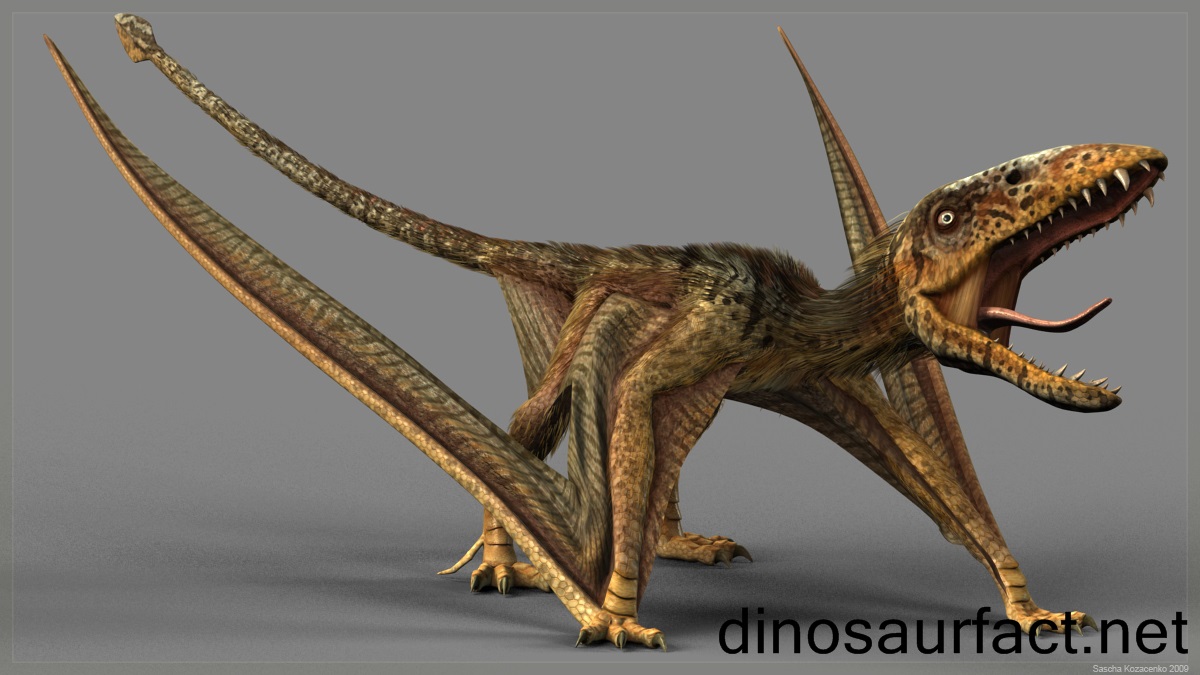
Much of what I've both read and seen indicated that basal pterosaurs had splayed rear legs, and were incapable of bringing them under their body, such as in this picture of Sordes http://www.flickr.com/photos/markwi.....57594082038974 , and this one of Dimorphodon http://www.dinosaurfact.net/Picture.....imorphodon.jpg
Dave Hone touched briefly on the difference between Pterodacyloid and Rhamphoryhnchoid feet in his post here http://archosaurmusings.wordpress.c.....-bad/#more-437 as well.
There is of course no way we can be certain about exactly what basal pterosaur feet looked like, but at this point in time, I find the evidence for their being plantigrade with a sprawling posture the most convincing.
Much of what I've both read and seen indicated that basal pterosaurs had splayed rear legs, and were incapable of bringing them under their body, such as in this picture of Sordes http://www.flickr.com/photos/markwi.....57594082038974 , and this one of Dimorphodon http://www.dinosaurfact.net/Picture.....imorphodon.jpg
Dave Hone touched briefly on the difference between Pterodacyloid and Rhamphoryhnchoid feet in his post here http://archosaurmusings.wordpress.c.....-bad/#more-437 as well.
There is of course no way we can be certain about exactly what basal pterosaur feet looked like, but at this point in time, I find the evidence for their being plantigrade with a sprawling posture the most convincing.


Comments