
 FA+
FA+ Shop
Shop
120
Views
Views
38
Favorites
Favorites
Category
All / All
Species Unspecified / Any
Size 1662 x 2217
File Size 4.23 MB
Report this content
More from Wilhelm


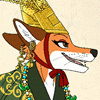
Buddhist monk at the dajeom (茶店, teahouse), 11~12th century, Goryeo (medieval Korea)
Tea drinking spread throughout East Asia alongside Buddhism. It is commonly believed that Chinese Buddhist monks started to drink tea to keep awake during late night prayers. This practice spread with their religion to Korea and Japan.
Koreans started to consume Chinese tea products at least from 7th century. In the early 9th century, domestic tea cultivation began to develop in Korea. However, tea drinking and the culture attached to it truly began to flourish during the Goryeo dynasty (918~1392). Xu Jing, a Song dynasty Chinese envoy who visited Goryeo in 1123, wrote that Koreans were avid tea drinkers and set out tea three times a day.
Gaegyeong, the capital of Goryeo, had numerous teahouses called "dajeom" (茶店) that were accessible to all classes. These teahouses served a variety of beverages, including Chinese and Korean teas, as well as cheaper substitute teas made by boiling grains or flowers. Some teahouses even had multi-story pavilions. Im Chun (林椿), a 12th-century Korean poet, wrote that he often takes a refreshing nap at one of these teahouse pavilions. Meanwhile, the ruling class, such as kings and monks, frequented luxury teahouses called “dajeong” (茶亭). Xu Jing remarks on his experience at one of these dajeong, when he had multiple cups of tea and played Go with Korean officials.
The method of preparing tea in Goryeo was similar to that of the Song China. A tea cake (團茶) was finely ground into powder, scooped into a bowl, and boiling water was poured over it. The crucial step was to vigorously stir it with a bamboo whisk –which is depicted in the drawing- to create a foam. This process is similar to the well-known Japanese matcha (抹茶) tea ceremony, as Japan also adopted Chinese tea-drinking customs. Many Goryeo poems liken tea to snow or milk because of the silky white foam, not unlike the modern latte. Goryeo tea was said to be light and delicate because it was made from especially tender leaves.
Sweet confections to accompany tea also began to flourish during this period. The drawing shows two types of these sweets, dasik (茶食) and yakgwa (藥果). Dasik is a soft dough sweetened with honey. The ingredients of the dough vary, which include rice flour, pine pollen, black sesame, and chestnut, depending on the type. The dough is then shaped into a bite-sized ball and pressed into a decorative mold. Yakgwa is made by frying the sweet dough. The most common ingredients are wheat and honey. Both key ingredients were exceptionally rare in Korea at the time, and the cooking oil was also quite expensive. So it was mostly enjoyed by the most affluent individuals, often from the ruling class. The type of yakgwa shown in the drawing is called Gaeseong yakgwa. Gaesong is the current name of Gaegyeong. Unlike most yakgwa, this has a light, crispy, layered texture like a pastry. It is also called moyakgwa because of its characteristic square shape.
The tableware in the drawing are all celadon. Celadon, or "cheongja" (靑磁) in Korean, is pottery glazed in the jade green color. Although celadon technique was introduced from China, Korean potters established a native style during the Goryeo period. The 12th century is regarded as a pinnacle of Goryeo celadon, particularly for its distinctive inlay decoration and color.
As a state religion, Buddhism and its ministers enjoyed a lot of prestige in Goryeo society. The monk in the drawing is the wangsa (王師, lit. Royal Preceptor), who was considered as one of the highest rank of the Buddhist clerical hierarchy. Even the king himself had to bow in front of the wangsa. He was appointed by the king often from the most influential Buddhist order at the time. He took charge of the religious matters of the state, such as officiating the state rituals and overseeing the national exam for monks.
The clothing is based on several portraits of Goryeo monks. With the extensive support from the state, Buddhism in Goryeo developed a lavish high culture. Priestly garments of the time also reflects this splendor. On the traditional Korean clothing of baji (trousers) and jeogori (upper garment), he wears a long robe called jangsam (長衫).
On top of jangsam, he wears a cloak called gasa (袈裟. Jiasha in Chinese, Kesa in Japanese). Gasa originates from the ancient Indian garment kasaya (काषाय), which was originally wrapped over the naked body. In East Asia, however, it became a ceremonial outer garment worn over the usual clothing due to the colder climate. It is a patchworked rectangular fabric that is fastened with a clasp at the left shoulder. Its color, material, and decoration differed according to the monk's rank. For example, Xu Jing describes that the royal preceptor wore the gasa with a landscape pattern (山水衲袈裟).
Lastly, the title Kleshas (क्लेश) is a Buddhist term that refers to negative mental states that cloud the mind. In English, it translates to afflictions, destructive emotions, disturbing emotions, and so on. In East Asia, it is most commonly translated to 煩惱 (Beonnoe in Korean, bonnō in Japanese). Buddhism in Goryeo, being a state-sponsored religion, was frequently intertwined with politics. I imagine many monks at the time would’ve faced this dilemma, especially if they worked directly with the king himself.
You can see my new artworks one month early.
https://www.patreon.com/WilhelmHistory
Tea drinking spread throughout East Asia alongside Buddhism. It is commonly believed that Chinese Buddhist monks started to drink tea to keep awake during late night prayers. This practice spread with their religion to Korea and Japan.
Koreans started to consume Chinese tea products at least from 7th century. In the early 9th century, domestic tea cultivation began to develop in Korea. However, tea drinking and the culture attached to it truly began to flourish during the Goryeo dynasty (918~1392). Xu Jing, a Song dynasty Chinese envoy who visited Goryeo in 1123, wrote that Koreans were avid tea drinkers and set out tea three times a day.
Gaegyeong, the capital of Goryeo, had numerous teahouses called "dajeom" (茶店) that were accessible to all classes. These teahouses served a variety of beverages, including Chinese and Korean teas, as well as cheaper substitute teas made by boiling grains or flowers. Some teahouses even had multi-story pavilions. Im Chun (林椿), a 12th-century Korean poet, wrote that he often takes a refreshing nap at one of these teahouse pavilions. Meanwhile, the ruling class, such as kings and monks, frequented luxury teahouses called “dajeong” (茶亭). Xu Jing remarks on his experience at one of these dajeong, when he had multiple cups of tea and played Go with Korean officials.
The method of preparing tea in Goryeo was similar to that of the Song China. A tea cake (團茶) was finely ground into powder, scooped into a bowl, and boiling water was poured over it. The crucial step was to vigorously stir it with a bamboo whisk –which is depicted in the drawing- to create a foam. This process is similar to the well-known Japanese matcha (抹茶) tea ceremony, as Japan also adopted Chinese tea-drinking customs. Many Goryeo poems liken tea to snow or milk because of the silky white foam, not unlike the modern latte. Goryeo tea was said to be light and delicate because it was made from especially tender leaves.
Sweet confections to accompany tea also began to flourish during this period. The drawing shows two types of these sweets, dasik (茶食) and yakgwa (藥果). Dasik is a soft dough sweetened with honey. The ingredients of the dough vary, which include rice flour, pine pollen, black sesame, and chestnut, depending on the type. The dough is then shaped into a bite-sized ball and pressed into a decorative mold. Yakgwa is made by frying the sweet dough. The most common ingredients are wheat and honey. Both key ingredients were exceptionally rare in Korea at the time, and the cooking oil was also quite expensive. So it was mostly enjoyed by the most affluent individuals, often from the ruling class. The type of yakgwa shown in the drawing is called Gaeseong yakgwa. Gaesong is the current name of Gaegyeong. Unlike most yakgwa, this has a light, crispy, layered texture like a pastry. It is also called moyakgwa because of its characteristic square shape.
The tableware in the drawing are all celadon. Celadon, or "cheongja" (靑磁) in Korean, is pottery glazed in the jade green color. Although celadon technique was introduced from China, Korean potters established a native style during the Goryeo period. The 12th century is regarded as a pinnacle of Goryeo celadon, particularly for its distinctive inlay decoration and color.
As a state religion, Buddhism and its ministers enjoyed a lot of prestige in Goryeo society. The monk in the drawing is the wangsa (王師, lit. Royal Preceptor), who was considered as one of the highest rank of the Buddhist clerical hierarchy. Even the king himself had to bow in front of the wangsa. He was appointed by the king often from the most influential Buddhist order at the time. He took charge of the religious matters of the state, such as officiating the state rituals and overseeing the national exam for monks.
The clothing is based on several portraits of Goryeo monks. With the extensive support from the state, Buddhism in Goryeo developed a lavish high culture. Priestly garments of the time also reflects this splendor. On the traditional Korean clothing of baji (trousers) and jeogori (upper garment), he wears a long robe called jangsam (長衫).
On top of jangsam, he wears a cloak called gasa (袈裟. Jiasha in Chinese, Kesa in Japanese). Gasa originates from the ancient Indian garment kasaya (काषाय), which was originally wrapped over the naked body. In East Asia, however, it became a ceremonial outer garment worn over the usual clothing due to the colder climate. It is a patchworked rectangular fabric that is fastened with a clasp at the left shoulder. Its color, material, and decoration differed according to the monk's rank. For example, Xu Jing describes that the royal preceptor wore the gasa with a landscape pattern (山水衲袈裟).
Lastly, the title Kleshas (क्लेश) is a Buddhist term that refers to negative mental states that cloud the mind. In English, it translates to afflictions, destructive emotions, disturbing emotions, and so on. In East Asia, it is most commonly translated to 煩惱 (Beonnoe in Korean, bonnō in Japanese). Buddhism in Goryeo, being a state-sponsored religion, was frequently intertwined with politics. I imagine many monks at the time would’ve faced this dilemma, especially if they worked directly with the king himself.
You can see my new artworks one month early.
https://www.patreon.com/WilhelmHistory
Category All / All
Species Unspecified / Any
Size 1662 x 2217px
File Size 4.23 MB



Comments