
 FA+
FA+ Shop
Shop
253
Views
Views
0
Favorites
Favorites
Category
Story / Miscellaneous
Species Unspecified / Any
Size 50 x 50
File Size 30.5 kB
Report this content
More from Gunslinger87





Locomotive Roster for the
Thunder Valley Narrow Gauge
(T.V.N.G.)
Road Number Class Builder
No. 1. 0-4-2T H.K. Porter
No. 2. 0-4-2T Baldwin
No. 3. 2-4-2T Baldwin
No. 4. 2-6-2T Baldwin
No. 5. 2-6-0 Brooks
No. 6. 2-6-0 Cooke
No. 7. 2-8-0 Brooks
No. 8. 4-8-0 Baldwin
No. 9. 4-4-0 Baldwin
No. 10. 4-4-0 Baldwin
No. 11. 2-8-0 Baldwin
No. 12. 2-8-0 Baldwin
No. 13. 2-8-0 Baldwin
No. 14. 2-8-2 Baldwin
Notes
Locomotive No. 1:
Locomotive #1 of the T.V.N.G. (Thunder Valley Narrow Gauge) was a small “8 Ton” 0-4-2T built by the H.K. Porter Co. in the mid 1890s. As was most of the locomotives on the Thunder Valley roster. The TVNG was a common carrier, however the primary reason for the railroad's existence were the countless copper mines scattered about Arizona's “Thunder Valley”. The diminutive locomotive hauled mixed trains consisting of both freight and passengers. Later in service the locomotive's service became limited to switching and inspections along the line due to it's small size and little tractive effort. That is compared to the larger locomotives the TVNG acquired throughout its operation.
Locomotive No. 2:
Locomotive #2 was the first “Large” locomotive acquisitioned by the TVNG. Like the #1 it was also an 0-4-2T and was a saddle tanker. However the locomotive was much larger and had a lot more strength. The locomotive had outside frames to help support a larger boiler. Also unlike the #1 the cab was fully enclosed and made of wood. The only locomotive to have a steel cab on the TVNG was #14, a Baldwin built 2-8-2.
Locomotive No. 3:
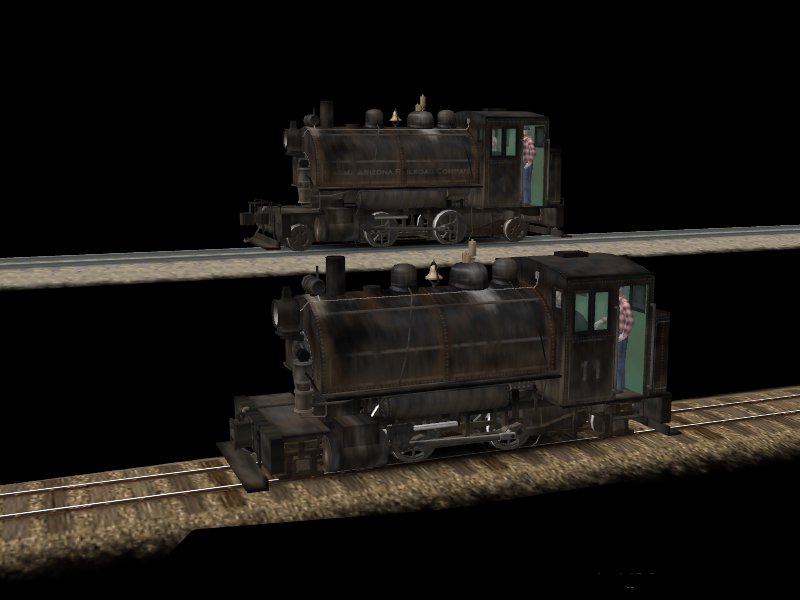
Locomotive #3 is another Baldwin product. A hefty 2-4-2T similar to the Magma Arizona RR's, but with outside frames rather than inside. It was easily twice as large as the #2 and the locomotive was limited to mostly freight service. Most often the locomotive could be seen hauling long strings of copper laden ore cars to the mills along the TVNG line. And on occasion the locomotive has been seen hauling short mixed trains.
Locomotive No. 4:
Locomotive #4 is a charming and perfectly proportioned 2-6-2T built by the Baldwin Locomotive Works in the late 1890s. She is similar in appearance to the Australia’s Victorian Railways' “NA” class 2-6-2Ts used on the Puffing Billy Railway. Albeit noticeably smaller. The Baldwin design for the locomotive was mostly for export locomotives, but the TVNG found the design suitable for short mixed trains and switching at the numerous mines and mills along the TVNG Right-Of-Way. Number 4, like engines #2 and 3, had outside frames. Although minus the external counterweights on the axle cranks. Its appearance was a mix of the new and old, She had a typical diamond stack for small coal burners and an 18in diameter oil burning headlamp. The locomotive also had a small wood road pilot reminiscent of the locomotives from the 1870s. However it did not have fluted domes, but round ones. And like the Victorian Railways' “NA” class had side tanks. Number 4 was the last tank engine acquired by the TVNG and was the only switcher to have side tanks.
Locomotive No. 5:
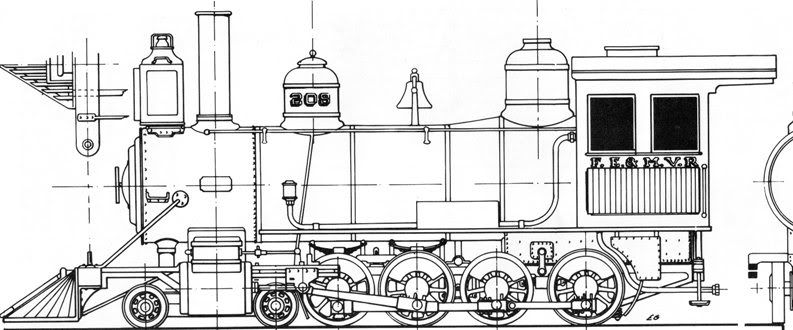
Engine number 5 was the first tender locomotive bought by the TVNG. It was a small 2-6-0 built by Brooks in the 1880s. It was acquired second hand, but the locomotive proved itself to be quite an asset for passenger service. It was not the fastest locomotive, perse, but it did prove to be reliable and versatile. It was one of the few locomotives to have a wagon top boiler and fluted domes.
Locomotive No. 6:
Locomotive number 6, like number 5, is also a 2-6-0 Mogul. But number 6 is larger and considerably stronger than #5. number six was built by Danforth Cooke in the mid 1880s and was bought second hand from an obscure Colorado road. Unfortunately the records for this locomotive have been lost to time due to a mysterious fire in the Ocalla, AZ library. Number 6, in terms of design and blue print, is identical to the Moguls built for the Denver South Park & Pacific RR. However shortly after arrival on the TVNG the locomotive received some aesthetic alterations after a wreck. Her Cooke style fluted domes were replaced by Baldwin style fluted domes and diamond stack like those used by Baldwin's “C-16” class locomotives, as dubbed by the D&RGW.
Locomotive No. 7:
Locomotive number 7 was the first 2-8-0 acquired by the TVNG. Number 7 was a Brooks product, but bared a striking resemblance to Baldwin's “C-16” locomotives. There only a few subtle differences that showed them apart. Mostly in the style and shape of the smoke stack and domes. The steam dome was taller than that on the Baldwin version and the smoke stack had more of a diamond shape, where as the Baldwin version's stack had a broader top. Number 7 was also a product produced in the 1880s and served well on a number of Arizona roads before falling into the hands of the TVNG. The engine was also considered “Lucky” after having a number of extremely close calls from freak accidents. On one occasion the locomotive was idling on a siding by one of the mining complexes and a misplaced dynamite charge caused a severe landslide. Strangely enough, aside from a thin layer of dust, the locomotive was unharmed. Unfortunately the same can't be said for it's consist. This was not the only event that gave the locomotive its reputation for being “lucky”. And so its crews have dubbed it “Lucky #7”.
Locomotive No. 8:
Number 8 was the only locomotive of its type to operate on the TVNG, let alone Arizona itself! It was a 4-8-0 “Mastodon” class locomotive with a wagon top boiler and rounded domes. Number 8 almost always hauled mixed trains consisting of mostly passenger and mail service, with a boxcar or some other freight car to deliver local goods. It had a bit more strength compared to #7, although it couldn't take as sharp a curve due to the slightly longer wheel base. So its service was mostly limited to that along the main line.
Locomotives No. 9 & 10:
Numbers 9 and 10 were the first Baldwin built 4-4-0 types to be bought by the TVNG. They were unusual due to their outside frame arraignment. The Baldwin design the were derived from from was mostly for that of an export locomotive popular in Mexico and Central America. Aside from the TVNG's early locomotives these engines were bought new from the builder and all locomotives following. They featured wooden cabs and smooth rounded domes. Tall “Capped” style smoke stacks and large “Box” style headlights and wooden road pilots. These locomotives were almost always limited to freight service and it wasn't uncommon to see them double heading a heavy freight while traversing the steep and winding grades of the TVNG Right-Of-Way.
Locomotive No. 11:
Number 11 was once the largest locomotive on the TVNG's roster. That is until another set of “twins” was bought, engines 12 and 13. Number 11 was primarily a freight hauler, but on occasion, like most of the other locomotives on the TVNG, hauled mixed trains. Most often when #11 hauled a mixed the consist would mostly be freight, but with a coach and a combine trailing at the rear. One unusual aspect of #11 was that for a locomotive of its size it had inside frames as apposed to outside frames. The locomotive also featured external Walcherts valve gear rather than Stephenson valve gear.
Locomotives No. 12 & 13:
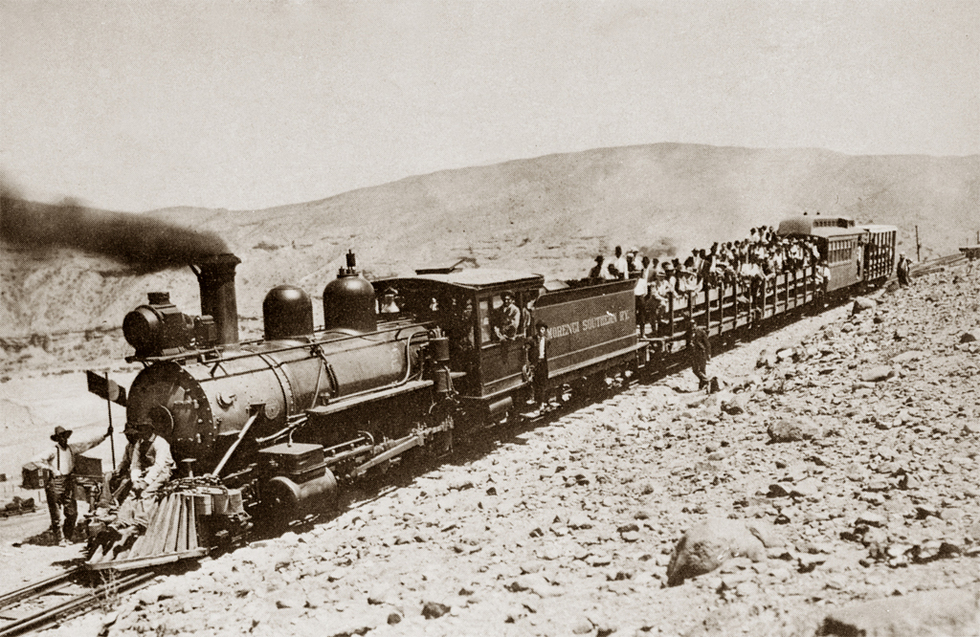
Engines number 12 and 13 were the second set of “Twins” bought by the TVNG. Appearances are deceptive however. Number 11 may look to be larger than engines 12 and 13, but it is not the case. Numbers 12 and 13 are in fact heavier and have more pulling power compared to #11. These two locomotives, like numbers 9 and 10, can often be seen hauling heavy freight trains up and down the winding grades of the TVNG's Right-Of-Way. In terms of appearances they are quite similar to the Morenci Southern's 2-8-0s. They have outside frames, but one difference is that the TVNG's have their counterweights on the wheel cranks rather than the wheels themselves. With their wooded cabs and pilots, capped stacks, smooth rounded domes, and box headlamps they are quite a sight to see when double heading and steaming up grade.
Locomotive No. 14:
Locomotive Number 14 was the final locomotive to be acquired by the TVRR and the third locomotive to be built after the turn of the century. Number 14 was also the largest locomotive and the only locomotive to be a 2-8-2. A unique characteristic of the locomotive was its large “Cabbage” stack, which really isn't necessary on a coal burning locomotive. And also, like #11, had inside frames which is also odd for its size. Number 14 was never seen operating with another locomotive. Its pulling power was more than enough to haul even the TVNG's heaviest trains. Mixed trains were very common on the TVNG and #14 headed a good number of them.
************************************************************
Well it certainly has been a while, hasn't it!?
So I'm still fiddling around with an On30 modeling project. It may have shifted a little since I last said anything online about it.
I still plan on modeling the Big Thunder Mountain RR in On30 in some way shape or form, but I also have envisioned a more realistic line that could connect to it. The "Thunder Valley Narrow Gauge".
Anyway, out of "boredome" I whipped up a roster of locomotives for the TVNG and decided to post it here for all of you to enjoy and perhaps derive inspiration for your own slim gauged modeling efforts. And here are some links so you can get a better visualization of the locomotives.
I hope you like and PLEASE leave comments!
***********************************************
#1. http://www.anticsonline.co.uk/l.aspx?k=2235663
#2. (no link yet)
#3. (Foreground Loco) http://steammachine.com/bdaneal/ima...../alco242ts.jpg
#4. (No Link Yet)
#5. http://www.museumsyndicate.com/images/5/49639.jpg
#6. http://on30center.com/on30/library/.....ckdate/bd1.jpg
#7.http://www.railmaster.co.nz/gallery/images%20Sn3/C16%20Zelkin2%20.jpg
#8. http://i305.photobucket.com/albums/.....rk2005/480.jpg
#9 & 10. http://www.model-junction.co.uk/0n3.....4modern440.jpg
#11. http://www.flickr.com/photos/captsp.....ng/4100122580/
#12 & 13. http://hikearizona.com/t2008/02/05/.....2199149-01.jpg
#14. http://www.google.com/imgres?q=Sumpter+Valley+%2316&hl=en&safe=active&gbv=2&tbm=isch&tbnid=nCbjpyAp4aW_DM:&imgrefurl=http://freepages.history.rootsweb.ancestry.com/~mydickfamily/locomotives_of_the_svrr.htm&docid=_PjFIFH3eqgThM&w=1558&h=1324&ei=9Q0zTojyMIy40AH9ooH1Cw&zoom=1&iact=hc&vpx=168&vpy=202&dur=460&hovh=207&hovw=244&tx=115&ty=122&page=2&tbnh=118&tbnw=143&start=19&ndsp=21&ved=1t:429,r:0,s:19&biw=1366&bih=557
Thunder Valley Narrow Gauge
(T.V.N.G.)
Road Number Class Builder
No. 1. 0-4-2T H.K. Porter
No. 2. 0-4-2T Baldwin
No. 3. 2-4-2T Baldwin
No. 4. 2-6-2T Baldwin
No. 5. 2-6-0 Brooks
No. 6. 2-6-0 Cooke
No. 7. 2-8-0 Brooks
No. 8. 4-8-0 Baldwin
No. 9. 4-4-0 Baldwin
No. 10. 4-4-0 Baldwin
No. 11. 2-8-0 Baldwin
No. 12. 2-8-0 Baldwin
No. 13. 2-8-0 Baldwin
No. 14. 2-8-2 Baldwin
Notes
Locomotive No. 1:
Locomotive #1 of the T.V.N.G. (Thunder Valley Narrow Gauge) was a small “8 Ton” 0-4-2T built by the H.K. Porter Co. in the mid 1890s. As was most of the locomotives on the Thunder Valley roster. The TVNG was a common carrier, however the primary reason for the railroad's existence were the countless copper mines scattered about Arizona's “Thunder Valley”. The diminutive locomotive hauled mixed trains consisting of both freight and passengers. Later in service the locomotive's service became limited to switching and inspections along the line due to it's small size and little tractive effort. That is compared to the larger locomotives the TVNG acquired throughout its operation.
Locomotive No. 2:
Locomotive #2 was the first “Large” locomotive acquisitioned by the TVNG. Like the #1 it was also an 0-4-2T and was a saddle tanker. However the locomotive was much larger and had a lot more strength. The locomotive had outside frames to help support a larger boiler. Also unlike the #1 the cab was fully enclosed and made of wood. The only locomotive to have a steel cab on the TVNG was #14, a Baldwin built 2-8-2.
Locomotive No. 3:
Locomotive #3 is another Baldwin product. A hefty 2-4-2T similar to the Magma Arizona RR's, but with outside frames rather than inside. It was easily twice as large as the #2 and the locomotive was limited to mostly freight service. Most often the locomotive could be seen hauling long strings of copper laden ore cars to the mills along the TVNG line. And on occasion the locomotive has been seen hauling short mixed trains.
Locomotive No. 4:
Locomotive #4 is a charming and perfectly proportioned 2-6-2T built by the Baldwin Locomotive Works in the late 1890s. She is similar in appearance to the Australia’s Victorian Railways' “NA” class 2-6-2Ts used on the Puffing Billy Railway. Albeit noticeably smaller. The Baldwin design for the locomotive was mostly for export locomotives, but the TVNG found the design suitable for short mixed trains and switching at the numerous mines and mills along the TVNG Right-Of-Way. Number 4, like engines #2 and 3, had outside frames. Although minus the external counterweights on the axle cranks. Its appearance was a mix of the new and old, She had a typical diamond stack for small coal burners and an 18in diameter oil burning headlamp. The locomotive also had a small wood road pilot reminiscent of the locomotives from the 1870s. However it did not have fluted domes, but round ones. And like the Victorian Railways' “NA” class had side tanks. Number 4 was the last tank engine acquired by the TVNG and was the only switcher to have side tanks.
Locomotive No. 5:
Engine number 5 was the first tender locomotive bought by the TVNG. It was a small 2-6-0 built by Brooks in the 1880s. It was acquired second hand, but the locomotive proved itself to be quite an asset for passenger service. It was not the fastest locomotive, perse, but it did prove to be reliable and versatile. It was one of the few locomotives to have a wagon top boiler and fluted domes.
Locomotive No. 6:
Locomotive number 6, like number 5, is also a 2-6-0 Mogul. But number 6 is larger and considerably stronger than #5. number six was built by Danforth Cooke in the mid 1880s and was bought second hand from an obscure Colorado road. Unfortunately the records for this locomotive have been lost to time due to a mysterious fire in the Ocalla, AZ library. Number 6, in terms of design and blue print, is identical to the Moguls built for the Denver South Park & Pacific RR. However shortly after arrival on the TVNG the locomotive received some aesthetic alterations after a wreck. Her Cooke style fluted domes were replaced by Baldwin style fluted domes and diamond stack like those used by Baldwin's “C-16” class locomotives, as dubbed by the D&RGW.
Locomotive No. 7:
Locomotive number 7 was the first 2-8-0 acquired by the TVNG. Number 7 was a Brooks product, but bared a striking resemblance to Baldwin's “C-16” locomotives. There only a few subtle differences that showed them apart. Mostly in the style and shape of the smoke stack and domes. The steam dome was taller than that on the Baldwin version and the smoke stack had more of a diamond shape, where as the Baldwin version's stack had a broader top. Number 7 was also a product produced in the 1880s and served well on a number of Arizona roads before falling into the hands of the TVNG. The engine was also considered “Lucky” after having a number of extremely close calls from freak accidents. On one occasion the locomotive was idling on a siding by one of the mining complexes and a misplaced dynamite charge caused a severe landslide. Strangely enough, aside from a thin layer of dust, the locomotive was unharmed. Unfortunately the same can't be said for it's consist. This was not the only event that gave the locomotive its reputation for being “lucky”. And so its crews have dubbed it “Lucky #7”.
Locomotive No. 8:
Number 8 was the only locomotive of its type to operate on the TVNG, let alone Arizona itself! It was a 4-8-0 “Mastodon” class locomotive with a wagon top boiler and rounded domes. Number 8 almost always hauled mixed trains consisting of mostly passenger and mail service, with a boxcar or some other freight car to deliver local goods. It had a bit more strength compared to #7, although it couldn't take as sharp a curve due to the slightly longer wheel base. So its service was mostly limited to that along the main line.
Locomotives No. 9 & 10:
Numbers 9 and 10 were the first Baldwin built 4-4-0 types to be bought by the TVNG. They were unusual due to their outside frame arraignment. The Baldwin design the were derived from from was mostly for that of an export locomotive popular in Mexico and Central America. Aside from the TVNG's early locomotives these engines were bought new from the builder and all locomotives following. They featured wooden cabs and smooth rounded domes. Tall “Capped” style smoke stacks and large “Box” style headlights and wooden road pilots. These locomotives were almost always limited to freight service and it wasn't uncommon to see them double heading a heavy freight while traversing the steep and winding grades of the TVNG Right-Of-Way.
Locomotive No. 11:
Number 11 was once the largest locomotive on the TVNG's roster. That is until another set of “twins” was bought, engines 12 and 13. Number 11 was primarily a freight hauler, but on occasion, like most of the other locomotives on the TVNG, hauled mixed trains. Most often when #11 hauled a mixed the consist would mostly be freight, but with a coach and a combine trailing at the rear. One unusual aspect of #11 was that for a locomotive of its size it had inside frames as apposed to outside frames. The locomotive also featured external Walcherts valve gear rather than Stephenson valve gear.
Locomotives No. 12 & 13:
Engines number 12 and 13 were the second set of “Twins” bought by the TVNG. Appearances are deceptive however. Number 11 may look to be larger than engines 12 and 13, but it is not the case. Numbers 12 and 13 are in fact heavier and have more pulling power compared to #11. These two locomotives, like numbers 9 and 10, can often be seen hauling heavy freight trains up and down the winding grades of the TVNG's Right-Of-Way. In terms of appearances they are quite similar to the Morenci Southern's 2-8-0s. They have outside frames, but one difference is that the TVNG's have their counterweights on the wheel cranks rather than the wheels themselves. With their wooded cabs and pilots, capped stacks, smooth rounded domes, and box headlamps they are quite a sight to see when double heading and steaming up grade.
Locomotive No. 14:
Locomotive Number 14 was the final locomotive to be acquired by the TVRR and the third locomotive to be built after the turn of the century. Number 14 was also the largest locomotive and the only locomotive to be a 2-8-2. A unique characteristic of the locomotive was its large “Cabbage” stack, which really isn't necessary on a coal burning locomotive. And also, like #11, had inside frames which is also odd for its size. Number 14 was never seen operating with another locomotive. Its pulling power was more than enough to haul even the TVNG's heaviest trains. Mixed trains were very common on the TVNG and #14 headed a good number of them.
************************************************************
Well it certainly has been a while, hasn't it!?
So I'm still fiddling around with an On30 modeling project. It may have shifted a little since I last said anything online about it.
I still plan on modeling the Big Thunder Mountain RR in On30 in some way shape or form, but I also have envisioned a more realistic line that could connect to it. The "Thunder Valley Narrow Gauge".
Anyway, out of "boredome" I whipped up a roster of locomotives for the TVNG and decided to post it here for all of you to enjoy and perhaps derive inspiration for your own slim gauged modeling efforts. And here are some links so you can get a better visualization of the locomotives.
I hope you like and PLEASE leave comments!
***********************************************
#1. http://www.anticsonline.co.uk/l.aspx?k=2235663
#2. (no link yet)
#3. (Foreground Loco) http://steammachine.com/bdaneal/ima...../alco242ts.jpg
#4. (No Link Yet)
#5. http://www.museumsyndicate.com/images/5/49639.jpg
#6. http://on30center.com/on30/library/.....ckdate/bd1.jpg
#7.http://www.railmaster.co.nz/gallery/images%20Sn3/C16%20Zelkin2%20.jpg
#8. http://i305.photobucket.com/albums/.....rk2005/480.jpg
#9 & 10. http://www.model-junction.co.uk/0n3.....4modern440.jpg
#11. http://www.flickr.com/photos/captsp.....ng/4100122580/
#12 & 13. http://hikearizona.com/t2008/02/05/.....2199149-01.jpg
#14. http://www.google.com/imgres?q=Sumpter+Valley+%2316&hl=en&safe=active&gbv=2&tbm=isch&tbnid=nCbjpyAp4aW_DM:&imgrefurl=http://freepages.history.rootsweb.ancestry.com/~mydickfamily/locomotives_of_the_svrr.htm&docid=_PjFIFH3eqgThM&w=1558&h=1324&ei=9Q0zTojyMIy40AH9ooH1Cw&zoom=1&iact=hc&vpx=168&vpy=202&dur=460&hovh=207&hovw=244&tx=115&ty=122&page=2&tbnh=118&tbnw=143&start=19&ndsp=21&ved=1t:429,r:0,s:19&biw=1366&bih=557
Category Story / Miscellaneous
Species Unspecified / Any
Size 50 x 50px
File Size 30.5 kB





Comments