
 FA+
FA+ Shop
Shop
64
Views
Views
2
Favorites
Favorites
Category
Artwork (Traditional) / Abstract
Species Unspecified / Any
Size 2252 x 1636
File Size 733.5 kB
Report this content
More from Onnoem



Listed in Folders


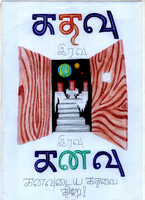
'The eye of the day and the two suns of my head'
In a lot of Austronesian languages the word for 'sun' means literally 'the eye of the day', like Indonesian mata-hari, Malagasy maso-andro or Fijian mata-ni-siga;
From the other side, interestingly, the modern Irish Gaelic word for 'eye' (súil) is etymologized by some scientists to derive from the phrase 'two suns', ultimately from proto-Indoeuropean, thus related to 'sol, solar' etc.
So the sun is 'eye of the day' but also our eyes are 'two suns' :3. Let's hope it's an eye of a watchful benevolent being and not of a cruel demiurg, even though I rather severely doubt this first possibility;
So I envisioned an eye in the middle of an opening gate, since I like the Georgian word ცისკარი (cisk'ari) which while denoting 'sunrise' means literally 'the doors of the sky';
And finally, the meaning of 'to see' and 'to have seen/know' are often intrinsically related to each other in many languages, like proto-Indoeuropean *weyd which gave ancient Greek οίδα "I know/have seen" είδον "I/they saw", Polish doublets 'wiedzieć' and 'widzieć' with the same meanings etc... I've also noticed that in Chontal of Oaxaca 'ca-shina' means 'I see' and 'ai-shina' 'I've seen/I know' so I guess this correlation is very popular cross-linguistically :3
From the other side, interestingly, the modern Irish Gaelic word for 'eye' (súil) is etymologized by some scientists to derive from the phrase 'two suns', ultimately from proto-Indoeuropean, thus related to 'sol, solar' etc.
So the sun is 'eye of the day' but also our eyes are 'two suns' :3. Let's hope it's an eye of a watchful benevolent being and not of a cruel demiurg, even though I rather severely doubt this first possibility;
So I envisioned an eye in the middle of an opening gate, since I like the Georgian word ცისკარი (cisk'ari) which while denoting 'sunrise' means literally 'the doors of the sky';
And finally, the meaning of 'to see' and 'to have seen/know' are often intrinsically related to each other in many languages, like proto-Indoeuropean *weyd which gave ancient Greek οίδα "I know/have seen" είδον "I/they saw", Polish doublets 'wiedzieć' and 'widzieć' with the same meanings etc... I've also noticed that in Chontal of Oaxaca 'ca-shina' means 'I see' and 'ai-shina' 'I've seen/I know' so I guess this correlation is very popular cross-linguistically :3
Category Artwork (Traditional) / Abstract
Species Unspecified / Any
Size 2252 x 1636px
File Size 733.5 kB

Comments