
 FA+
FA+ Shop
Shop
464
Views
Views
18
Favorites
Favorites
Category
Artwork (Digital) / Animal related (non-anthro)
Species Thylacine
Size 1288 x 876
File Size 1.33 MB
Report this content
★
More from trinket_collector


Listed in Folders


In memory of Thylacine (Collaboration With ShangXian)
This is a Post in Collaboration with  shangxian
Base drawing of Thylacine and description by ShangXian
Rendering and background by me!
Visit their profile for many pictures of beautiful birds, beautiful drawings and Interesting facts about the animal kingdom!
The thylacine was the carnivorous marsupial native to the Australian mainland and the islands of Tasmania and New
Guinea, that sadly went extinct in the 1930s. More precisely the last known of its species died in 1936 at Hobart Zoo in
Tasmania. Other names of this species were Tasmanian tiger or Tasmanian wolf, but it was not a felid neither a canid. It
was called “tiger” because of the dark transverse stripes that radiated from the top of its back, and “wolf” because it
resembled a medium- to large-sized canid. Sharp teeth, powerful jaws, raised heels, and the same general body form
typical of canid species is an example of convergent evolution. The name thylacine is derived from thýlakos meaning
"pouch" and ine meaning "pertaining to", and refers to the marsupial pouch. Both sexes had a pouch. The females used
theirs for rearing young, and the males used theirs as a protective sheath, covering the external reproductive organs. Its
closest living relatives are the other members of Dasyuromorphia including the Tasmanian devil, from which it is
estimated to have split 42–36 million years ago.
There is evidence for at least some year-round breeding (cull records show joeys discovered in the pouch at all times of
the year), although the peak breeding season was in winter and spring. They would produce up to four joeys per litter
(typically two or three), carrying the young in a pouch for up to three months and protecting them until they were at
least half adult size. Early pouch young were hairless and blind, but they had their eyes open and were fully furred by
the time they left the pouch. The young also had their own pouches that are not visible until they are 9.5 weeks old.
After leaving the pouch, and until they were developed enough to assist, the juveniles would remain in the lair while
their mother hunted. The mature thylacine measured about 60cm in shoulder height and 1–1.3 m in body length,
excluding the tail which measured around 50 to 65 cm. They may have weighed anywhere from 15 to 35 kg, usually
their average body mass would be 16.7 kg. Males were larger than females on average. Early scientific studies
suggested it possessed an acute sense of smell which enabled it to track prey, but analysis of its brain structure revealed
that its olfactory bulbs were not well developed. It is likely to have relied on sight and sound when hunting instead, and
when hunting, the thylacine relied on stamina rather than speed in the chase.
Like I said the animal was present in Australia too and this is proved by the numerous thylacine engravings and rock art
that have been found, dating back to at least 1000 BC. These petroglyphs can be found at the Dampier Rock Art
Precinct, on the Burrup Peninsula in Western Australia; I leave you here a link of some their images:
https://www.researchgate.net/figure.....rson-Valley-a-
Haul-Rd_fig5_264723277
I find extremely interesting and even adorable that indigenous Australians may have tried to prevent the extinction of
the thylacine with ritual practices, says a rock art specialist. Ken Mulvaney, president of the Australian Rock Art
Research Association, based his theory on recently located engravings in the Pilbara region of northwest Australia.
"There are roughly 20 that we know of but no detailed survey has ever been conducted of the entire Burrup," he said,
adding that only around six of these had been previously documented. He said that while the motifs were relatively rare,
they were more common than snakes and goannas in the rock art of the region. Mulvaney said the engravings would be
older than 3000 years old, based on the idea that the thylacine became extinct on the Australian mainland, possibly due
to the arrival of the dingo around that time(1). One particular thylacine engraving, located in the past few months, had
unique features. It had pounded pits inside the outline of its body and scored lines radiating out from it and across
numerous boulders. This special engraving was surrounded by 22 engravings of an ancient species of fat-tailed
kangaroo, that Mulvaney said appeared to have gone extinct around the same time as the thylacine. "I would argue that
they are trying to connect the thylacine with its prey," he said. This association of dominant predator and prey, along
with similarities observed with current day ritual practices, suggested to Mulvaney that the special engraving could have
formed part of Aboriginal rituals to protect species. So Aboriginal Australians were aware of, and concerned about, the
thylacine’s dwindling numbers around that time.
But the animal went extinct in Tasmania island too and it was a short step from misnaming and maligning the native
wildlife to seeking its replacement with introduced varieties. The heaviest distributions of thylacines were in the
northeast, northwest and north-midland regions of the state, there were an estimated 5,000 at that time. They were rarely
sighted during this time but slowly began to be credited with numerous attacks on sheep. Let's remember that it was a
nocturnal and crepuscular hunter, spending the daylight hours in small caves or hollow tree trunks in a nest of twigs,
bark, or fern fronds. It tended to retreat to the hills and forest for shelter during the day and hunted in the open heath at
night. Early observers noted that the animal was typically shy and secretive, with awareness of the presence of
humans and generally avoiding contact, though it occasionally showed inquisitive traits.
Historical accounts suggest than in the wild, the thylacine preyed on small mammals and birds, with waterbirds being
the most commonly recorded bird prey, with historical accounts of thylacines predating on black ducks and teals with
coots, Tasmanian nativehens, swamphens, herons and black swans also being likely items of prey. The thylacine may
also have preyed upon the now extinct Tasmanian emu. The most commonly recorded mammalian prey was: the red-
necked wallaby, the Tasmanian pademelon and the short-beaked echidna. Other probable mammalian prey includes
other marsupials like bandicoots and brushtail possums, as well as native rodents like water rats.
But let's get back to what humans did to this creature in Tasmania. As I said the species started to be perceived as a
threat to poulty by farmers. However, analysis by Robert Paddle suggests that there is little real evidence of thylacines
preying on sheep or domestic poultry. Throughout the 20th century, the thylacine was often characterised as primarily a
blood drinker; according to Robert Paddle, the story's popularity seems to have originated from a single second-hand
account heard by Geoffrey Smith (1881–1916) in a shepherd's hut. This led to the establishment of bounty schemes in
an attempt to control their numbers. The Van Diemen's Land Company introduced bounties on the thylacine from as
early as 1830, and between 1888 and 1909 the Tasmanian government paid £1 per head for dead adult thylacines and ten
shillings for pups. In all, they paid out 2,184 bounties, but it is thought that many more thylacines were killed than were
claimed for. Its extinction is popularly attributed to these relentless efforts by farmers and bounty hunters. Not only this
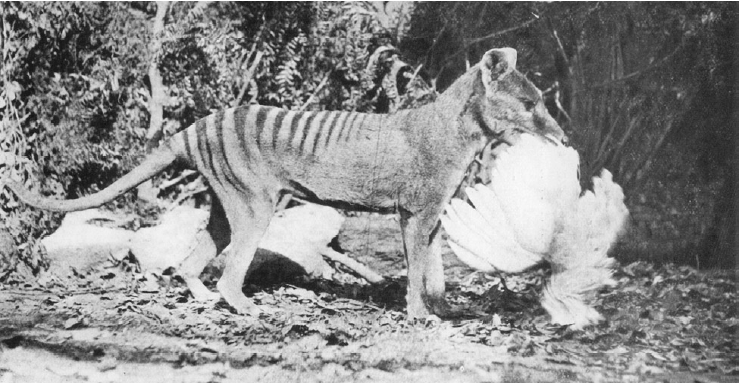
but a fake news campain started in order to justify the killing of this beautiful animal, look at this photo by Henry
Burrel: https://upload.wikimedia.org/wikipe.....ne-chicken.png
It may prove its bloodthirsty nature for blood and poulty, it was widely distributed and may have helped secure the
animal's reputation as a poultry thief. BUT the image had been cropped to hide the fact that the animal was in
captivity, and analysis by one researcher has concluded that this thylacine was a dead specimen, posed for the
camera. The photograph may even have involved photo manipulation. A fine example of how fake news can kill...If you
want to exlore more about this photo, here a link:
https://web.archive.org/web/2012090....._picture_worth
Other factors of thylacine's extinction in Tasmania were competition with wild dogs introduced by European settlers,
erosion of its habitat, already-low genetic diversity, the concurrent extinction or decline of prey species, and a
distemper-like disease that affected many captive specimens at the time
The thylacine was big and an apex predator but even more impressive than this role as an apex carnivore is where the
species sits in the evolutionary pantheon. “The thylacine was the last member of its own family,” Helgen (Australian
Museum Chief Scientist, a mammalogist and National Geographic Explorer) said. “That’s profound when you think
about a mammalian family—bears are a family, giraffes are a family, horses are a family, dolphins are a family. Within
Australia there’s only a handful of these families: kangaroos, sugar gliders, ringtail possums, all the other marsupial
carnivores. The thylacine wasn’t part of any of these groups. The last wild specimen was shot in 1930 in rural northwest
Tasmania while the last captive specimen died in 1936 just two months prior to that animal’s death, Tasmania’s
government had finally seen fit to declare the thylacine a protected species—or as thylacine researcher Robert Paddle
put it, “The species was totally protected for the last 59 days of its existence.”
I want to conclude this long description with something more relaxed about its cultural significance among Aboriginal
people.Various Aboriginal Tasmanian names for the thylacine have been recorded, such as coorinna, kanunnah, cab-
berr-one-nen-er, loarinna, laoonana, can-nen-ner and lagunta, while kaparunina is used in Palawa kani. One Nuenonne
myth tells of a thylacine pup saving Palana, a spirit boy, from an attack by a giant kangaroo. Palana marked the pup's
back with ochre as a mark of its bravery, giving thylacines their stripes. A constellation, "Wurrawana Corinna"
(identified as within or near Gemini), was also created as a commemoration of this mythic act of bravery. An early
European record tells how Aboriginals believed bad weather was caused by a Thylacine carcass being left exposed on
the ground, instead of being covered by a small shelter.
As last thing I leave here an article about the possibility that resurrecting this apex predator may help to recover the
environment too, in a similar way it happened when wolves were introduced to Yellowstone Park in which vegetation
recovered from heavy herbivore's pressure (I know the comparison may be a bit forced but as analogy it reminded me of
this): https://www.nationalgeographic.com/.....er-get-a-boost
(1) Causes of extinction in mainland Australia are more complex. Dingo may have led to the extinction of the thylacine
in mainland Australia because the dingo outcompeted the thylacine in preying on the Tasmanian nativehen. Dingo's
skull despite having a weaker bite force, can resist greater stresses, allowing it to pull down larger prey than the
thylacine and is more versatile in terms of food items than the hypercarnivorous diet of the thylacine. Aside from wild
dingoes, the adoption of the dingo as a hunting companion by the indigenous peoples would have put the thylacine
under increased pressure. But a 2014 study suggested that, while dingoes were a contributing factor to the thylacine's
demise on the mainland, larger factors were the intense human population growth, technological advances and the
abrupt change in the climate during the period.
This is the study in case you are interested:
https://doi.org/10.1890%2F13-0746.1
Fun fact: on 7 September, the date on which the last known thylacine died in 1936, National Threatened Species Day is
commemorated in Australia.
Fun fact 2: the Aboriginal name of Tasmania island is Lutruwita.
Fun fact 3: life expectancy in the wild is estimated to have been 5 to 7 years, although captive specimens survived up to
9 years.
Not so fun fact: Europeans pinned various names to the animal—zebra opossum, marsupial wolf, Australian magpie,
Tasmanian dingo—out of colonial prejudice as much as ignorance. Northern Hemisphere mammals were considered
superior in every way to Australian marsupials that early observers deemed “helpless, deformed and monstrous works of
nature.” Today’s much loved koala was derided as “uncouth ... awkward and unwieldy,” and the thylacine, the world’s
largest marsupial predator to survive into modern times, was dismissed as a primitive scavenger, “brutish” and “stupid.”
shangxian Base drawing of Thylacine and description by ShangXian
Rendering and background by me!
Visit their profile for many pictures of beautiful birds, beautiful drawings and Interesting facts about the animal kingdom!
The thylacine was the carnivorous marsupial native to the Australian mainland and the islands of Tasmania and New
Guinea, that sadly went extinct in the 1930s. More precisely the last known of its species died in 1936 at Hobart Zoo in
Tasmania. Other names of this species were Tasmanian tiger or Tasmanian wolf, but it was not a felid neither a canid. It
was called “tiger” because of the dark transverse stripes that radiated from the top of its back, and “wolf” because it
resembled a medium- to large-sized canid. Sharp teeth, powerful jaws, raised heels, and the same general body form
typical of canid species is an example of convergent evolution. The name thylacine is derived from thýlakos meaning
"pouch" and ine meaning "pertaining to", and refers to the marsupial pouch. Both sexes had a pouch. The females used
theirs for rearing young, and the males used theirs as a protective sheath, covering the external reproductive organs. Its
closest living relatives are the other members of Dasyuromorphia including the Tasmanian devil, from which it is
estimated to have split 42–36 million years ago.
There is evidence for at least some year-round breeding (cull records show joeys discovered in the pouch at all times of
the year), although the peak breeding season was in winter and spring. They would produce up to four joeys per litter
(typically two or three), carrying the young in a pouch for up to three months and protecting them until they were at
least half adult size. Early pouch young were hairless and blind, but they had their eyes open and were fully furred by
the time they left the pouch. The young also had their own pouches that are not visible until they are 9.5 weeks old.
After leaving the pouch, and until they were developed enough to assist, the juveniles would remain in the lair while
their mother hunted. The mature thylacine measured about 60cm in shoulder height and 1–1.3 m in body length,
excluding the tail which measured around 50 to 65 cm. They may have weighed anywhere from 15 to 35 kg, usually
their average body mass would be 16.7 kg. Males were larger than females on average. Early scientific studies
suggested it possessed an acute sense of smell which enabled it to track prey, but analysis of its brain structure revealed
that its olfactory bulbs were not well developed. It is likely to have relied on sight and sound when hunting instead, and
when hunting, the thylacine relied on stamina rather than speed in the chase.
Like I said the animal was present in Australia too and this is proved by the numerous thylacine engravings and rock art
that have been found, dating back to at least 1000 BC. These petroglyphs can be found at the Dampier Rock Art
Precinct, on the Burrup Peninsula in Western Australia; I leave you here a link of some their images:
https://www.researchgate.net/figure.....rson-Valley-a-
Haul-Rd_fig5_264723277
I find extremely interesting and even adorable that indigenous Australians may have tried to prevent the extinction of
the thylacine with ritual practices, says a rock art specialist. Ken Mulvaney, president of the Australian Rock Art
Research Association, based his theory on recently located engravings in the Pilbara region of northwest Australia.
"There are roughly 20 that we know of but no detailed survey has ever been conducted of the entire Burrup," he said,
adding that only around six of these had been previously documented. He said that while the motifs were relatively rare,
they were more common than snakes and goannas in the rock art of the region. Mulvaney said the engravings would be
older than 3000 years old, based on the idea that the thylacine became extinct on the Australian mainland, possibly due
to the arrival of the dingo around that time(1). One particular thylacine engraving, located in the past few months, had
unique features. It had pounded pits inside the outline of its body and scored lines radiating out from it and across
numerous boulders. This special engraving was surrounded by 22 engravings of an ancient species of fat-tailed
kangaroo, that Mulvaney said appeared to have gone extinct around the same time as the thylacine. "I would argue that
they are trying to connect the thylacine with its prey," he said. This association of dominant predator and prey, along
with similarities observed with current day ritual practices, suggested to Mulvaney that the special engraving could have
formed part of Aboriginal rituals to protect species. So Aboriginal Australians were aware of, and concerned about, the
thylacine’s dwindling numbers around that time.
But the animal went extinct in Tasmania island too and it was a short step from misnaming and maligning the native
wildlife to seeking its replacement with introduced varieties. The heaviest distributions of thylacines were in the
northeast, northwest and north-midland regions of the state, there were an estimated 5,000 at that time. They were rarely
sighted during this time but slowly began to be credited with numerous attacks on sheep. Let's remember that it was a
nocturnal and crepuscular hunter, spending the daylight hours in small caves or hollow tree trunks in a nest of twigs,
bark, or fern fronds. It tended to retreat to the hills and forest for shelter during the day and hunted in the open heath at
night. Early observers noted that the animal was typically shy and secretive, with awareness of the presence of
humans and generally avoiding contact, though it occasionally showed inquisitive traits.
Historical accounts suggest than in the wild, the thylacine preyed on small mammals and birds, with waterbirds being
the most commonly recorded bird prey, with historical accounts of thylacines predating on black ducks and teals with
coots, Tasmanian nativehens, swamphens, herons and black swans also being likely items of prey. The thylacine may
also have preyed upon the now extinct Tasmanian emu. The most commonly recorded mammalian prey was: the red-
necked wallaby, the Tasmanian pademelon and the short-beaked echidna. Other probable mammalian prey includes
other marsupials like bandicoots and brushtail possums, as well as native rodents like water rats.
But let's get back to what humans did to this creature in Tasmania. As I said the species started to be perceived as a
threat to poulty by farmers. However, analysis by Robert Paddle suggests that there is little real evidence of thylacines
preying on sheep or domestic poultry. Throughout the 20th century, the thylacine was often characterised as primarily a
blood drinker; according to Robert Paddle, the story's popularity seems to have originated from a single second-hand
account heard by Geoffrey Smith (1881–1916) in a shepherd's hut. This led to the establishment of bounty schemes in
an attempt to control their numbers. The Van Diemen's Land Company introduced bounties on the thylacine from as
early as 1830, and between 1888 and 1909 the Tasmanian government paid £1 per head for dead adult thylacines and ten
shillings for pups. In all, they paid out 2,184 bounties, but it is thought that many more thylacines were killed than were
claimed for. Its extinction is popularly attributed to these relentless efforts by farmers and bounty hunters. Not only this
but a fake news campain started in order to justify the killing of this beautiful animal, look at this photo by Henry
Burrel: https://upload.wikimedia.org/wikipe.....ne-chicken.png
It may prove its bloodthirsty nature for blood and poulty, it was widely distributed and may have helped secure the
animal's reputation as a poultry thief. BUT the image had been cropped to hide the fact that the animal was in
captivity, and analysis by one researcher has concluded that this thylacine was a dead specimen, posed for the
camera. The photograph may even have involved photo manipulation. A fine example of how fake news can kill...If you
want to exlore more about this photo, here a link:
https://web.archive.org/web/2012090....._picture_worth
Other factors of thylacine's extinction in Tasmania were competition with wild dogs introduced by European settlers,
erosion of its habitat, already-low genetic diversity, the concurrent extinction or decline of prey species, and a
distemper-like disease that affected many captive specimens at the time
The thylacine was big and an apex predator but even more impressive than this role as an apex carnivore is where the
species sits in the evolutionary pantheon. “The thylacine was the last member of its own family,” Helgen (Australian
Museum Chief Scientist, a mammalogist and National Geographic Explorer) said. “That’s profound when you think
about a mammalian family—bears are a family, giraffes are a family, horses are a family, dolphins are a family. Within
Australia there’s only a handful of these families: kangaroos, sugar gliders, ringtail possums, all the other marsupial
carnivores. The thylacine wasn’t part of any of these groups. The last wild specimen was shot in 1930 in rural northwest
Tasmania while the last captive specimen died in 1936 just two months prior to that animal’s death, Tasmania’s
government had finally seen fit to declare the thylacine a protected species—or as thylacine researcher Robert Paddle
put it, “The species was totally protected for the last 59 days of its existence.”
I want to conclude this long description with something more relaxed about its cultural significance among Aboriginal
people.Various Aboriginal Tasmanian names for the thylacine have been recorded, such as coorinna, kanunnah, cab-
berr-one-nen-er, loarinna, laoonana, can-nen-ner and lagunta, while kaparunina is used in Palawa kani. One Nuenonne
myth tells of a thylacine pup saving Palana, a spirit boy, from an attack by a giant kangaroo. Palana marked the pup's
back with ochre as a mark of its bravery, giving thylacines their stripes. A constellation, "Wurrawana Corinna"
(identified as within or near Gemini), was also created as a commemoration of this mythic act of bravery. An early
European record tells how Aboriginals believed bad weather was caused by a Thylacine carcass being left exposed on
the ground, instead of being covered by a small shelter.
As last thing I leave here an article about the possibility that resurrecting this apex predator may help to recover the
environment too, in a similar way it happened when wolves were introduced to Yellowstone Park in which vegetation
recovered from heavy herbivore's pressure (I know the comparison may be a bit forced but as analogy it reminded me of
this): https://www.nationalgeographic.com/.....er-get-a-boost
(1) Causes of extinction in mainland Australia are more complex. Dingo may have led to the extinction of the thylacine
in mainland Australia because the dingo outcompeted the thylacine in preying on the Tasmanian nativehen. Dingo's
skull despite having a weaker bite force, can resist greater stresses, allowing it to pull down larger prey than the
thylacine and is more versatile in terms of food items than the hypercarnivorous diet of the thylacine. Aside from wild
dingoes, the adoption of the dingo as a hunting companion by the indigenous peoples would have put the thylacine
under increased pressure. But a 2014 study suggested that, while dingoes were a contributing factor to the thylacine's
demise on the mainland, larger factors were the intense human population growth, technological advances and the
abrupt change in the climate during the period.
This is the study in case you are interested:
https://doi.org/10.1890%2F13-0746.1
Fun fact: on 7 September, the date on which the last known thylacine died in 1936, National Threatened Species Day is
commemorated in Australia.
Fun fact 2: the Aboriginal name of Tasmania island is Lutruwita.
Fun fact 3: life expectancy in the wild is estimated to have been 5 to 7 years, although captive specimens survived up to
9 years.
Not so fun fact: Europeans pinned various names to the animal—zebra opossum, marsupial wolf, Australian magpie,
Tasmanian dingo—out of colonial prejudice as much as ignorance. Northern Hemisphere mammals were considered
superior in every way to Australian marsupials that early observers deemed “helpless, deformed and monstrous works of
nature.” Today’s much loved koala was derided as “uncouth ... awkward and unwieldy,” and the thylacine, the world’s
largest marsupial predator to survive into modern times, was dismissed as a primitive scavenger, “brutish” and “stupid.”
Category Artwork (Digital) / Animal related (non-anthro)
Species Thylacine
Size 1288 x 876px
File Size 1.33 MB

Comments