
 FA+
FA+ Shop
Shop
262
Views
Views
3
Favorites
Favorites
Category
All / All
Species Unspecified / Any
Size 1280 x 930
File Size 621 kB
Report this content
★
More from LarkspurDragon


Listed in Folders

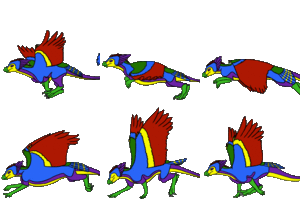
It's a runner; can you tell?
When hunting, the creature runs using only its front and hind legs, like our earth cheetah. It keeps the medial legs tucked up to its sides, and extends them to catch the prey when it gets close enough. The retractable claws extend to grab the prey, and a quick slash from the pre-nasal beak injects a potent venom which quickly paralyzes the prey, letting the hunter eat in peace.
When walking, it walks with all six legs. The gait is quite comical, especially in juveniles, which have not yet mastered control of their limbs and often step on their medial feet by accident.
This is not a precursor to modern dragons. Instead, it evolved alongside dragons, and came from the same six-legged ancestor. It is considered a dragon by some biologists.
There is a breeding program afoot as an attempt to save the species, and my own kennels are full. This is a closed species, as it is endangered in the wild, and there are only 84 known individual Tilarraa in captivity. I need to expand the breeding program to other handlers. Are you up to the task?
Because of the scarcity of the species, it is best to spread them out among the handlers, so I'm allowing only one Tilarraa per person for the time being. You are allowed to breed your Tilarraa with another handler's, as long as you consult me first, and you do not need to worry about whether you have a male or a female, as this is a hermaphroditic species.
When hunting, the creature runs using only its front and hind legs, like our earth cheetah. It keeps the medial legs tucked up to its sides, and extends them to catch the prey when it gets close enough. The retractable claws extend to grab the prey, and a quick slash from the pre-nasal beak injects a potent venom which quickly paralyzes the prey, letting the hunter eat in peace.
When walking, it walks with all six legs. The gait is quite comical, especially in juveniles, which have not yet mastered control of their limbs and often step on their medial feet by accident.
This is not a precursor to modern dragons. Instead, it evolved alongside dragons, and came from the same six-legged ancestor. It is considered a dragon by some biologists.
There is a breeding program afoot as an attempt to save the species, and my own kennels are full. This is a closed species, as it is endangered in the wild, and there are only 84 known individual Tilarraa in captivity. I need to expand the breeding program to other handlers. Are you up to the task?
Because of the scarcity of the species, it is best to spread them out among the handlers, so I'm allowing only one Tilarraa per person for the time being. You are allowed to breed your Tilarraa with another handler's, as long as you consult me first, and you do not need to worry about whether you have a male or a female, as this is a hermaphroditic species.
Category All / All
Species Unspecified / Any
Size 1280 x 930px
File Size 621 kB

Comments