
 FA+
FA+ Shop
Shop
377
Views
Views
19
Favorites
Favorites
Category
Artwork (Traditional) / General Furry Art
Species Vulpine (Other)
Size 575 x 575
File Size 216.8 kB
Report this content
More from sasta


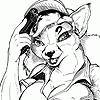
A couple of foxes.
It isn't meant to be a macro pic. It's two doodles I was paying around with which I put on the same page, one was a lot smaller than the other. I suppose it could be, in which case the little one is regular height.
It isn't meant to be a macro pic. It's two doodles I was paying around with which I put on the same page, one was a lot smaller than the other. I suppose it could be, in which case the little one is regular height.
Category Artwork (Traditional) / General Furry Art
Species Vulpine (Other)
Size 575 x 575px
File Size 216.8 kB


Foxes! These both look very cool, and they do look very distinct to me - enough so that they 'feel' right at the sizes they are (and yeah, it feels very much normal-and-large to me, too). I really like the fairly nonchalant expression that the black-and-white one is wearing: just standing around, drinking a soda, swishing a tail longer than she is tall... The other one has a vaguely annoyed feel about her, and something in the mouth (maybe the lips and especially the cleft?) feels awkward, but I really like the color of the hair and of course I'm a big fan of the Chie Harada glasses. Cool stuff all around, and of course, thank you for sharing!

Cran D'Arche, Staedtler and Derwent water-soluble colouring pencils.
They're like regular pencil crayons (sorry, colouring pencils) but are essentially watercolour paint in pencil form. Used on wet paper, or with water and a brush after they're laid down, turns them into a wash. There's a version of Derwent Graphite pencils that behave in a similar way, and I used them a bit with this as well.
Finally, some india ink with a brush. The B&W fox is all ink, and a few lines on the colour fox were as well.
They're like regular pencil crayons (sorry, colouring pencils) but are essentially watercolour paint in pencil form. Used on wet paper, or with water and a brush after they're laid down, turns them into a wash. There's a version of Derwent Graphite pencils that behave in a similar way, and I used them a bit with this as well.
Finally, some india ink with a brush. The B&W fox is all ink, and a few lines on the colour fox were as well.

Oh, I see a texture only wet mediums could produce. I kind of thought they were marker. Those must be expensive.
Can you further explain what you meant by how you got the wet paper effect? Are you saying you colored it then used a wet brush over it?
I really love how soft the texture is yet how strong the colors look.
Can you further explain what you meant by how you got the wet paper effect? Are you saying you colored it then used a wet brush over it?
I really love how soft the texture is yet how strong the colors look.
Well, there are two ways to do it.
One method is to actually use wet paper. Basically, a board, several sheets of newspaper to extend the time it will stay wet. There are certain types of watercolour paper that are meant to be soaked, then it is stretched and stapled down. At that point, using the colouring pencils will make them bleed and spread.
The other method is to just colour, then using a wet brush paint and blend. It has a tendency to warp the paper a little bit, again, unless one is using the right kind of paper.
They're not hugely expensive.
One method is to actually use wet paper. Basically, a board, several sheets of newspaper to extend the time it will stay wet. There are certain types of watercolour paper that are meant to be soaked, then it is stretched and stapled down. At that point, using the colouring pencils will make them bleed and spread.
The other method is to just colour, then using a wet brush paint and blend. It has a tendency to warp the paper a little bit, again, unless one is using the right kind of paper.
They're not hugely expensive.
The using wet paper method sounds like a lot and seems that it would require precise actions. Do you really mean soaking the paper? Submerging it in water and later stretching it?
I like the second way you mentioned. It's actually how I pictured it when you first mentioned wetting it. I hear what you're saying about warping the paper a bit. I guess it can't go without consequence since the properties are being altered a bit. I think I have some papers in mind that could manage better with water. I don't have it but I understand.
I like the second way you mentioned. It's actually how I pictured it when you first mentioned wetting it. I hear what you're saying about warping the paper a bit. I guess it can't go without consequence since the properties are being altered a bit. I think I have some papers in mind that could manage better with water. I don't have it but I understand.
Yes, soaking and stretching it, working on it while it's wet. Re-wetting it if it gets too dry. It's more a technique for using actual watercolour paints, but the watercolour colouring pencils work well that way as well.
Watercolour paper itself usually is something like 150lb. It tends to be more expensive and distinctive than random sketchbook.
Watercolour paper itself usually is something like 150lb. It tends to be more expensive and distinctive than random sketchbook.
I have to get some watercolor pencils. They seem cool. I wonder if there's something I can do with my dry color pencils to get a similar effect.
You're right about the price. Are you from somewhere in Europe? No pun intended but I almost mistaken you for saying that the paper weighed 150lb. I had to think about it first.
About the inked fox, could something like that be done with a sharpie?
You're right about the price. Are you from somewhere in Europe? No pun intended but I almost mistaken you for saying that the paper weighed 150lb. I had to think about it first.
About the inked fox, could something like that be done with a sharpie?
The inked fox, yes, easily could be done with a sharpie.
I think you can get a similar effect with rubbing alcohol and regular colouring pencils.
I'm in Canada currently, I've been other places.
I knew the explanation behind the paper classification at one time. It's something along the lines of the pressure applied to the sheet when drying it, or the weight of a certain number of them, or the roll they are cut from. Typically it means the heavier weight papers are thicker and smoother, but not always.
I think you can get a similar effect with rubbing alcohol and regular colouring pencils.
I'm in Canada currently, I've been other places.
I knew the explanation behind the paper classification at one time. It's something along the lines of the pressure applied to the sheet when drying it, or the weight of a certain number of them, or the roll they are cut from. Typically it means the heavier weight papers are thicker and smoother, but not always.
That's good because I'm looking for the right things to outline with for thicker lines.
Oh, so you were talking about the weight. Interesting... this is very new to me. I'm shocked to hear that there's such a method as this that works. When I can, I'd like to experiment with these methods.
Oh, so you were talking about the weight. Interesting... this is very new to me. I'm shocked to hear that there's such a method as this that works. When I can, I'd like to experiment with these methods.


Comments