
 FA+
FA+ Shop
Shop
1408
Views
Views
66
Favorites
Favorites
Category
All / All
Species Raccoon
Size 1237 x 927
File Size 120 kB
Report this content
More from baroncoon



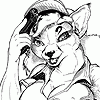
Some more sketches of my busty raccoon Jessica Knight from my A&K Prime dreamscape. Now I have posed Jessica with many firearms over the years http://www.furaffinity.net/view/882846/ http://www.furaffinity.net/view/1012419/ http://www.furaffinity.net/view/1061984/ for example, but I have never actually posted any study sketches of main carry firearm which is a Para-Ordnance P12-45.
She chose the P12-45 because it seemed to be the best compromise between portability and firepower. Also she was very familiar with its manual of arms since she had grown up shooting Colt 1911a1's at the local gun club. Fortunately she was able to secure a supply of the 12 round magazines even after the passing of the 1992 Crime Bill, and since becoming a deputized Federal Marshall she has been able to procure more of them. Still even with just 10 round magazines it is a fair amount of concealable firepower.
In any Conceal Carry Weapon, or CCW, situation the chose of holster can sometimes even more important than the weapon itself. After all it will be worn more than fired but must remain quickly accessible while remaining hidden from all but the trained observer. Jessica considered an inside the waistband or IWB holster, but she wears a skirts and dresses just often enough that it would require her use a different holsters for those occasions. Since she didn't want use a purse holster unless absolutely necessary she went with a horizontal shoulder holster. In particular she wears a Galco Miami Classic.
Now just like weapons any holster has its pluses and minuses. The shoulder holster meant she could wear skirts but she has to wear a jacket or vest when wearing the Miami Classic. Her ample bust line helps keep the pistol from printing through her jacket; however because of her ample bust line people have a tendency to look at it more. "My eyes are up here." is a common phrase she uses. Also she has to reach around and move her left breast to reach the P12-45.
The Para-Ordnance P12-45 is an alloy frame model that has been customized but not to the extreme you see in some "custom" 1911's. It has been tuned to assure absolute reliability. The original trigger has been replaced and hand fitted to the pistol. However she has kept the trigger pull at about four and half pounds for safety reasons. The pistol has had all sharp edges removed or dehorned so that the weapon does not abrade her garments or chafe sensitive parts of her. She's had Novak tritium sights installed and has had the weapon refinished with an NP3 coating to eliminate corrosion problems. Along with the pistol she carries two spare magazines for it on the opposite of the shoulder holster. As a back-up she also carries a S&W 642 in a Kramer pocket holster. Usually in left pocket of the jacket or vest she is wearing.
She chose the P12-45 because it seemed to be the best compromise between portability and firepower. Also she was very familiar with its manual of arms since she had grown up shooting Colt 1911a1's at the local gun club. Fortunately she was able to secure a supply of the 12 round magazines even after the passing of the 1992 Crime Bill, and since becoming a deputized Federal Marshall she has been able to procure more of them. Still even with just 10 round magazines it is a fair amount of concealable firepower.
In any Conceal Carry Weapon, or CCW, situation the chose of holster can sometimes even more important than the weapon itself. After all it will be worn more than fired but must remain quickly accessible while remaining hidden from all but the trained observer. Jessica considered an inside the waistband or IWB holster, but she wears a skirts and dresses just often enough that it would require her use a different holsters for those occasions. Since she didn't want use a purse holster unless absolutely necessary she went with a horizontal shoulder holster. In particular she wears a Galco Miami Classic.
Now just like weapons any holster has its pluses and minuses. The shoulder holster meant she could wear skirts but she has to wear a jacket or vest when wearing the Miami Classic. Her ample bust line helps keep the pistol from printing through her jacket; however because of her ample bust line people have a tendency to look at it more. "My eyes are up here." is a common phrase she uses. Also she has to reach around and move her left breast to reach the P12-45.
The Para-Ordnance P12-45 is an alloy frame model that has been customized but not to the extreme you see in some "custom" 1911's. It has been tuned to assure absolute reliability. The original trigger has been replaced and hand fitted to the pistol. However she has kept the trigger pull at about four and half pounds for safety reasons. The pistol has had all sharp edges removed or dehorned so that the weapon does not abrade her garments or chafe sensitive parts of her. She's had Novak tritium sights installed and has had the weapon refinished with an NP3 coating to eliminate corrosion problems. Along with the pistol she carries two spare magazines for it on the opposite of the shoulder holster. As a back-up she also carries a S&W 642 in a Kramer pocket holster. Usually in left pocket of the jacket or vest she is wearing.
Category All / All
Species Raccoon
Size 1237 x 927px
File Size 120 kB







Well to be honest Jessica has not been taught to do a tactical draw in one swift action. In reality a tactical draw breaks draw down generally to four steps. Now there are many variants but Jessica generally abides by what is taught to many military and security personnel.
The draw begins with the realization that you need the weapon. It also works on the premise that you not be the one initiating the gun fight. When suddenly startled there is a tendency bring both hands up in front of us and to slight crouch down to defend ourselves. It is not a very useful gesture but it is instinct. The type of draw she's learned takes that automatic reflex into account and incorporates into the first step. What is necessary to performing a consistent, fast, and controlled draw is the ability to do the same steps over and over again.
The hands come up and she crouches slightly. The hands then come back to her chest, both hands slightly cupped, and contact with it. Generally around the sternum. This creates the first orientation point since you sternum and chest usually in the same place.
The crouching will usually create an opening between the body and the garment which makes it easier to gain access to the weapon and the holster. Also bringing the hands back to the chest will often push some of the garment aside to further help gain access to the weapon.
The right hand slides in roughly parallel along the chest to contact the weapon. The fingers on the hand starts to grasp the gun as the thumb pops the safety restraint on the holster, if it has one. In Jessica's case, or any case of any woman using a shoulder rig that has a bust line, the right hand slides under and lifts the breast out of the way to grasp the weapon.
Having grasped the weapon and released it from the holster the right hand more or less retraces its path back across the chest to the center. Note, the index finger is not on the trigger nor has weapon's safety been released. The sketch in the bottom left shows this step.
At this point the shooter begins to rotate the hand and forearm to begin pointing the weapon at the target. However there is none of the grand sweeping gestures found in Hollywood. The weapon remains close to the body. If the left hand is not required for fending off attack from assailants then it will also at point grasp the weapon.
Unless the assailant or assailants are arms length distance or less at this point the shooter extends their arms straight out toward the target. As they are do this they disengage the safety and they their index finger moves to engage the trigger. Ideally at the sights should come into view just as arms finish extending and the trigger is squeezed at that moment. Average time for a draw and fire is between 1.5 and 2.0 seconds from beginning to end.
The draw begins with the realization that you need the weapon. It also works on the premise that you not be the one initiating the gun fight. When suddenly startled there is a tendency bring both hands up in front of us and to slight crouch down to defend ourselves. It is not a very useful gesture but it is instinct. The type of draw she's learned takes that automatic reflex into account and incorporates into the first step. What is necessary to performing a consistent, fast, and controlled draw is the ability to do the same steps over and over again.
The hands come up and she crouches slightly. The hands then come back to her chest, both hands slightly cupped, and contact with it. Generally around the sternum. This creates the first orientation point since you sternum and chest usually in the same place.
The crouching will usually create an opening between the body and the garment which makes it easier to gain access to the weapon and the holster. Also bringing the hands back to the chest will often push some of the garment aside to further help gain access to the weapon.
The right hand slides in roughly parallel along the chest to contact the weapon. The fingers on the hand starts to grasp the gun as the thumb pops the safety restraint on the holster, if it has one. In Jessica's case, or any case of any woman using a shoulder rig that has a bust line, the right hand slides under and lifts the breast out of the way to grasp the weapon.
Having grasped the weapon and released it from the holster the right hand more or less retraces its path back across the chest to the center. Note, the index finger is not on the trigger nor has weapon's safety been released. The sketch in the bottom left shows this step.
At this point the shooter begins to rotate the hand and forearm to begin pointing the weapon at the target. However there is none of the grand sweeping gestures found in Hollywood. The weapon remains close to the body. If the left hand is not required for fending off attack from assailants then it will also at point grasp the weapon.
Unless the assailant or assailants are arms length distance or less at this point the shooter extends their arms straight out toward the target. As they are do this they disengage the safety and they their index finger moves to engage the trigger. Ideally at the sights should come into view just as arms finish extending and the trigger is squeezed at that moment. Average time for a draw and fire is between 1.5 and 2.0 seconds from beginning to end.

Thanks for the break down, during my training days at Customs school we drew from the hip, but the weapons weren't concealed, so the time was a little shorter. I supplimented my firearms training with draw drills, it was quite helpful when it came to qualification. As my instuctor said, "Do the fast things fast (the draw) and the slow things slow (the trigger squeeze)."
Yeah when I was learning how to shoot the rifle when it came time to learn how to fire quickly offhand the one piece of advice I got from someone who was a former Army range officer was. "Take as much time as you need, and not one second more." It is in many ways a rather zen style of reasoning.

Well her dad is former US Marine and was a sharpshooter and armorer for the Corp. Besides between Olivia Campatello http://www.furaffinity.net/view/942651/ Zonto http://www.furaffinity.net/view/4117172/ and Twitch http://www.furaffinity.net/view/1058801/ your either going gain more self-confidence or lose any you had!
Yeah I'm rather fond of them. They don't have the refined finish of many of the Kimbers, Colts, Springfields, but all the ones I've fired print right on target and work every time. The only hiccup I've had is with a very early P10-45 that just refused to feed 185gr JHP but would eat 230gr ammo all day.





Comments