
 FA+
FA+ Shop
Shop
451
Views
Views
37
Favorites
Favorites
Category
Photography / Animal related (non-anthro)
Species Tiger
Size 800 x 533
File Size 243.7 kB
Report this content
More from WalkingTiger


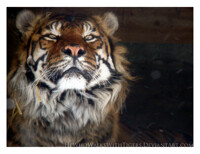



“Sexual dimorphism”, that is the name of the game in this photograph of two Sumatran tigers (Panthera tigris sumatrae) at the Toronto Zoo, Rengat and Brtyne. If you are wondering what that term means, it is simply that, male and females differ noticeably in their form, which can be seen in male and female lions, but it is also noticeable when these two are side by side.
For example, males are often larger, heavier, have a wider skull and more prominent “ruff” than their female counterparts. This can be quite noticeable, but also at times quite subtle. If you spend some time observing tigers you will begin to have an eye for it.
So, who is who?
---
Tigers are the largest of the big cats and are exclusively found in Asia from India to Vietnam, from Indonesia to the Russian Far East. The tiger can be divided into 9 subspecies: 4 are currently critically endangered and 3 are already extinct. Though estimations of tiger populations only a few years ago was 5,500-6,000, today populations are likely closer to 3,500 and are still declining. Dramatic declines of the tiger in India, thought to host the majority of the world's tigers, have fallen to less than 1,411. Overall, the past decade has seen a 40% reduction in tiger habitat, which now represents a mere 7% of its historic range. Poaching is a significant problem throughout the tiger's range, the demand for its body parts in traditional medicines, tonics, and exotic dishes driving a lucrative trade that is wiping out entire populations. Long-term threats include habitat fragmentation and prey depletion, which is accelerating the tiger's demise and subsequently reducing the long-term genetic viability of many populations.
If you want to help, the best for you to do is to educate yourself (http://wwf.panda.org/what_we_do/endangered_species/tigers/), never buy products made from tigers or endangered species (http://www.wildaid.org), and tell others. Contact me for more information.
For example, males are often larger, heavier, have a wider skull and more prominent “ruff” than their female counterparts. This can be quite noticeable, but also at times quite subtle. If you spend some time observing tigers you will begin to have an eye for it.
So, who is who?
---
Tigers are the largest of the big cats and are exclusively found in Asia from India to Vietnam, from Indonesia to the Russian Far East. The tiger can be divided into 9 subspecies: 4 are currently critically endangered and 3 are already extinct. Though estimations of tiger populations only a few years ago was 5,500-6,000, today populations are likely closer to 3,500 and are still declining. Dramatic declines of the tiger in India, thought to host the majority of the world's tigers, have fallen to less than 1,411. Overall, the past decade has seen a 40% reduction in tiger habitat, which now represents a mere 7% of its historic range. Poaching is a significant problem throughout the tiger's range, the demand for its body parts in traditional medicines, tonics, and exotic dishes driving a lucrative trade that is wiping out entire populations. Long-term threats include habitat fragmentation and prey depletion, which is accelerating the tiger's demise and subsequently reducing the long-term genetic viability of many populations.
If you want to help, the best for you to do is to educate yourself (http://wwf.panda.org/what_we_do/endangered_species/tigers/), never buy products made from tigers or endangered species (http://www.wildaid.org), and tell others. Contact me for more information.
Category Photography / Animal related (non-anthro)
Species Tiger
Size 800 x 533px
File Size 243.7 kB


I really need to brush up on this! I can tell from life, but I need to be able to incorporate it into my artwork, as I could never quite put my finger on what made the tigers look female vs male. Thank you for posting this, and for the info! The picture is gorgeous. If you have any more tips like this, they would be greatly appreciated.
The bulk of visible dimoprhism (apart from general size) is observable in the skull and on the other end (males have extra bits =P). There quite a few studies quantifying the differences, but not too many offer comparative figures of real life tigers. You can view skull figures with this article: http://www.carnivoreconservation.or.....morphism.pdf). Generally, the same types of differences can be found in other cats, but it certainly takes an eye for it. There are also quite visible differences in subspecies, which are a bit easier to discern along other perameters (fur color/tone, thickness of stripes, number of stripes, fur length, whisker length, skull length/width, weight etc.) especially with subspecies separated by vast geographic distances (sumatran/siberian) though the differences blur somewhat with geographically adjascent subspecies (bengal/indo-chinese, amur/caspian).
If you are interested, you could always try googling male tigers (http://tinyurl.com/24gwryy) vs female tigers (http://tinyurl.com/23repjp).
Never hesitate to ask questions. I'm always happy to help.
If you are interested, you could always try googling male tigers (http://tinyurl.com/24gwryy) vs female tigers (http://tinyurl.com/23repjp).
Never hesitate to ask questions. I'm always happy to help.

Comments