
 FA+
FA+ Shop
Shop
408
Views
Views
8
Favorites
Favorites
Category
Artwork (Digital) / Fantasy
Species Unspecified / Any
Size 922 x 1072
File Size 308 kB
Report this content
More from MandelSoft


Listed in Folders

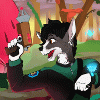
Here we have nine portraits of Kylestin Radeikos, each one representing one of the nine different peoples of the Mythically Mundane universe. I challenged myself to draw her several times as different species other than her cannon species as a human, and use this opportunity to give you some backgrounds about this world:
Humans are the dominant species of this world. Two thirds of this Earth's population is human, though proportions are different per region. In Australia and Oceania, they are pretty much the only sentient species on land, while in Eurasia and North-Africa, they have to share the land with many different peoples. Being in the majority means they also hold most positions of power, and are at the head of most of the world's governments and multinationals.
Of all the sentient species, humans are the only species can be traced further back than the event known as The Fae Fracturing, where all "fae" (now known as "non-human sentient species", or "nusents" for short) and other strange creatures emerged in this world 26 centuries ago. Their status as being the "original species" that has been around for a longer time than anyone else give some groups a sense of superiority, which has lead to several conflicts with nusent nations.
Elves were physically better in almost every way. On average were stronger, more agile, had more stamina, lived longer, had better hearing and eyesight and could even see in dim light conditions. Mentally, however, they were no smarter than humans, nor wiser. In fact, their physical superiority made them arrogant. This eventually became their undoing; by provoking humans into war with them, they lost these battle by overwhelming numbers from the human side, and the final nail to the coffin was their longer lifespans, which meant that their reproductive cycle was also slower and thus couldn't repopulate before they were driven to extinction. Elves are still used as an example how arrogance can lead to one's own downfall.
Priminae (plural for priman and primina) look like they're a step back in human evolution. They are generally shorter than humans and share a lot of traits with monkeys, including a tail and feet with opposeable thumbs. Priminae are very dexterous, even able to seemingly effortlessly climb even at old age. In ancient history, they were considered to be primitive and weren't taken seriously. It wasn't until the time of the great discoveries where they prove themselves very capable crew members on sailing ships. Priminae seafarers were in high demand and it allowed them to show the world they were not "stupid monkeys".
A significant portion of them joined the clergy as well, gaining them respect in society even more. This role they still fulfil in surprisingly large numbers in the Rinerthist religion. Sincethen, they popularly fulfil jobs in civil service.
Fauns have an appearance that's a mix between human and several ungulates (most dominantly goats). They're known as pacifists and lived in egalitarian tribes for most of history. Most of them stayed out of politics and the military conflicts. They're renowned for their contributions to culture, in the form of literature, music an theater, and their mentality of living in the present is popular amongst mindfulness enthusiasts. However, their care-free attitude has also gained them a reputation of hedonism and laziness, something most modern Fauns are a victim of being undervalued because of that. Fauns have a hard time being taken seriously by humans.
Slitherlings are the closest species this world has for nagas and lamias, but they are fully mamal creatures, slithering around on their long, fur-covered tails. In the past, they were very disciplined warriors, lead by a matriarch. Nowadays, their culture still values hard work, and their work ethic shows that. Despite their efforts, it frustrates them that so few of them gained a position of power, and it is rumoured that humans are afraid of them taking over. Most nusents wish they actually did take over these positions...
Centaurs are creatures with a human upper body and a quadrupedal lower body. It is a collective name for five subspecies, each having a lower body of a different ungulate creature common in their region of origin: horse, donkey, reindeer, camel and llama. They mostly fulfil physically demanding jobs, and are mostly active in agriculture and forestry nowadays. This historic focus on their physical capabilities leaves them undervalued for their mental capabilities; there are not many centaur scientists or engineers, partly due to their own stubborn traditional culture. But with ever growing automation and motorisation, the traditional jobs centaurs have are slowly but surely become redundant...
Orcs are bald humanoids with visible tusks and a grey skin. They're often physically slightly stronger than humans and look intimidating. Orcs used to raid villages and cities, much like people like the Vikings did in our timeline, but they abandoned this lifestyle the more they became integrated into the rest of society. Nonetheless, this gave them a reputation of being barbaric, which they're still being confronted by today. Orcs form the underclass of society, doing jobs most people don't want to do.
Merfolk mostly live in their underwater settlements, and have a lower body fit to swim fast. Though they can breathe above water as well, it's not comfortable and they'd quickly dry out if they don't wear filters on their gills. Their eyesight above water is also poor and blurry. There are two merfolk subspecies: one with a dolphin-like tail, who live in the (sub)tropical regions of the Earth, and one with a seal-like tail, who are more suited for colder climates.
Merfolk lived in tribes for a long time, occasionally trading fish with the peoples from the land for goods they couldn't produce under water. It was until the modern era where they found themselves in a position where they would co-operate more and more with the land dwellers, being able to do jobs underwater that would take people from the land a lot of effort. It was also a time of innovation that allowed merfolk to live on land for a longer time. Nonetheless, they still feel literally like a fish out of water there.
Minotauri have a cow-like appearance, and live rather isolated. They have a disciplined warrior culture, having turned duels into an art, where the lines between dancing and fighting blur. Despite their warrior culture reputation, they're actually quite peaceful and very social creatures. They live in herds, lead by an elder called the Shepherd. Minotauri are hard to bond with as an outsider, but if you managed to make a bond, you have a friend for life with a caring family.
If they experience strong emotions of anger, fear or even grief that they can't adequately process, they enter a feral state called The Rage, in which they lose control and their hormones go out of control. It was an instinct for survival, but it can damage the brain in such a way that if one individual stays in the Rage long enough, they can never be snapped out of it and this can be lethal.
____________________
Drawn in Inkscape
Human
Humans are the dominant species of this world. Two thirds of this Earth's population is human, though proportions are different per region. In Australia and Oceania, they are pretty much the only sentient species on land, while in Eurasia and North-Africa, they have to share the land with many different peoples. Being in the majority means they also hold most positions of power, and are at the head of most of the world's governments and multinationals.
Of all the sentient species, humans are the only species can be traced further back than the event known as The Fae Fracturing, where all "fae" (now known as "non-human sentient species", or "nusents" for short) and other strange creatures emerged in this world 26 centuries ago. Their status as being the "original species" that has been around for a longer time than anyone else give some groups a sense of superiority, which has lead to several conflicts with nusent nations.
Elf (extinct)
Elves were physically better in almost every way. On average were stronger, more agile, had more stamina, lived longer, had better hearing and eyesight and could even see in dim light conditions. Mentally, however, they were no smarter than humans, nor wiser. In fact, their physical superiority made them arrogant. This eventually became their undoing; by provoking humans into war with them, they lost these battle by overwhelming numbers from the human side, and the final nail to the coffin was their longer lifespans, which meant that their reproductive cycle was also slower and thus couldn't repopulate before they were driven to extinction. Elves are still used as an example how arrogance can lead to one's own downfall.
Primina
Priminae (plural for priman and primina) look like they're a step back in human evolution. They are generally shorter than humans and share a lot of traits with monkeys, including a tail and feet with opposeable thumbs. Priminae are very dexterous, even able to seemingly effortlessly climb even at old age. In ancient history, they were considered to be primitive and weren't taken seriously. It wasn't until the time of the great discoveries where they prove themselves very capable crew members on sailing ships. Priminae seafarers were in high demand and it allowed them to show the world they were not "stupid monkeys".
A significant portion of them joined the clergy as well, gaining them respect in society even more. This role they still fulfil in surprisingly large numbers in the Rinerthist religion. Sincethen, they popularly fulfil jobs in civil service.
Faun
Fauns have an appearance that's a mix between human and several ungulates (most dominantly goats). They're known as pacifists and lived in egalitarian tribes for most of history. Most of them stayed out of politics and the military conflicts. They're renowned for their contributions to culture, in the form of literature, music an theater, and their mentality of living in the present is popular amongst mindfulness enthusiasts. However, their care-free attitude has also gained them a reputation of hedonism and laziness, something most modern Fauns are a victim of being undervalued because of that. Fauns have a hard time being taken seriously by humans.
Slitherling
Slitherlings are the closest species this world has for nagas and lamias, but they are fully mamal creatures, slithering around on their long, fur-covered tails. In the past, they were very disciplined warriors, lead by a matriarch. Nowadays, their culture still values hard work, and their work ethic shows that. Despite their efforts, it frustrates them that so few of them gained a position of power, and it is rumoured that humans are afraid of them taking over. Most nusents wish they actually did take over these positions...
Centaur
Centaurs are creatures with a human upper body and a quadrupedal lower body. It is a collective name for five subspecies, each having a lower body of a different ungulate creature common in their region of origin: horse, donkey, reindeer, camel and llama. They mostly fulfil physically demanding jobs, and are mostly active in agriculture and forestry nowadays. This historic focus on their physical capabilities leaves them undervalued for their mental capabilities; there are not many centaur scientists or engineers, partly due to their own stubborn traditional culture. But with ever growing automation and motorisation, the traditional jobs centaurs have are slowly but surely become redundant...
Orc
Orcs are bald humanoids with visible tusks and a grey skin. They're often physically slightly stronger than humans and look intimidating. Orcs used to raid villages and cities, much like people like the Vikings did in our timeline, but they abandoned this lifestyle the more they became integrated into the rest of society. Nonetheless, this gave them a reputation of being barbaric, which they're still being confronted by today. Orcs form the underclass of society, doing jobs most people don't want to do.
Merfolk
Merfolk mostly live in their underwater settlements, and have a lower body fit to swim fast. Though they can breathe above water as well, it's not comfortable and they'd quickly dry out if they don't wear filters on their gills. Their eyesight above water is also poor and blurry. There are two merfolk subspecies: one with a dolphin-like tail, who live in the (sub)tropical regions of the Earth, and one with a seal-like tail, who are more suited for colder climates.
Merfolk lived in tribes for a long time, occasionally trading fish with the peoples from the land for goods they couldn't produce under water. It was until the modern era where they found themselves in a position where they would co-operate more and more with the land dwellers, being able to do jobs underwater that would take people from the land a lot of effort. It was also a time of innovation that allowed merfolk to live on land for a longer time. Nonetheless, they still feel literally like a fish out of water there.
Minotaur
Minotauri have a cow-like appearance, and live rather isolated. They have a disciplined warrior culture, having turned duels into an art, where the lines between dancing and fighting blur. Despite their warrior culture reputation, they're actually quite peaceful and very social creatures. They live in herds, lead by an elder called the Shepherd. Minotauri are hard to bond with as an outsider, but if you managed to make a bond, you have a friend for life with a caring family.
If they experience strong emotions of anger, fear or even grief that they can't adequately process, they enter a feral state called The Rage, in which they lose control and their hormones go out of control. It was an instinct for survival, but it can damage the brain in such a way that if one individual stays in the Rage long enough, they can never be snapped out of it and this can be lethal.
____________________
Drawn in Inkscape
Category Artwork (Digital) / Fantasy
Species Unspecified / Any
Size 922 x 1072px
File Size 308 kB

Comments