
 FA+
FA+ Shop
Shop
629
Views
Views
1
Favorites
Favorites
Category
Other / Miscellaneous
Species Unspecified / Any
Size 497 x 595
File Size 21.9 kB
Report this content
More from stgiga


![[Read Desc] Bitmap Font - UnifontEX](http://d.furaffinity.net/art/stgiga/1654552573/1654552573.stgiga_unknown-46_png.png "Click to change the View")

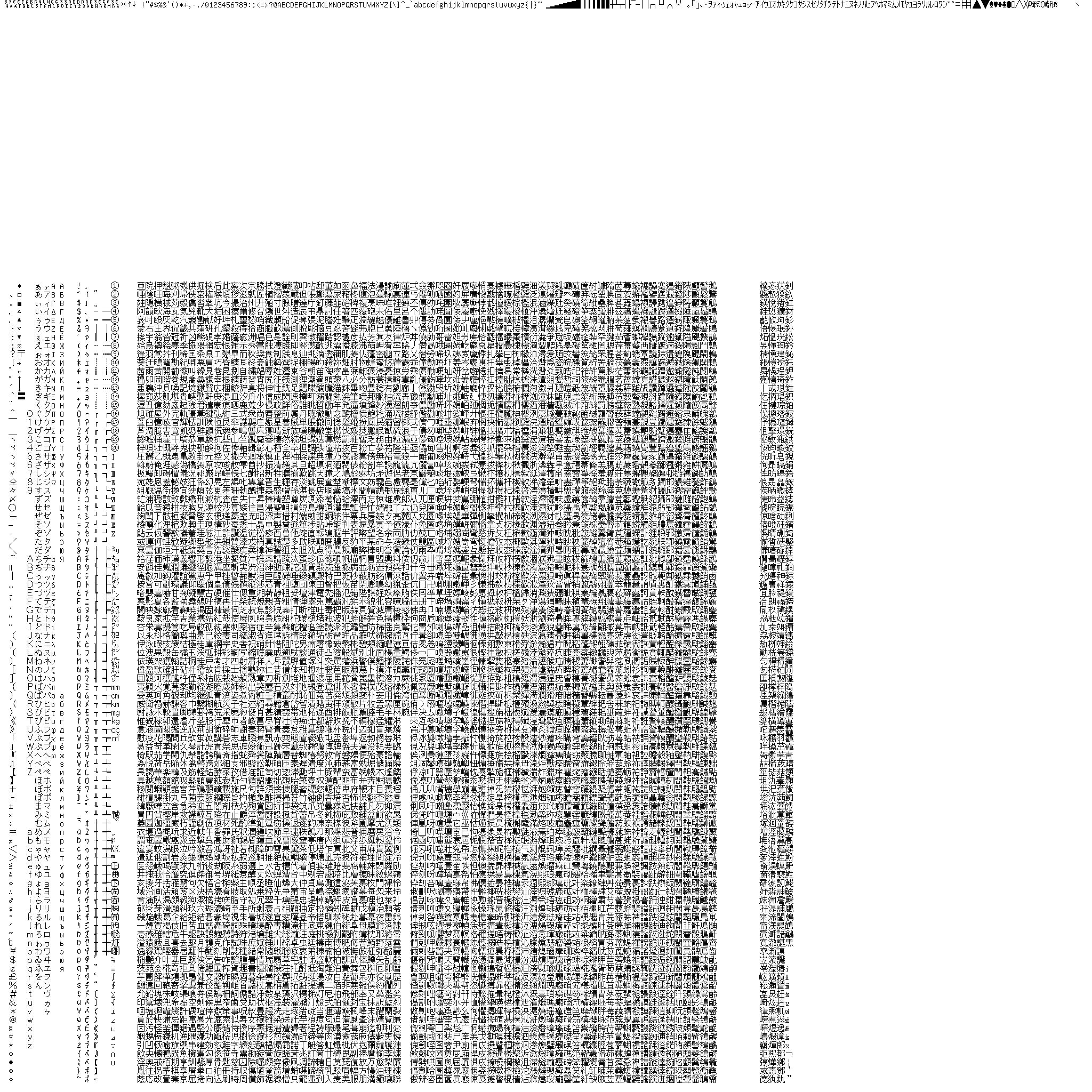
This is my fork of GNU Unifont, known as UnifontEX. It's specifically GNU Unifont 15.0.06-JP merged with GNU Unifont 11.0.01 Upper (the last versions that can be merged after deleting the placeholder hexboxes in non-Upper [Upper has no hexboxes.]) GNU Unifont's devs never officially merged Upper with non-Upper, and after 11.0.01 it became impossible to merge higher versions of Upper with anything. You can merge newer versions of non-Upper with 11.0.01 Upper, which I did here.
Note that the preview is a cropped version of the full 4096x65536 PNG, because FA only goes to 1280x1280.
TrueType:
https://stgiga.github.io/UnifontEX/.....fontExMono.ttf
PNG:
https://stgiga.github.io/UnifontEX/.....fontExMono.png
BDF:
https://stgiga.github.io/UnifontEX/.....tExMono-16.bdf
iOS SVG Webfont version:
https://stgiga.github.io/UnifontEX/.....fontExMono.svg
PC98 BMP version:
https://stgiga.github.io/UnifontEX/UFEXPC98.BMP
WOFF:
https://stgiga.github.io/UnifontEX/.....ontExMono.woff
WOFF2:
https://stgiga.github.io/UnifontEX/.....ntExMono.woff2
FontForge SFD:
https://stgiga.github.io/UnifontEX/.....ntExMonoSFD.7z
EOT:
https://stgiga.github.io/UnifontEX/.....fontExMono.eot
Proof-of-Concept SVGZ Version:
https://stgiga.github.io/UnifontEX/.....ontExMono.svgz
OTB:
https://stgiga.github.io/UnifontEX/.....fontExMono.otb
macOS DFONT:
https://stgiga.github.io/UnifontEX/.....ExMonoDFONT.7z
Proof-of-Concept WOFF3 Version:
https://stgiga.github.io/UnifontEX/.....ntExMono.woff3
Cross-browser UnifontEX Webfont Stylesheet:
https://stgiga.github.io/UnifontEX/.....fontExMono.css
UCGLIB Arduino Version:
https://stgiga.github.io/UnifontEX/.....ExMonoUCGLIB.c
U8G2 Arduino Version:
https://stgiga.github.io/UnifontEX/.....ntExMonoU8G2.c
LVGL C Version:
https://stgiga.github.io/UnifontEX/.....ntExMonoLVGL.c
LVGL Binary Version:
https://stgiga.github.io/UnifontEX/.....xMonoLVGL.font
Typeface.js JS+JSON Version
https://stgiga.github.io/UnifontEX/.....oTypefaceJS.7z
Uint8_t C++ File Version:
https://stgiga.github.io/UnifontEX/.....noUint8tCPP.7z
DOS/V FontX2 Kanji Version:
https://stgiga.github.io/UnifontEX/.....noKanji.fontx2
DOS/V FontX2 Non-Kanji Version:
https://stgiga.github.io/UnifontEX/.....MonoAnk.fontx2
PostScript Type42 Version:
https://stgiga.github.io/UnifontEX/.....ntExMonoT42.7z
Adafruit_GFX Version:
https://stgiga.github.io/UnifontEX/.....AdafruitGFX.7z
LibreCAD LFF Version:
https://stgiga.github.io/UnifontEX/.....ntExMonoLFF.7z
iOS Mobileconfig Version:
https://stgiga.github.io/UnifontEX/.....o.mobileconfig
ALL formats in one 7z:
https://UnifontEX.sourceforge.io/UnifontEX.7z
ALL formats in one Zip:
https://UnifontEX.sourceforge.io/UnifontEX.zip
ALL formats in one BWTC32Key Tarball:
https://UnifontEX.sourceforge.io/UnifontEX.B3K
The TTF is about 14MiB, and the PNG is under 1MiB
Unifont is 16px, which on Windows is considered 12 point, and so if you are ever in a situation like MLA paper writing where 12 point is required but are not forced to use Times New Roman, you can use this (ask your instructor of course, since some ignore the MLA standard and force Times New Roman). Since this is a merger of Upper and non-Upper, there IS a full set of italics, allowing it to comply with THAT part of MLA. Unicode 11 was released in mid-2018, and the Tumblr exodus happened in late (December) 2018. Emoji pronouns are/were largely a Tumblr thing (one I do not disapprove of, in fact I myself have Unicode pronouns as part of my set), so technically you can use this font to respect as many pronouns as possible, what with its support for old languages as well as all emoji from the last peak of Tumblr. In total there are 65417 glyphs in the TTF (3 of which are glyphs that TrueType relies on but are not standard and not in the PNG). I used TTF2PNG to generate the PNG (and then GIMP to make it truly 1bpp like TTF2PNG failed to do), and I did so in a way that does not require a bloated definitions file (storing every character sequentially without removing gaps, hence the 4096x65536 size, since it's read in 16x16 increments from U+0000 to U+10FFFF). TTF2PNG is a renderer that utilizes FreeType, so this is essentially a giant screenshot. In the USA images of fonts are equivalent in usability to Public Domain. So while I cannot use the TTF in something like a custom-ordered Noritake character VFD, I CAN however use the zipped PNG for that purpose, on a 1MiB flash memory chip the size of a screwpost, especially since I did not use hinting or a definitions file, meaning that it's totally an image of a font with none of what the law in my region (USA) considers "font code". Hardware deflate decoder chips exist, so I could run this through that twice, and then handle the character reads the same way the Famicom Network System did, where a specific character is chosen by telling the font logic to STOP on a certain character (the Famicom Network System is constantly reading from its Kanji chip, and a character is picked by telling the character reader logic to STOP on the requested character, and this lets us get around the lack of random access in Deflate). So this could go into a custom video or display chip with no need for an advanced CPU. The Panasonic 3DO has a 1MiB Kanji chip and was even made into a DOS PC card, so there is precedent for using this in PCs and also it's a historically accurate size for a font chip. My ASUS ZenBook Pro Duo actually uses Unifont in its BIOS updater. Also if I combined this font with DOS/V, PK-ZIP, and Lotus Multibyte Character Set, I could make a Unicode version of MS-DOS. DOS/V uses 16x16 characters, Lotus Multi-Byte Character Set supports Unicode AND replicates the DOS codepages so no need to break existing programs, and PKZIP can run even on an 8088 DOS machine with 85K of RAM (so the 640K conventional memory can have room for the DOS/V and other code). I would handle alt codes via using decimal Unicode codepoint values inputted while holding ALT. This version of DOS would be able to unzip other stuff too, so it would be a feature upgrade. And it would be a single floppy that could upgrade an existing DOS/V install. Due to all the stuff like technical symbols, food emoji, and other stuff, it would be VERY handy for commercial equipment like cash registers, restaurant backends, industrial status displays, and it would also be useful for so many other uses. Oh, and you could put it in your games like Minecraft did with an ANCIENT version of Unifont. And for your TDDs you can have Playing Cards, Mahjong Tiles, Dominoes, Chess, and Musical symbols plus emoji to aid in conversation (Obviously you would use UTF8 to not clobber other TDDs), and for dysgraphia keyboards like the AlphaSmart, you would gain the ability to enter in math characters because Unicode has a LOT of them. Also Unifont has gender symbols, including the transgender symbol, as well as ones for orientations, and it also has U+2B89, a character that is an inverted-color version of the symbol Bullydog and some other people here have associated with andromorphs under their old term. I have Firefox and Basilisk XPMod (special fork of Firefox for XP that has support for Flash, Windows XP, and IA32 still) configured to force ALL page fonts to this font, (emoji newer than 2018 show up with default system fonts), and APPARENTLY Unifont, like Discord's Whitney, is a Neo-grotesque gothic humanist sans-serif hybrid, so using browser discord in this Firefox (not a modded client) results in a familiar experience. It's important to note that Twitter and Discord emoji are not broken by this. Emoji in this Unifont are 16x16 monochrome. So larger than the 1999 DoCoMo emoji, but half the size of the 1997 SoftBank SkyWalker J-Phone emoji. Altogether this font is something I use because it looks cool. I just made a good thing BETTER. It's many years newer than RockBox and Minecraft's implementations of Unifont. The official Unifont BDF is 1MiB but does not include the Plane 1 characters in this. It's important to note that 11.0.0x versions of Unifont are a bit more language-agnostic with their CJK Unified Ideographs than higher versions. Unifont ORIGINALLY had Japanese versions of CJK Unified Ideographs way back in its early days, but at one point, a non-insignificant amount of them (the ones that were less receptive to a 16x16 size) were replaced with Simplified Chinese ones for readability purposes, but a complete eradication of the original Japanese glyphs never happened. Unifont 12 decided to make a Japanese-specific version of Unifont alongside the normal, so favoring happened. If we're putting this in a display chip or trying to use it as a standardized subset of Unicode for embedded systems, we don't want to favor a particular country's CJK Unified Ideographs. Plus the 16x16 survival should be retained. Also there are cursive, bold cursive, italics, bold, bold italics, double-struck (outline), Fraktur, bold Fraktur, and typewriter English and Greek characters, so you could represent formatting in-text. There's honestly enough special characters in this font that you could indeed make a text-based GUI OS out of this. One thing I did with the TTF recently was make a Minecraft resource pack that updates the game's Unicode support (MC added Plane 1 and TTF support fairly recently but didn't touch their Unifont implementation, so no emoji. My update fixes that issue).
Sorry for the dissertation about this font.
Update 2024:
May 2024: The VDMX-containing build from February 2nd, 2024 has been pushed to SourceForge and OpenGameArt in addition to Github. Computer moving is so difficult. I also made more versions for exotic formats, as well as new ones (WOFF3 is BWTC32Key applied to TrueType, SVGZ is GZipped SVG). I'm planning on doing a metadata update that changes no functionality when I'm less exhausted.
June 4th, 2024:
New formats have been added, and it's the 1 year anniversary of Unifont-JP 15.0.06.
December 7th, 2024:
Added links to the bundle of every format simultaneously, made the links work in Blink-engine browsers.
Note that the preview is a cropped version of the full 4096x65536 PNG, because FA only goes to 1280x1280.
TrueType:
https://stgiga.github.io/UnifontEX/.....fontExMono.ttf
PNG:
https://stgiga.github.io/UnifontEX/.....fontExMono.png
BDF:
https://stgiga.github.io/UnifontEX/.....tExMono-16.bdf
iOS SVG Webfont version:
https://stgiga.github.io/UnifontEX/.....fontExMono.svg
PC98 BMP version:
https://stgiga.github.io/UnifontEX/UFEXPC98.BMP
WOFF:
https://stgiga.github.io/UnifontEX/.....ontExMono.woff
WOFF2:
https://stgiga.github.io/UnifontEX/.....ntExMono.woff2
FontForge SFD:
https://stgiga.github.io/UnifontEX/.....ntExMonoSFD.7z
EOT:
https://stgiga.github.io/UnifontEX/.....fontExMono.eot
Proof-of-Concept SVGZ Version:
https://stgiga.github.io/UnifontEX/.....ontExMono.svgz
OTB:
https://stgiga.github.io/UnifontEX/.....fontExMono.otb
macOS DFONT:
https://stgiga.github.io/UnifontEX/.....ExMonoDFONT.7z
Proof-of-Concept WOFF3 Version:
https://stgiga.github.io/UnifontEX/.....ntExMono.woff3
Cross-browser UnifontEX Webfont Stylesheet:
https://stgiga.github.io/UnifontEX/.....fontExMono.css
UCGLIB Arduino Version:
https://stgiga.github.io/UnifontEX/.....ExMonoUCGLIB.c
U8G2 Arduino Version:
https://stgiga.github.io/UnifontEX/.....ntExMonoU8G2.c
LVGL C Version:
https://stgiga.github.io/UnifontEX/.....ntExMonoLVGL.c
LVGL Binary Version:
https://stgiga.github.io/UnifontEX/.....xMonoLVGL.font
Typeface.js JS+JSON Version
https://stgiga.github.io/UnifontEX/.....oTypefaceJS.7z
Uint8_t C++ File Version:
https://stgiga.github.io/UnifontEX/.....noUint8tCPP.7z
DOS/V FontX2 Kanji Version:
https://stgiga.github.io/UnifontEX/.....noKanji.fontx2
DOS/V FontX2 Non-Kanji Version:
https://stgiga.github.io/UnifontEX/.....MonoAnk.fontx2
PostScript Type42 Version:
https://stgiga.github.io/UnifontEX/.....ntExMonoT42.7z
Adafruit_GFX Version:
https://stgiga.github.io/UnifontEX/.....AdafruitGFX.7z
LibreCAD LFF Version:
https://stgiga.github.io/UnifontEX/.....ntExMonoLFF.7z
iOS Mobileconfig Version:
https://stgiga.github.io/UnifontEX/.....o.mobileconfig
ALL formats in one 7z:
https://UnifontEX.sourceforge.io/UnifontEX.7z
ALL formats in one Zip:
https://UnifontEX.sourceforge.io/UnifontEX.zip
ALL formats in one BWTC32Key Tarball:
https://UnifontEX.sourceforge.io/UnifontEX.B3K
The TTF is about 14MiB, and the PNG is under 1MiB
Unifont is 16px, which on Windows is considered 12 point, and so if you are ever in a situation like MLA paper writing where 12 point is required but are not forced to use Times New Roman, you can use this (ask your instructor of course, since some ignore the MLA standard and force Times New Roman). Since this is a merger of Upper and non-Upper, there IS a full set of italics, allowing it to comply with THAT part of MLA. Unicode 11 was released in mid-2018, and the Tumblr exodus happened in late (December) 2018. Emoji pronouns are/were largely a Tumblr thing (one I do not disapprove of, in fact I myself have Unicode pronouns as part of my set), so technically you can use this font to respect as many pronouns as possible, what with its support for old languages as well as all emoji from the last peak of Tumblr. In total there are 65417 glyphs in the TTF (3 of which are glyphs that TrueType relies on but are not standard and not in the PNG). I used TTF2PNG to generate the PNG (and then GIMP to make it truly 1bpp like TTF2PNG failed to do), and I did so in a way that does not require a bloated definitions file (storing every character sequentially without removing gaps, hence the 4096x65536 size, since it's read in 16x16 increments from U+0000 to U+10FFFF). TTF2PNG is a renderer that utilizes FreeType, so this is essentially a giant screenshot. In the USA images of fonts are equivalent in usability to Public Domain. So while I cannot use the TTF in something like a custom-ordered Noritake character VFD, I CAN however use the zipped PNG for that purpose, on a 1MiB flash memory chip the size of a screwpost, especially since I did not use hinting or a definitions file, meaning that it's totally an image of a font with none of what the law in my region (USA) considers "font code". Hardware deflate decoder chips exist, so I could run this through that twice, and then handle the character reads the same way the Famicom Network System did, where a specific character is chosen by telling the font logic to STOP on a certain character (the Famicom Network System is constantly reading from its Kanji chip, and a character is picked by telling the character reader logic to STOP on the requested character, and this lets us get around the lack of random access in Deflate). So this could go into a custom video or display chip with no need for an advanced CPU. The Panasonic 3DO has a 1MiB Kanji chip and was even made into a DOS PC card, so there is precedent for using this in PCs and also it's a historically accurate size for a font chip. My ASUS ZenBook Pro Duo actually uses Unifont in its BIOS updater. Also if I combined this font with DOS/V, PK-ZIP, and Lotus Multibyte Character Set, I could make a Unicode version of MS-DOS. DOS/V uses 16x16 characters, Lotus Multi-Byte Character Set supports Unicode AND replicates the DOS codepages so no need to break existing programs, and PKZIP can run even on an 8088 DOS machine with 85K of RAM (so the 640K conventional memory can have room for the DOS/V and other code). I would handle alt codes via using decimal Unicode codepoint values inputted while holding ALT. This version of DOS would be able to unzip other stuff too, so it would be a feature upgrade. And it would be a single floppy that could upgrade an existing DOS/V install. Due to all the stuff like technical symbols, food emoji, and other stuff, it would be VERY handy for commercial equipment like cash registers, restaurant backends, industrial status displays, and it would also be useful for so many other uses. Oh, and you could put it in your games like Minecraft did with an ANCIENT version of Unifont. And for your TDDs you can have Playing Cards, Mahjong Tiles, Dominoes, Chess, and Musical symbols plus emoji to aid in conversation (Obviously you would use UTF8 to not clobber other TDDs), and for dysgraphia keyboards like the AlphaSmart, you would gain the ability to enter in math characters because Unicode has a LOT of them. Also Unifont has gender symbols, including the transgender symbol, as well as ones for orientations, and it also has U+2B89, a character that is an inverted-color version of the symbol Bullydog and some other people here have associated with andromorphs under their old term. I have Firefox and Basilisk XPMod (special fork of Firefox for XP that has support for Flash, Windows XP, and IA32 still) configured to force ALL page fonts to this font, (emoji newer than 2018 show up with default system fonts), and APPARENTLY Unifont, like Discord's Whitney, is a Neo-grotesque gothic humanist sans-serif hybrid, so using browser discord in this Firefox (not a modded client) results in a familiar experience. It's important to note that Twitter and Discord emoji are not broken by this. Emoji in this Unifont are 16x16 monochrome. So larger than the 1999 DoCoMo emoji, but half the size of the 1997 SoftBank SkyWalker J-Phone emoji. Altogether this font is something I use because it looks cool. I just made a good thing BETTER. It's many years newer than RockBox and Minecraft's implementations of Unifont. The official Unifont BDF is 1MiB but does not include the Plane 1 characters in this. It's important to note that 11.0.0x versions of Unifont are a bit more language-agnostic with their CJK Unified Ideographs than higher versions. Unifont ORIGINALLY had Japanese versions of CJK Unified Ideographs way back in its early days, but at one point, a non-insignificant amount of them (the ones that were less receptive to a 16x16 size) were replaced with Simplified Chinese ones for readability purposes, but a complete eradication of the original Japanese glyphs never happened. Unifont 12 decided to make a Japanese-specific version of Unifont alongside the normal, so favoring happened. If we're putting this in a display chip or trying to use it as a standardized subset of Unicode for embedded systems, we don't want to favor a particular country's CJK Unified Ideographs. Plus the 16x16 survival should be retained. Also there are cursive, bold cursive, italics, bold, bold italics, double-struck (outline), Fraktur, bold Fraktur, and typewriter English and Greek characters, so you could represent formatting in-text. There's honestly enough special characters in this font that you could indeed make a text-based GUI OS out of this. One thing I did with the TTF recently was make a Minecraft resource pack that updates the game's Unicode support (MC added Plane 1 and TTF support fairly recently but didn't touch their Unifont implementation, so no emoji. My update fixes that issue).
Sorry for the dissertation about this font.
Update 2024:
May 2024: The VDMX-containing build from February 2nd, 2024 has been pushed to SourceForge and OpenGameArt in addition to Github. Computer moving is so difficult. I also made more versions for exotic formats, as well as new ones (WOFF3 is BWTC32Key applied to TrueType, SVGZ is GZipped SVG). I'm planning on doing a metadata update that changes no functionality when I'm less exhausted.
June 4th, 2024:
New formats have been added, and it's the 1 year anniversary of Unifont-JP 15.0.06.
December 7th, 2024:
Added links to the bundle of every format simultaneously, made the links work in Blink-engine browsers.
Category Other / Miscellaneous
Species Unspecified / Any
Size 497 x 595px
File Size 21.9 kB


Comments