
 FA+
FA+ Shop
Shop
486
Views
Views
13
Favorites
Favorites
Category
Artwork (Traditional) / Miscellaneous
Species Western Dragon
Size 821 x 1224
File Size 612.5 kB
Report this content
More from Creoste


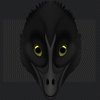
Creoste's speshul breed of critter. They're a free species, but please tell me if you want one, I like to see them!
Wetland Drake (Boglizards, Marshdragons, Crocktails, Swampbeasties)
Parvasuchοs versicolor
Family: Occidental (Western)
Size: While they never stop growing, the rate slows as they age, and the oldest females tend to be 9-12 metres long and the oldest males 7-10 metres. Most adults, however, range between 2-5 metres long. Despite their size, dragons in peak condition could weigh only half that of another animal of similar size, due to their flight adaptations.
Diet: These dragons are opportunistic feeders who can and will eat absolutely anything, with the vast majority of their diet tending to consist of things that don’t run away. If they do chase prey, it tends to be smaller animals of various species. Certain individuals have their surrounding areas suspiciously free of neighbourhood cats and dogs. In general, each dragon has a preference, but certain things like grapes, water lilies, poppy seeds, dove eggs, hazelnuts, mangoes and frogspawn agree with every one of them.
Habitat: With a cosmopolitan distribution and a tolerance for a wide range of environmental conditions, these sparsely dispersed but common dragons can be found almost anywhere in the world. They prefer access to water, frequenting areas with plenty of trees, undergrowth, rocks or caves for hunting, with certain individuals preferring thick forests, open plains or tidal zones. While most commonly found marshland, mangroves, ponds and streams, some families even live solely on reefs, perching on the corals at low tide, or live and hunt around kelp forests.
That said, such natural habits are not the extent of their range. They’re very willing to cooperate with other species, especially human races (thanks to the comfortably similar sizes). They happily integrate with other communities, taking jobs as farm hands, artists, witches, labourers, librarians (anything), even buying property and otherwise participating in the economy. Other dragon flights sometimes find themselves with a drake or two mingled in their midst, and likewise they happily take orphans of any species, and even wild individuals will gleefully tame other animals as pets.
On the other hand, other dragons take pride in their traditions and heritage, forming Clans and holding onto a way of life for hundreds of years. Most of these tribes form in places somewhat less conducive to the leisurely lonesome lifestyle they would other lead, such as thick rainforests and bleak mountainsides…Places without open bodies of water. Certain clans even choose flood-plain territory and hibernate through the driest parts of the year.
General: While inherently magical, not many of them can tap into their mana and even fewer of them can wield it to any impressive extent. Most of their magi consist of mediocre mages and alchemists who use focus points and reagents to add oomph to their spells. However, quite a few of these dragons have passive magical talents, such as a fiery breath, empathy or a chilly bite among others. Often these are tied to their voices, sourced from paired voice boxes in the chest (like a songbird) and giving them the flexibility to mimic almost any sound. And yet, despite their shrieking, chirps, barks, hisses, warbles, tweets, chortles, purrs and rumbles, the thing that seems to escape them is the ability to actually roar.
They are primarily exothermic but when outside temperatures become too extreme their metabolisms speed up to compensate (endothermic). Drakes in exothermic mode feed either in sporadic bursts of massive amounts, or constantly of small amounts. To some degree their very size affords them some homeostatic advantage, and the larger individuals can go without food for months, or even years at a time. Sex determination is temperature dependant, with most temperatures producing males. Very harsh extremes of temperature (perilously close to killing the embryo) are required to produce females, and only older, experienced dragons even try. As such, most females are born in secluded clans under the practised care of ‘midwives’, with eggs requested or donated from certain unions.
The wide geographic distribution of these dragons have given rise to a number of cultures and clans, but these often span far broader boundaries than human tribal groups thanks to the greater mobility of the dragons. Most of them are by nature independent for most of their lives, with males claiming and holding a territory, and females being either nomadic or claiming a set ‘harem’ of males and their homes. Some pair-bond and mate for life, others form small travelling troops of four to seven individuals, certain females claim enormous territories and capture males…the variety is staggering, but most stick to the instinctive way of life. At the centre of each population, however, is a clan of elders, to whom instinct guides hatchlings no matter where they are born. These elders teach the children what has not been sung to them while in the egg. Most male hatchlings are expected to reach the sacred place on their own, while females are generally born there. All of the hatchlings are born knowing where to find any elder clan. However, not all elder clans are created equal, and often a young drake will reject a group of stoners, old farts or religious nuts for a more reliable (or sane) one.
One of the most bizarre aspects of this breed is the massive variety of decorations their scaly hides can display. While they all maintain a monitor-like body plan and a elongate, crocodilian tail, many of their superficial features are entirely unpredictable. At the heart, they all have four digits on each of their six limbs, with hand like, thumbed forepaws and very long, spindly lizard toes on the back. Wings are broad, their bodies low-slung, and they all have only two horns, a hollow, beaky projection over their soft lips (like a long fingernail) and highly manoeuvrable fins that lead to the small ear hole. From there, anything seems to go. Some have fins and frills coming out of every possible angle of their bodies, others have their large scales tipped with sharp, thorny projections, some have spines, webbed feet, whiskers…And that isn’t mentioning the colours.
Most of them tend to be earth browns, blues, and greens, with markings of other colours, but any colour combination or pattern type is possible, and a quarter of the population have varying degrees of colour-changing ability. Frustratingly, they start out positively blank slates as hatchlings and grow the features on a whim before they mature and get their scales, and certain adults can even slowly change their features over the years.
The trick is their skin, which is loose on their bodies like a cat. While they can hardly change their shape or squish through tiny holes like an octopus, the little fuckers are frustratingly flexible and difficult to get a hold of. Their lungs and heart are the super-efficient machines of dinosaurs and birds, while their muscle mass produces the same power-per-pound as other reptiles—four times as much as a mammal’s. They seem fluid and slinky, moving with catlike grace on reptilian anatomy with very avian reflexes. They’re strong, fast and versatile, opportunists of the most irritating sort, but they all cultivate a natural suspicion and jumpiness. However strong they might be, they are not big dragons and most others can easily overpower them, and while a single human is no match for them, a group of them can bring one down like a crocodile. They tend to avoid confrontation and tend to weasel their way out of trouble either physically or verbally. Most don’t even realise that they’re as strong as they are…and beware the plump ones. They punch hardest.
Wetland Drake (Boglizards, Marshdragons, Crocktails, Swampbeasties)
Parvasuchοs versicolor
Family: Occidental (Western)
Size: While they never stop growing, the rate slows as they age, and the oldest females tend to be 9-12 metres long and the oldest males 7-10 metres. Most adults, however, range between 2-5 metres long. Despite their size, dragons in peak condition could weigh only half that of another animal of similar size, due to their flight adaptations.
Diet: These dragons are opportunistic feeders who can and will eat absolutely anything, with the vast majority of their diet tending to consist of things that don’t run away. If they do chase prey, it tends to be smaller animals of various species. Certain individuals have their surrounding areas suspiciously free of neighbourhood cats and dogs. In general, each dragon has a preference, but certain things like grapes, water lilies, poppy seeds, dove eggs, hazelnuts, mangoes and frogspawn agree with every one of them.
Habitat: With a cosmopolitan distribution and a tolerance for a wide range of environmental conditions, these sparsely dispersed but common dragons can be found almost anywhere in the world. They prefer access to water, frequenting areas with plenty of trees, undergrowth, rocks or caves for hunting, with certain individuals preferring thick forests, open plains or tidal zones. While most commonly found marshland, mangroves, ponds and streams, some families even live solely on reefs, perching on the corals at low tide, or live and hunt around kelp forests.
That said, such natural habits are not the extent of their range. They’re very willing to cooperate with other species, especially human races (thanks to the comfortably similar sizes). They happily integrate with other communities, taking jobs as farm hands, artists, witches, labourers, librarians (anything), even buying property and otherwise participating in the economy. Other dragon flights sometimes find themselves with a drake or two mingled in their midst, and likewise they happily take orphans of any species, and even wild individuals will gleefully tame other animals as pets.
On the other hand, other dragons take pride in their traditions and heritage, forming Clans and holding onto a way of life for hundreds of years. Most of these tribes form in places somewhat less conducive to the leisurely lonesome lifestyle they would other lead, such as thick rainforests and bleak mountainsides…Places without open bodies of water. Certain clans even choose flood-plain territory and hibernate through the driest parts of the year.
General: While inherently magical, not many of them can tap into their mana and even fewer of them can wield it to any impressive extent. Most of their magi consist of mediocre mages and alchemists who use focus points and reagents to add oomph to their spells. However, quite a few of these dragons have passive magical talents, such as a fiery breath, empathy or a chilly bite among others. Often these are tied to their voices, sourced from paired voice boxes in the chest (like a songbird) and giving them the flexibility to mimic almost any sound. And yet, despite their shrieking, chirps, barks, hisses, warbles, tweets, chortles, purrs and rumbles, the thing that seems to escape them is the ability to actually roar.
They are primarily exothermic but when outside temperatures become too extreme their metabolisms speed up to compensate (endothermic). Drakes in exothermic mode feed either in sporadic bursts of massive amounts, or constantly of small amounts. To some degree their very size affords them some homeostatic advantage, and the larger individuals can go without food for months, or even years at a time. Sex determination is temperature dependant, with most temperatures producing males. Very harsh extremes of temperature (perilously close to killing the embryo) are required to produce females, and only older, experienced dragons even try. As such, most females are born in secluded clans under the practised care of ‘midwives’, with eggs requested or donated from certain unions.
The wide geographic distribution of these dragons have given rise to a number of cultures and clans, but these often span far broader boundaries than human tribal groups thanks to the greater mobility of the dragons. Most of them are by nature independent for most of their lives, with males claiming and holding a territory, and females being either nomadic or claiming a set ‘harem’ of males and their homes. Some pair-bond and mate for life, others form small travelling troops of four to seven individuals, certain females claim enormous territories and capture males…the variety is staggering, but most stick to the instinctive way of life. At the centre of each population, however, is a clan of elders, to whom instinct guides hatchlings no matter where they are born. These elders teach the children what has not been sung to them while in the egg. Most male hatchlings are expected to reach the sacred place on their own, while females are generally born there. All of the hatchlings are born knowing where to find any elder clan. However, not all elder clans are created equal, and often a young drake will reject a group of stoners, old farts or religious nuts for a more reliable (or sane) one.
One of the most bizarre aspects of this breed is the massive variety of decorations their scaly hides can display. While they all maintain a monitor-like body plan and a elongate, crocodilian tail, many of their superficial features are entirely unpredictable. At the heart, they all have four digits on each of their six limbs, with hand like, thumbed forepaws and very long, spindly lizard toes on the back. Wings are broad, their bodies low-slung, and they all have only two horns, a hollow, beaky projection over their soft lips (like a long fingernail) and highly manoeuvrable fins that lead to the small ear hole. From there, anything seems to go. Some have fins and frills coming out of every possible angle of their bodies, others have their large scales tipped with sharp, thorny projections, some have spines, webbed feet, whiskers…And that isn’t mentioning the colours.
Most of them tend to be earth browns, blues, and greens, with markings of other colours, but any colour combination or pattern type is possible, and a quarter of the population have varying degrees of colour-changing ability. Frustratingly, they start out positively blank slates as hatchlings and grow the features on a whim before they mature and get their scales, and certain adults can even slowly change their features over the years.
The trick is their skin, which is loose on their bodies like a cat. While they can hardly change their shape or squish through tiny holes like an octopus, the little fuckers are frustratingly flexible and difficult to get a hold of. Their lungs and heart are the super-efficient machines of dinosaurs and birds, while their muscle mass produces the same power-per-pound as other reptiles—four times as much as a mammal’s. They seem fluid and slinky, moving with catlike grace on reptilian anatomy with very avian reflexes. They’re strong, fast and versatile, opportunists of the most irritating sort, but they all cultivate a natural suspicion and jumpiness. However strong they might be, they are not big dragons and most others can easily overpower them, and while a single human is no match for them, a group of them can bring one down like a crocodile. They tend to avoid confrontation and tend to weasel their way out of trouble either physically or verbally. Most don’t even realise that they’re as strong as they are…and beware the plump ones. They punch hardest.
Category Artwork (Traditional) / Miscellaneous
Species Western Dragon
Size 821 x 1224px
File Size 612.5 kB


Comments