
 FA+
FA+ Shop
Shop
449
Views
Views
3
Favorites
Favorites
Category
All / All
Species Unspecified / Any
Size 816 x 552
File Size 19.9 kB
Report this content
More from JustChecking418



We don't really know what a blimpball arena/stadium looks like, but even so, I have come up with the basketball-style scoreboard you see here, with up to five lines for scoring: Pd for period, Sc for scorer (player who scored), and Ba for ball (player who was used to score). The latest goal is displayed despite the goal celebration animation being on the board and the clock not yet wiped out.
From a sports fan's perspective, I also thought I'd share some impressions of the game. I'm 12 years older than when the FBA came on the scene and more cautious about taking part, and the imaginary game might not go into that much burdensome depth, but here I go.
UPDATE 3/23/22 10:11 PM EDT - It's come up in the comments -- I'm surprised there was even one -- that an understanding of the concepts laid out for the game shouldn't be taken for granted. The document can be found here. https://docs.google.com/document/d/.....-17eYyUKI/edit
And, I've just realized: Would there ever be any call to "pull" a goalie in desperation as there is in ice hockey?
INSURMOUNTABLE LEADS
Only one goal may be scored in each period, but does that mean a game would end if a team scored in each of the first five periods or if any other situation made it impossible for the trailing team not to lose?
PENALTIES
So we've established that some infractions make it so players are sent to the top and covered with advertising signs. How is this punishment implemented (in case there are youngsters watching, better use the mouth)? To what size does an ejected player inflate? If it's for the entire game, then is a substitution made or does one team have the "power play" until one of its players gets the card or scores a goal?
PERSONNEL
There is at least one picture of an inflated official. Would that official, too, be ten feet in diameter, or a different size? That official would also have to do a lot to avoid getting hit, and if an official does get hit, judgment calls would be made as to whether it was intentional. We can rule out the pre-game coin toss unless there's another official on the ground level. Would there be platforms for those who carry out ejection to the penalty banners and for a player who leaves the field so another player can come in?
MOVING AND POSITIONING
Are the players positioned according to closeness to the goal, or is it, as in concept art, a matter of upper, middle, and lower? Relative to each other, how easy or difficult are moving forward and backward, left and right, and up and down?
PLAYER SIZE
Height and mass when uninflated counts for more than some observers might think. Larger players might not get as far off the ground at ten feet of diameter as smaller ones, hence so many goalies being large before being inflated to twenty. How does being inflated to regulation size affect, say, a 5-6 and 150 player compared to a six-foot and 200-pound player?
CONDITIONING
Any athlete needs the right exercise and nutrition to be in full control, and in this situation, a player must not only stay afloat yet mobile at all times (would there be a standard pressure or not?), but also have a well regulated inside in other ways. I'd say a true blimpball player does not expel gas or get "aroused" during a game or within about an hour of it, as difficult as avoiding either might be.
EQUIPMENT
Speaking of which, it would be an awkward and thankless job placing athletic supporters on players who need them after they've inflated. Uniform clothing (tops, bottoms, socks, gloves) would stretch, but would pads, bands, braces, and sleeves need to be equipped after inflation, if allowed? Shoes are obviously not worn.
UNIFORMS
One uniform won't do. What about white ones for road games, as in hockey, or white ones for home games, as in basketball? We've established that the goalies would have to wear their own distinctive uniforms as well, as they do in soccer. That's to avoid confusion; being eight times as voluminous as players in the field wouldn't always be.
UNIFORM NUMBERS, WHERE FOUND
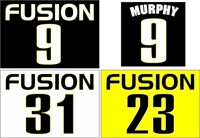
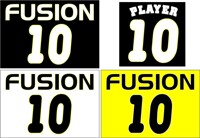
The big number on the back is obviously needed as in all sports, and so may be the smaller ones on the left chest. What about TV numbers? The sleeves and shoulders are out, aren't they? Both sides of the shorts would have them, too; I'm thinking left back and right front. Maybe even on the sides of the jersey, where numbers would look tacky on uninflated athletes. The challenge is to have them in places where they can be seen at all times but have the uniform look good whether inflated or not. Of course, there are players who wear different cuts.
UNIFORM NUMBERS, RANGE OF
The system of single digits for goalies, 10-19 for strikers, 20-29 for backers, and 30-39 for drifters has been suggested but not always adhered to. Will it end up being a rule?
SPECTATORS
Given the structure of the playing area, not everyone in attendance would get an unobstructed view of the playing area, and seating would probably be different from that of a standard arena. Remote-control TV and still cameras would have to be stationed in certain places. Would seating be closer to one thousand, five thousand, or twenty-five thousand?
THE FIELD
The sphere has a circumference in excess of 300 feet, over 30,000 square feet of surface area, and about half a million cubic feet of volume. That's a lot of fencing and a lot of assembly. This and the seating might rule out the inexpensive option of playing in a basketball or hockey arena, but I'm not saying definitely.
LOCATION
Is the game typically played indoors or outdoors? It's been said that teams offer seating above the sphere, but can something 100 feet high be contained within a basketball or hockey arena? If outdoors, are games ever rained out? How does the wind affect play? The altitude, temperature, and humidity? How often do teams change goals?
So far, that's most of it.
From a sports fan's perspective, I also thought I'd share some impressions of the game. I'm 12 years older than when the FBA came on the scene and more cautious about taking part, and the imaginary game might not go into that much burdensome depth, but here I go.
UPDATE 3/23/22 10:11 PM EDT - It's come up in the comments -- I'm surprised there was even one -- that an understanding of the concepts laid out for the game shouldn't be taken for granted. The document can be found here. https://docs.google.com/document/d/.....-17eYyUKI/edit
And, I've just realized: Would there ever be any call to "pull" a goalie in desperation as there is in ice hockey?
INSURMOUNTABLE LEADS
Only one goal may be scored in each period, but does that mean a game would end if a team scored in each of the first five periods or if any other situation made it impossible for the trailing team not to lose?
PENALTIES
So we've established that some infractions make it so players are sent to the top and covered with advertising signs. How is this punishment implemented (in case there are youngsters watching, better use the mouth)? To what size does an ejected player inflate? If it's for the entire game, then is a substitution made or does one team have the "power play" until one of its players gets the card or scores a goal?
PERSONNEL
There is at least one picture of an inflated official. Would that official, too, be ten feet in diameter, or a different size? That official would also have to do a lot to avoid getting hit, and if an official does get hit, judgment calls would be made as to whether it was intentional. We can rule out the pre-game coin toss unless there's another official on the ground level. Would there be platforms for those who carry out ejection to the penalty banners and for a player who leaves the field so another player can come in?
MOVING AND POSITIONING
Are the players positioned according to closeness to the goal, or is it, as in concept art, a matter of upper, middle, and lower? Relative to each other, how easy or difficult are moving forward and backward, left and right, and up and down?
PLAYER SIZE
Height and mass when uninflated counts for more than some observers might think. Larger players might not get as far off the ground at ten feet of diameter as smaller ones, hence so many goalies being large before being inflated to twenty. How does being inflated to regulation size affect, say, a 5-6 and 150 player compared to a six-foot and 200-pound player?
CONDITIONING
Any athlete needs the right exercise and nutrition to be in full control, and in this situation, a player must not only stay afloat yet mobile at all times (would there be a standard pressure or not?), but also have a well regulated inside in other ways. I'd say a true blimpball player does not expel gas or get "aroused" during a game or within about an hour of it, as difficult as avoiding either might be.
EQUIPMENT
Speaking of which, it would be an awkward and thankless job placing athletic supporters on players who need them after they've inflated. Uniform clothing (tops, bottoms, socks, gloves) would stretch, but would pads, bands, braces, and sleeves need to be equipped after inflation, if allowed? Shoes are obviously not worn.
UNIFORMS
One uniform won't do. What about white ones for road games, as in hockey, or white ones for home games, as in basketball? We've established that the goalies would have to wear their own distinctive uniforms as well, as they do in soccer. That's to avoid confusion; being eight times as voluminous as players in the field wouldn't always be.
UNIFORM NUMBERS, WHERE FOUND
The big number on the back is obviously needed as in all sports, and so may be the smaller ones on the left chest. What about TV numbers? The sleeves and shoulders are out, aren't they? Both sides of the shorts would have them, too; I'm thinking left back and right front. Maybe even on the sides of the jersey, where numbers would look tacky on uninflated athletes. The challenge is to have them in places where they can be seen at all times but have the uniform look good whether inflated or not. Of course, there are players who wear different cuts.
UNIFORM NUMBERS, RANGE OF
The system of single digits for goalies, 10-19 for strikers, 20-29 for backers, and 30-39 for drifters has been suggested but not always adhered to. Will it end up being a rule?
SPECTATORS
Given the structure of the playing area, not everyone in attendance would get an unobstructed view of the playing area, and seating would probably be different from that of a standard arena. Remote-control TV and still cameras would have to be stationed in certain places. Would seating be closer to one thousand, five thousand, or twenty-five thousand?
THE FIELD
The sphere has a circumference in excess of 300 feet, over 30,000 square feet of surface area, and about half a million cubic feet of volume. That's a lot of fencing and a lot of assembly. This and the seating might rule out the inexpensive option of playing in a basketball or hockey arena, but I'm not saying definitely.
LOCATION
Is the game typically played indoors or outdoors? It's been said that teams offer seating above the sphere, but can something 100 feet high be contained within a basketball or hockey arena? If outdoors, are games ever rained out? How does the wind affect play? The altitude, temperature, and humidity? How often do teams change goals?
So far, that's most of it.
Category All / All
Species Unspecified / Any
Size 816 x 552px
File Size 19.9 kB


Comments