
 FA+
FA+ Shop
Shop
4578
Views
Views
32
Favorites
Favorites
Category
Photography / Tutorials
Species Vulpine (Other)
Size 1186 x 795
File Size 2.22 MB
Report this content
More from The_Furry_Art_Academy
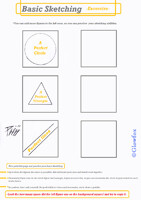
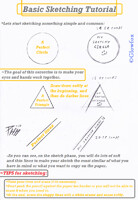
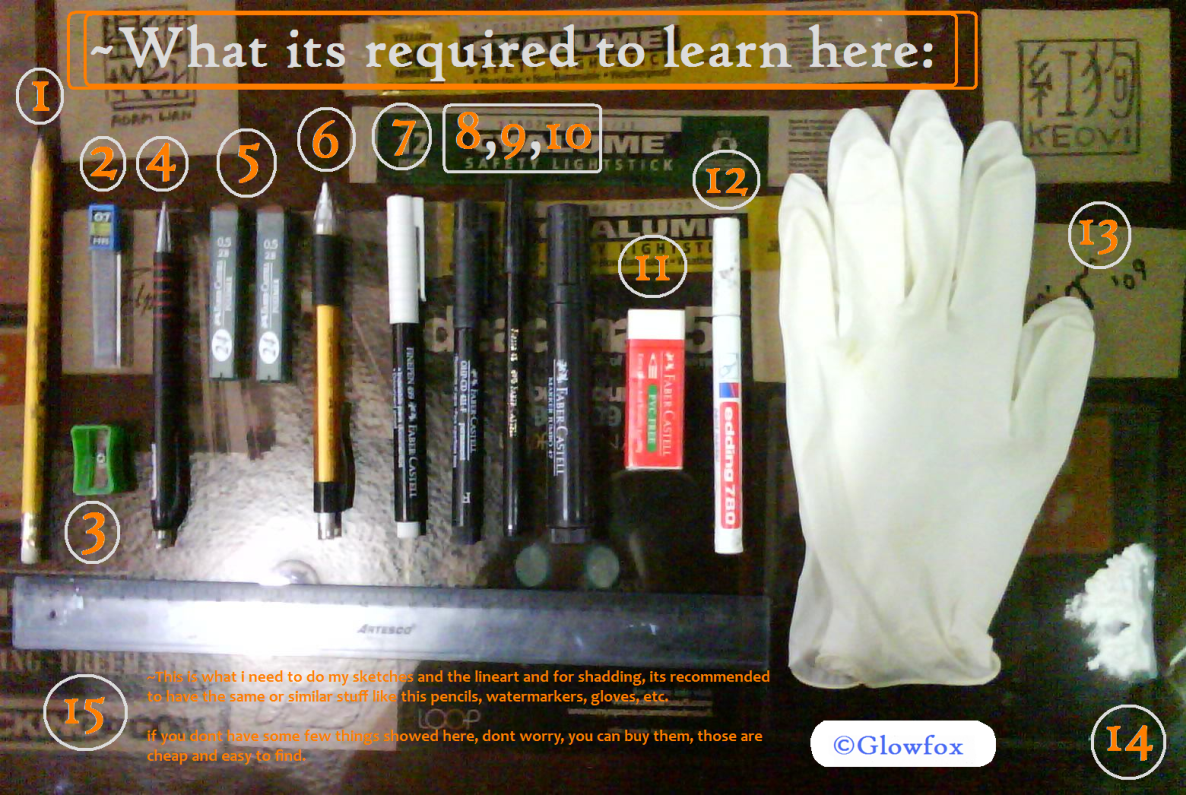
This is what I recommend you to use for draw, and this is what I use:
1)Normal pencil (for shadows and sketches in B/W).
2)0.7mm charcoal mines for mechanical pencils.
3)Sharpener.
4)Mechanical pencil (0.7mm).
5)0.5mm charcoal mines for mechanical pencils.
6)Mechanical pencil (0.5mm).
7)Fine pen-permanent marker BLACK (for lineart).
8,9,10)permanent marker,conventional watermarker,board watermarker(all of them black for lineart).
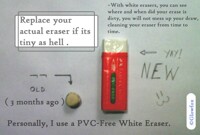
11)PVC Free White eraser.
12)Corrector pen or "liquid paper".
13)Latex gloves.(or nitrile ones if you are alergic to latex)
14)Powder (for hands and the gloves).
15)30cm Ruler.
For sketching:
1,2,3,4,5,6,7,11,13,14
for lineart:
7,8,9,10,12,13,14,15
the gloves are important when you draw,te sweatness of your hand makes the draw look dirty and sometimes impossible to erase. so add some powder, put the gloves on, and add a bit of powder over the gloves.
you wll get used to them, this is useful to make the drawing look clean.
with the mechanical pencils, the sketch will be more clean and more easy to trace for the final draw, you can use normal pencils but those are difficult to erase.
stay tunned, more tutorials on the way, for now, this is what you need.
___
 ___
___-Glowy-
Owner/Teacher
Category Photography / Tutorials
Species Vulpine (Other)
Size 1186 x 795px
File Size 2.22 MB









Ah, sweet. Well, even though I sketch, that's all I do unless I go to Photoshop. To be honest though, I sometimes sketch with your average .5mm mechanical pencil, but I also bought these red and blue lead refills which are the same size to start sketching. Very useful in my opinion. They're just more fragile than regular lead.
If you're still looking for the blue pencil lead, you'll find them here.
http://www.dickblick.com/products/p.....-lead-refills/
(The Red ones are just as good in my opinion. I got both.)
Basically what they mean is that when you scan the pictures with the blue pencils, they don't show up that much or at all, depending on how dark it is on the paper. If there's any left, you can use any program like Photoshop and mess with the bright and darkness of the picture (I think it's the Hue and Saturation option). That'll usually get rid of them easily.
http://www.dickblick.com/products/p.....-lead-refills/
(The Red ones are just as good in my opinion. I got both.)
Basically what they mean is that when you scan the pictures with the blue pencils, they don't show up that much or at all, depending on how dark it is on the paper. If there's any left, you can use any program like Photoshop and mess with the bright and darkness of the picture (I think it's the Hue and Saturation option). That'll usually get rid of them easily.


Protip: You don't need gloves if you switch to blue or red polymer lead in mechanical pencils. It doesn't smear the way graphite does, thus your pictures don't get smutty when you sketch. I find gloves actually hamper me because I need to feel the paper under my hand in order to sketch properly, and the glove feels like it's in the way. If you're the least bit worried about pencil smudges, though, do your inks on a clean sheet of paper utilizing a lightbox, light table, or even a convenient window, and don't ink directly over the original pencils. This gives you the benefit of clean inks on an unsullied surface, and as many chances as you need to get your inks right. If you screw up, you can simply start over on the inks without having to trash your original sketch and start from the beginning. It also gives you cleaner, crisper lines, because if you erase over your inks to remove pencil marks from beneath them, you will end up graying/fading them out with the eraser.
My basic materials of choice are:
Canson 65# sketch paper in 9x12 size
0.9mm Koh-i-noor Rapidomatic mechanical pencil with blue (or red) polymer lead (the larger size is harder to break, but still capable of details if you know how to control it)
Pentel Tri-Eraser for details
Mars white plastic eraser for larger areas
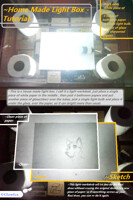
Lightbox to transfer inks
Canson 98# Mix Media paper in 9x12 size (for finished inks and watercolor or acrylic washes)
Pigma or Zigg microns for inking (Faber Castell pens tend to bleed if you're using marker or watercolor over them, Pigmas and Ziggs don't)
Deciding which tools to use is as individual a process as that of creating the art itself. =) Every artist has to discover what they're ultimately the most comfortable with. I happen to like my $12 pencil, but not everyone will want one like that.
My basic materials of choice are:
Canson 65# sketch paper in 9x12 size
0.9mm Koh-i-noor Rapidomatic mechanical pencil with blue (or red) polymer lead (the larger size is harder to break, but still capable of details if you know how to control it)
Pentel Tri-Eraser for details
Mars white plastic eraser for larger areas
Lightbox to transfer inks
Canson 98# Mix Media paper in 9x12 size (for finished inks and watercolor or acrylic washes)
Pigma or Zigg microns for inking (Faber Castell pens tend to bleed if you're using marker or watercolor over them, Pigmas and Ziggs don't)
Deciding which tools to use is as individual a process as that of creating the art itself. =) Every artist has to discover what they're ultimately the most comfortable with. I happen to like my $12 pencil, but not everyone will want one like that.


Comments