
 FA+
FA+ Shop
Shop
205
Views
Views
9
Favorites
Favorites
Category
Photography / Animal related (non-anthro)
Species Tiger
Size 600 x 826
File Size 560.8 kB
Report this content
More from WalkingTiger


Before the advent of the gun, the tiger roamed the earth unchallenged and occupied man's mind as the greatest of beasts - it was the epitome of power and was synonymous with the divine. Those living with the tiger showed both fear and reverence towards the species, even treating it as a god.
Out of respect, I always keep this in mind when getting close to these animals. Not one of these experiences goes by where I do not feel a wave of these ancient beliefs casting goosebumps on my body. Compared with such power I am insignificant and weak...then, as the tiger approaches, it begins to greet you with sounds of acceptance and camaraderie. You feel something else.
Perhaps we are not so different...to him, I am just another tiger.
---
Tigers are the largest of the big cats and are exclusively found in Asia from India to Vietnam, from Indonesia to the Russian Far East. The tiger can be divided into 9 subspecies: 4 are currently critically endangered and 3 are already extinct. Though estimations of tiger populations only a few years ago was 5,500-6,000, today populations are likely closer to 3,500 and are still declining. Dramatic declines of the tiger in India, thought to host the majority of the world’s tigers, have fallen to less than 1,411. Overall, the past decade has seen a 40% reduction in tiger habitat, which now represents a mere 7% of its historic range. Poaching is a significant problem throughout the tiger’s range, the demand for its body parts in traditional medicines, tonics, and exotic dishes driving a lucrative trade that is wiping out entire populations. Long-term threats include habitat fragmentation and prey depletion, which is accelerating the tiger’s demise and subsequently reducing the long-term genetic viability of many populations.
If you want to help, the best for you to do is to educate yourself (http://www.savethetigerfund.org), never buy products made from tigers or endangered species (http://www.wildaid.org), and tell others. Contact me for more information.
Out of respect, I always keep this in mind when getting close to these animals. Not one of these experiences goes by where I do not feel a wave of these ancient beliefs casting goosebumps on my body. Compared with such power I am insignificant and weak...then, as the tiger approaches, it begins to greet you with sounds of acceptance and camaraderie. You feel something else.
Perhaps we are not so different...to him, I am just another tiger.
---
Tigers are the largest of the big cats and are exclusively found in Asia from India to Vietnam, from Indonesia to the Russian Far East. The tiger can be divided into 9 subspecies: 4 are currently critically endangered and 3 are already extinct. Though estimations of tiger populations only a few years ago was 5,500-6,000, today populations are likely closer to 3,500 and are still declining. Dramatic declines of the tiger in India, thought to host the majority of the world’s tigers, have fallen to less than 1,411. Overall, the past decade has seen a 40% reduction in tiger habitat, which now represents a mere 7% of its historic range. Poaching is a significant problem throughout the tiger’s range, the demand for its body parts in traditional medicines, tonics, and exotic dishes driving a lucrative trade that is wiping out entire populations. Long-term threats include habitat fragmentation and prey depletion, which is accelerating the tiger’s demise and subsequently reducing the long-term genetic viability of many populations.
If you want to help, the best for you to do is to educate yourself (http://www.savethetigerfund.org), never buy products made from tigers or endangered species (http://www.wildaid.org), and tell others. Contact me for more information.
Category Photography / Animal related (non-anthro)
Species Tiger
Size 600 x 826px
File Size 560.8 kB


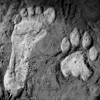
a beautiful profile pic to show to those artists who give big cats a stop in the noseridge deeper than the jaws, and call it "realistic". :)
also, I think the biggest problem these days is the easy availability of powerful rifles, and more and more people who can afford the products made of endangered animals everywhere. back in the days killing a tiger or lion was a huge accomplishment, done with spears and traps and whatnot. nowadays you lay low, pull the trigger, and feel oh-so-proud. :P
also, I think the biggest problem these days is the easy availability of powerful rifles, and more and more people who can afford the products made of endangered animals everywhere. back in the days killing a tiger or lion was a huge accomplishment, done with spears and traps and whatnot. nowadays you lay low, pull the trigger, and feel oh-so-proud. :P
...or set a steel snare...or buy a bottle of poison and lace a dead animal with it... or run an electrified wire across a well-used path...
There are plenty of ways to do it and, in all those cases, it costs very little...even as low as $1. As a result, anyone with a grudge or need to get some extra cash can kill a tiger. Combine that with the fact that the people living near tigers are often the poorest and less likely to recover from killed livestock or a family member and you have a recipe for disaster. Vast criminal organizations of poachers are always lying in wait to exploit this. Consequently, the illegal trade in wildlife is only behind guns and drugs for lucrative international illegal activity.
It's a tough hill to climb, but if we can lobby governments to change the laws and conviction processes to ones that swiftly and harshly deal with criminals while simultaneously offering communities the support they need to live with tigers then we can start to fix this. Reducing the demand for illegal wildlife products in places like China, USA and Japan (1st, 2nd, 3rd greatest consumers, respectively) is also critical because, as WildAid says, "When the buying stops, the killing can too".
There are plenty of ways to do it and, in all those cases, it costs very little...even as low as $1. As a result, anyone with a grudge or need to get some extra cash can kill a tiger. Combine that with the fact that the people living near tigers are often the poorest and less likely to recover from killed livestock or a family member and you have a recipe for disaster. Vast criminal organizations of poachers are always lying in wait to exploit this. Consequently, the illegal trade in wildlife is only behind guns and drugs for lucrative international illegal activity.
It's a tough hill to climb, but if we can lobby governments to change the laws and conviction processes to ones that swiftly and harshly deal with criminals while simultaneously offering communities the support they need to live with tigers then we can start to fix this. Reducing the demand for illegal wildlife products in places like China, USA and Japan (1st, 2nd, 3rd greatest consumers, respectively) is also critical because, as WildAid says, "When the buying stops, the killing can too".
absolutely. without buyers there ain't no market.
curiously enough,. as many problems as russia has they still try to protect their siberian tiger population. members of the army, natives from siberia, go out of their way to protect what's left of them. many times though, they have to burn the remaining pieces of tigers.
with countries, it seems to be busines as usual: nuclear weapons are more importantn than helping the land populace to develop a living without destroying the land. in india, there is also a huge overpopulation which makes things worse.
of course, the reasons are never that simple. but that doesn't mean one can't try and change them. fir trade organisations can help a lot. for example, helping the farmers getting rid of the necessity to cut down vast jungles for a meager income in wheat. which eases the pressure on the environment...
unfortunately, people want cheap stuff. instead of looking closer atn the products' whereabouts and maybe simply say 'no'.
curiously enough,. as many problems as russia has they still try to protect their siberian tiger population. members of the army, natives from siberia, go out of their way to protect what's left of them. many times though, they have to burn the remaining pieces of tigers.
with countries, it seems to be busines as usual: nuclear weapons are more importantn than helping the land populace to develop a living without destroying the land. in india, there is also a huge overpopulation which makes things worse.
of course, the reasons are never that simple. but that doesn't mean one can't try and change them. fir trade organisations can help a lot. for example, helping the farmers getting rid of the necessity to cut down vast jungles for a meager income in wheat. which eases the pressure on the environment...
unfortunately, people want cheap stuff. instead of looking closer atn the products' whereabouts and maybe simply say 'no'.
oh yeah. have you heard that the EU wanted to raise the amount of 'bio'-methanole in all gasoline and diesel fuels? from 3% to some 10%. germany tried to go ahead and raise it as soon as possible... even though everybody told our glorious government that it woudl destroy most actual rides' injection systems (methanole is aggressive against many plastics and is hygroscopic, which adds water to the mixture, and thus, corrosion). they didn't stop the plans until they were convinceed that
1: all of germany's agricultural areas couldn't produce enough plant matter to serve the demand
2: all of germany per se would be too small
3: the current world production wouldn't be enough
and 4: that making third-world countries stop producing food for themselves and producing alcohole for our gas tanks has nothign to do with ecological fuel production at all. or any other argument they tried to use...
Mercedes-Benz started to use coconut fibre mats to bolster their seats shunning synthetic fibres and rubber fibres. thing is, they need insane amounts of it, and if I recall right you can't produce coconuts like say we, bananas. or any other domestic plant... so third-world countries try to rasie coconut palms in order to make Mercedes drivers not having to sit on the floor. :P
1: all of germany's agricultural areas couldn't produce enough plant matter to serve the demand
2: all of germany per se would be too small
3: the current world production wouldn't be enough
and 4: that making third-world countries stop producing food for themselves and producing alcohole for our gas tanks has nothign to do with ecological fuel production at all. or any other argument they tried to use...
Mercedes-Benz started to use coconut fibre mats to bolster their seats shunning synthetic fibres and rubber fibres. thing is, they need insane amounts of it, and if I recall right you can't produce coconuts like say we, bananas. or any other domestic plant... so third-world countries try to rasie coconut palms in order to make Mercedes drivers not having to sit on the floor. :P

Well, to Tekahn's credit, he was the one that tolerated me long enough for me to get some good shots and he's the one that makes the glory in the shot, not me. I was just in the right place in the right time. =3
Thank you though. I'll be sure to tell Tekahn next time I see him.
Thank you though. I'll be sure to tell Tekahn next time I see him.

Comments