
 FA+
FA+ Shop
Shop
2140
Views
Views
34
Favorites
Favorites
Category
Artwork (Digital) / Animal related (non-anthro)
Species Unspecified / Any
Size 741 x 1280
File Size 222.3 kB
Report this content
More from GREGOLE


Excerpt from the journal of Doctor Wendy Gemshire, whose credentials are largely useless on Fronterra.
The Fragean continent, though abundant in resources, is dotted with mountains which produce no shortage of rain shadow. Jungles and deserts exist side by side, oasis and badland alike shaping the flora and fauna of the land.
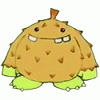
As a result of this, while many creatures are adapted for one or the other, there is considerable overlap in habitat, and many can comfortably shift between the two. I have none the less divided the megafauna by preferred environment. My charger still works, so in lieu of sketches, I’ve provided tastefully stylized drawings via tablet.
1. Squamhog -
Combining the worst aspects of warthogs, hippos, ceratopsids and dolphins, this reptimammal is one of the most feared beasts on Fronterra. Though it does not hunt, it eats what it kills, and it fights for the sheer thrill of it. Squamhogs are viciously aggressive, owing to their highly intelligent brains and desire for emotional stimulation, coupled with their tremendous strength and weaponry. Seeking out fights is simply their favorite game.
Squamhogs will eat just about anything, from cacti to carrion. They enjoy chewing, as their mighty jaws require constant stimulation, and many will carry their favorite bones, rocks or even pieces of destroyed vehicles in their throat-pouches to chew on at their leisure.
2. Galvaderm - Representing the ossaderms, a group of arthropods who have developed vertebrate-like shapes and roles, I believe the galvaderm or its ancestors hail from some alternate Earth many millions of years ahead of my own.
The galvaderm is so named for the biological metal that comprises its shell, which it generates with a mineral-heavy diet. Young galvaderms are subterranean, foraging voraciously for roots, tubers and fellow burrowing animals to build up their bodies, in addition to the various metallic ore they consume and assimilate. Only when they reach full size do they come to the surface, where their lifestyle dramatically changes.
Adult galvaderms are photosynthetic, burying their underbellies and heads in the sand and leaving their large dorsal plates exposed, soaking up as much sun as possible in their sleep, then rising at night to explore and snack.
Galvaderms are curious creatures, and can travel great distances at night, only to return to their burrows by day and continue to absorb solar energy.
Galvaderm shells are prized as materials for solar panels, and many domestic breeds exist with different shell compositions based on what metals they were fed as larvae.
3. Iguanadon - Largely what one would expect from a giant iguana. The iguanadon is an opportunistic herbivore, inhabiting both the deserts and the jungles with equal comfort, preferring ferns and shrubs, but willing to eat cacti if necessary. Though males become agitated and trigger-happy when in heat, females are mellow year-round. When threatened or angered, the lizard will rattle its tail spines to deter threats, lashing out with them only as a last resort.
Curiously, the iguanadon retains an ability of its smaller cousins, allowing it to regenerate its tail if it is separated from its body. This regeneration is more thorough than the smaller species, with the replacement almost indistinguishable from the original. Naturally, this renewability has made it a cornerstone in Fronterran farming, and domestic breeds produce fatter tails with fewer nerve endings.
4. Demisuchus - What I first took to be a predatory ankylosaur surprised me when, upon studying the bones and teeth at the Fracture Wildlife Facility, I realized I was looking at a crocodile! Demisuchus is the logical result of a world where salamanders fill the roles of crocodilians: A crocodile filling the role of a land predator.
Known as “sukes” colloquially, demisuchus is a feared desert hunter, willing to ambush lone travelers and known for invading livestock pens. It is primarily a daytime threat, its dark back scutes absorbing sunlight to warm its body for quick bursts of energy.
Demisuchus competes directly with scissormites for the same prey, and skirmishes between the nocturnal arthropods and the diurnal reptile are not uncommon. The mites have been known to seek out the crocodile in its sleep and attempt to assassinate it to knock out the competition, which the crocodile responds to with its powerful, spiked tail, bone-crunching jaws and extremely thick osteoderms.
5. Sand emperor - Fronterra’s oxygen-rich atmosphere has allowed even seemingly earthly arthropods greater range in their growth, with none showing this more than the sand emperor, the largest of the gigarach family.
Beyond its tremendous size, the sand emperor is remarkably similar to smaller, earthly scorpions, preferring to burrow underground and emerging at night to hunt. They have a preference for the meat of other arthropods, which their venom is specially designed to bring down.
Their complex respiratory systems allow them to safely process both air and water, and larger specimens have been known to gravitate towards bodies of water, where the burden of their tremendous weight may be eased.
Though not “officially” domesticated, wild sand emperors do live in symbiosis with rural communities, locals occasionally feeding them in order to keep them around, the scorpions in turn deterring other large predators. Though similar in thought process to their smaller kin, the scorpions’ enormous brains do allow for more complexity, which in turn allows for the formation of emotional bonds. Though not truly social, a sand emperor may still come to enjoy the company of its neighbors.
6. Night harpy - Shrouded in myth and folklore, the night harpy is, to our current understanding, Fronterra's second largest pterosaur, though its behavior is closer to that of predatory vampire bats. A nocturnal predator that makes its lair in mountainous caverns, it is notorious for shrieking each evening to announce the commencement of its hunt. While warning potential prey of its presence may seem counter-intuitive, this act does appear to serve a purpose. The harpy's facial crest acts as a sound chamber, allowing the creature to figuratively 'throw' its voice, shrieking its call into thickly wooded or otherwise sheltered areas, spooking potential victims into fleeing, and thus announcing their own presence. As it is not above hunting humanoids, travelers have taken to carrying intense light sources with them. The harpy's eyes are quite sensitive to sudden changes in ambient light, and so even the light of a powerful flashlight can wrack them with pain and turn them away.
7. Diablogarto - This ceratopsian is most analogous to mountain goats, preferring elevated terrain. Though its fat body and thick, hoof-like feet may seem poorly equipped for climbing, the diablogarto is exceptionally agile in its home environment.
Though an obligate herbivore, feeding on grasses, mushrooms, and having a special taste for mosses, the diablogarto is none the less highly aggressive, perceiving any similar-sized creature as a threat, and delivering bone-shattering headbutts. When encountered, it is best to maintain eye contact with the creature, then back away slowly. Letting it know that you know it sees you is critical to preventing it from flying into a violent panic. This attitude makes them exceptionally difficult to tame or domesticate, though that hasn't stopped desert communities from integrating the beast into their sports, much the way earthlings treat bulls.
8. Squam - A distant relative of the more threatening squamhog, this reptimammal is a low grazer, living off of root plants and shrubs. With few defenses beyond numbers and the ability to sprint short distances at great speed, the squam is one of the most significant livestock animals on the continent. Culturally, they are analogous to pigs, though not quite as intelligent. Their leather is a frequent crafting material for when armor and bone aren’t needed.
9. Lindorm - Though superficially resembling a monstrous centipede, this creature’s inner workings are unlike anything currently known to science. Instead of muscles, its limbs move via compressed gas pumped into almost hollow shells. Instead of a brain, it has a massively decentralized nervous system, in which every appendage contains a small amount of brain. Even its digestive system operates less like an arthropod’s than it does a snake’s.
The lindorm is a lowland creature, lurking under the sand or beneath the shrubbery, waiting for prey to pass by, which it will seize in its deadly forelimbs, immobilize with its venom, and then swallow whole.
Lindorms are prasitic breeders, preferring to lay their eggs in the bodies of enormous herbivores killed by their venom. They will lay up to seventy eggs at a time inside the victim, depending on the size, then abandon them. Once the larva devour their cradle, they will turn on one another until only a few remain, then go their separate ways.
Curiously, dissection of larvae reveals only a single, relatively compact brain. It seems that this cannibalism is not only normal, but necessary for the creature’s development, as juvenile specimens appear to have integrated the brains of their siblings into their own nervous system. In some ways, the creatures’ brutal development ritual may be less a matter of killing their competition than a means of determining which body came out strongest, so that the neurons may flock to the best vessel.
The largest specimen on record was an individual known as "Old Lambton", who I have chosen to illustrate for the sake of satisfying my colleagues, for whom the figure is something of a cultural icon. Old Lambton, as the stories go, was so massive and therefor so neurologically complex that they were capable of speech, and that they helped liberate the west from the rule of the Fair Folk, who once plundered and hoarded the land's resources for themselves. While I cannot verify these stories, and have yet to encounter a specimen exceeding eight feet in length, I must concede that there seems nothing *preventing* the creatures from growing larger, and that a larger specimen would, theoretically, be that much smarter.
10. Piglizard - A holdover from the Permian, this walking garbage disposal has survived purely through its ability to digest just about anything, and sheer litter size. Slow, stupid. non-aggressive, lacking in defenses, and with a soft, leathery hide, the piglizard has become yet another farm animal, a few generations of selective breeding doing more to change the creatures than the entire Mesozoic era had.
11-12. Scissormite/Scissormoth - These pests could best be compared to coyotes, albeit heavily armored ones with jaws-of-life for heads. Scissormites are, in fact, one of the most problematic animals on the frontier, individuals picking off livestock, while packs ambush travelers - even armored transports aren’t safe from sufficiently large groups, as their jaws can and will peel away vehicular armor.
A lone scissormite will more likely run than fight from even a single human, but a group of two or more is a deadly threat. This is owed to the creatures’ extreme capacity for emotions - when they’re afraid, they’re morbidly terrified, but when they’re worked up, they feel the whole world will bow down to them. The invigoration of even a single other pack member will turn these beasts suicidally brave.
The scissormite is actually the larval state of the scissormoth, albeit in a truly bizarre way. When the creatures reach five years of age, they begin gorging themselves in preparation for the change. When sufficiently bloated, they will find a place to lie and let themselves split open, releasing anywhere from five to seventeen scissormoths, going from fearsome hunters to harmless, nocturnal scavengers.
It was once thought that the scissormoth was a parasitic organism innate to the species, but trained specimens in captivity have demonstrated the ability to retain knowledge from one stage to another, with entire groups of scissormoths responding to the same cues that the singular larva did. It would seem, miraculously, that the scissormite truly divides its consciousness into multiple entities when it transforms.
13. Sand spectre - A mantid adapted for a purely terrestrial existence, this insect is a master of agoraphobic combat. Preferring to dig holes and lie in wait for prey to pass over, the spectre goes the extra mile by hoarding pieces of its environment to disguise the hole. When food is scarce and it must leave, it covers itself with bushes, rocks, bark, or even concrete or pieces of buildings in order to move about and find a new spot.
Because of its segmented body plan and narrow waist, the spectre’s digestive system is inverted, with its mouth being located in its abdomen. Victims are dismembered and fed into its fanged backside and processed then and there.
The sand spectre poses a constant threat to communities, as it enjoys setting up amidst them, where prey is plentiful. Searches must be constantly made in order to determine that they haven’t set up shop.
14. Dreadnousaur - Though the exact evolutionary lineage of this dinosaur is unknown, popular theory places it somewhere amidst the hadrosaurs, albeit highly derived. This behemoth fears nothing, wandering the deserts, the mountains and the jungles alike to sample a wide range of vegetables. When they tire of one group, they will move on to another. They have a special fondness for tangweed, and are one of the few creatures that can safely digest it - “safely” in this context meaning two days of rampant intoxication, rather than the expected muscular paralysis and suffocation.
Most societies treat them like elephants, giving them a wide berth and letting them go about their business. The dreadnousaur, in turn, tends not to bother those who don’t bother it, save for the occasional bout of tearing into food stocks when the wrong craving hits it.
15. Blue Strider - Fragea’s go-to mount, this enormous bird can be found all over the continent. Though omnivorous, they have a fondness for fruit, and clever handlers may “spoil” them on certain treats, so as to deter any predatory instincts they may otherwise direct towards pets or small children.
Striders can be finicky in the wild, and are specifically bred for docility. Though edible, most folks find the idea distasteful, comparable to how most westerners view eating horses.
16. Tundron - A bizarre descendant of protomammals, the tundron is unlike anything currently known to the fossil record. Ecologically, it is similar to an enormous gorilla, preferring to wander the plains and graze from treetops, and occupying small but close-knit family groups. Though highly intelligent and able to use tools, the tundron prefers to keep to its own, avoiding contact with civilization. Their primary natural enemies include guangis, lindorms and swarms of scissormites.
17. Guangi - The largest theropod on Fronterra, the guangi is a highly derived ceratosaurid, adapted for hunting the various heavily armored megafauna it shares territory with. Its muscular body and powerful jaws are built to crack open even the toughest of bodies, and what it can’t get its jaws around, it will simply break open with its dense, bony head crest.
The guangi prefers somewhat elevated terrain, sticking to mountains and valleys, and only rarely venturing down into the plains. Their thick, muscular bodies allow them to leap great distances and survive considerable impact, allowing them to hunt the deadly-yet-meaty squamhogs and dreadnousaurs that dwell in the same lands.
18. Crocodiles - Not all of Fronterra’s crocodiles are so dramatic as demisuchus. Although it prefers the land to water, this galloping reptile is largely unchanged from its earthly cousins.
19. Nyctoraptor - This fleet-footed scavenger excels at cleaning up what larger predators leave behind. Adapted for quick bursts of speed, entire packs will swoop in, pick choice cuts from a fresh guangi kill, then retreat before it can even react.
Nyctoraptors are not unwilling to hunt, but they prefer their meat desiccated, and when given something fresh, will often hang it in trees or let it bake under the sun before eating it. This makes them dangerous only when thoroughly starved, to the point where some travelers use them as mounts - though less capable of sustained running than a strider, they are far more agile at navigating elevated terrain.
20. Sandworm - In a land of abundant resources, the worms can grow quite large. Despite the name, sandworms can be found in most biomes, serving as decomposers and scavengers, cleaning up rotten vegetable matter and enriching the soil. Farmers frequently import their eggs to act as natural plows and fertilizers for their crops.
Despite being relatively docile, the sandworm is not entirely harmless, able to spray their digestive enzymes orally or anally to repel would-be attackers. While not easily spooked, the obituaries of rural lands are not without a face-melting or two.
21. Bembi - A relative of nothosaurs, this creature lurks in Fronterra's waterways, feasting on aquatic vegetation, as well as the odd fish or frog. They are skittish and easily spooked, rushing into the water when spooked by landbound creatures, or coming ashore for refuge from watery threats. They are surprisingly agile and quick, but have few other defenses, making them a cornerstone prey item for the wetland ecosystems.
22. Bufosaur - A descendant of basal frogs, this monstrous amphibian retains its tail into adulthood. Beginning life as small scavengers, their tadpoles grow ever larger, hungrier and bolder as they age until at last they sprout legs and make their way onto land. Primarily found in rainforests, their thick, bony osteoderms protect their bodies from the large arthropods they prey on, though they aren't exactly discerning with their meals; If it can fit even partially into their mouths, they will try to get it down.
Bufosaurs are well known for their outrageous regenerative abilities, able to restore vital organs in days, survive injuries that nothing should reasonably be able to weather, and even - allegedly - regenerate whole bodies from as little as a severed paw. While this last one is somewhat dubious, it remains that they are quite sought after for medical research.
23. Agropelter - Another dubiously appropriate beast, the agropelter is a simian creature with a truly bizarre anatomy. Its arms are elongated and boneless, functioning more as tentacles via which it executes its preferred hunting strategy of flinging or 'snapping' objects into victims at high speeds. The force with which it can fling these objects is comparable to a high caliber firearm, and it has been known to take down creatures far larger than itself. Many reported encounters imply a rather sadistic sense of humor, as the beasts enjoy sniping or even 'kneecapping' travelers and watching them struggle to escape. Whether the creatures intend to eat them or simply enjoys the act of taking potshots, I cannot say, though its dentation and preference for the flesh of small birds and fish means it's a predator.
24. Deer - This creature demonstrates a bizarre quirk of the region’s translation system, as every person I’ve asked to identify this animal describes it as a deer, despite it very clearly being something else.
No doubt a small ornithopod dinosaur, the “deer” does, none the less, occupy a similar ecological niche to its namesake, grazing on grasses, mosses and shrubs, and relying primarily on speed to escape predators. Its skin color changes in response to ambient lighting, giving it an almost translucent quality in densely forested areas.
The “deer” is an explosive breeder, making up for its limited defenses through sheer attrition as a species.
25. Royal crotalus - This tree viper has adopted a constrictor-esque role, being Fronterra’s requisite giant snake. Its venom is a sedative, which it uses to quickly tire and paralyze prey while its body constricts them.
Though the crotalus represents some danger, its habitat is generally very deep within the green, making it a very distant danger.
26. Kumokiri - This arachnid is most closely related to pseudoscorpions, albeit far larger than any on Earth. It requires both dense jungle and firm soil to function properly. Disguising itself as a tree, it may remain motionless for days at a time, save for to sway in the wind before lashing out with its forelegs and eviscerating its prey. Delicate, syringe-like mouthparts suck the carcass dry of fluids before the rest of the mass is deposited directly into the creature's stomach via the rear entrance, ensuring nothing is wasted.
27. Bone gibbon - Possibly a case of species-wide therianthropy, the bone gibbon is arguably two creatures in one. By day, it is a docile and playful creature, frolicking in the trees and, apparently, never eating. On nights where all three moons shine, however, the bone gibbon undergoes a radical transformation, its grey fur turning a dark violet, its snout elongating and its lips pulling back, becoming an marauding predator, gorging itself, not only on fruits and leaves, but on whatever flesh it can find. Packs of 'lunar' bone gibbons have been known to take down zinos and mokembes in their mad feeding frenzy before, ultimately, reverting back to their docile selves, apparently with no memory of the evening's events. Fortunately, they seldom leave the denser jungle and post little threat to those who stick to the roads.
28. Slurpasaur - This lizard derives its affectionate name from its resemblance to the ancient dimetrodon, despite being about as far removed from it on the evolutionary tree as a reptile can be. Their large dorsal fins allow them to gather thermal energy into a single location, which the creature then uses to trigger a blinding flash across the chromatophores of the sail's skin, stunning predator and prey alike.
29. Graggle - I am reluctant to include an explicitly sapient creature among what are otherwise "mundane" animals, but the locals seem insistent that I not forget them. The graggle seems to be a sort of local child-eating bogeyman, figuring into many folktales, usually demonstrating strange and contradictory abilities. The graggle may administer curses, blight the land, hide behind rocks a tenth of its size, control the weather, transform into primates, move through two-dimensional spaces, remove a person's ability to pronounce the 'Q' sound, and still others. I'm inclined to assign this variability to differing individuals. Their weaknesses, at least, seem fairly consistent. The graggle is psychologically incapable of lying, nor of understanding that others lie. A blatantly false or unbelievable statement will register to a graggle as some sort of eldritch ability and, more than likely, enrage it. Beyond these pieces of trivia, I can find very little concrete to say about the creature, necessitating further study.
30. Water strider - Named after a much smaller earth animal, science is still not sure if this insect represents an earthly arthropod grown to enormous size, or a bizarre form of ossaderm.
Despite its monumentally greater size, the water strider is able to effectively walk on water - a feat which is accomplished by highly controlled electrolysis, via electrocysts along its limbs. From this vantage point, it shoots its long, spear-like mandibles into the water to snatch fish and amphibians.
31. Krogar - Also known as the “devil dragon”, and perhaps the most infamous predator of the rainforest, this lizard combines the best traits of komodo monitors, jaguars and, of all things, flying squirrels. Inflatable hollows in its sides allow it to propel its bulky body through the air for short distances, aided by the membrane between its limbs, allowing it to pounce upon prey from above, which it dispatches with bladelike fangs and anti-coagulant venom in its saliva.
Despite, or perhaps because of its status as a feared predator, many attempts have been made to domesticate the krogar, with occasional individual success.
32. Velvet creeper - Resembling some gigantic, freudian parody of a velvet worm, I am not inclined to assign this creature any definite classification, as it is known only from extremely grainy footage from a doomed expedition.
From what can be gathered from the record, the creeper hunts by projecting a sticky mucus from the twin nozzles on what passes for its face, immobilizing prey, which is then fed whole into its sphincter-like mouth and digested alive. It appears to prefer a subterranean existence, but will emerge onto the surface to hunt. It is not currently known what might prey on it, as it appears to lack any hard parts which might be discovered in other predators’ leavings.
33. Marsh drake - My studies have pointed to at least four different creatures that have been referred to as “marsh drakes”. However, I feel most confident in assigning the term to the one with an actual breath weapon.
The marsh drake is a monstrous salamander, lurking at the bottom of lake beds and streams, sucking prey into its enormous maw through simple vacuums. Its legs can barely support it on land, making escaping it seemingly fairly simple. In response to this strategy, the drake has adapted, not by developing stronger legs, but by using its own weaknesses as a weapon. For the normally sluggish and bulky amphibian can quickly build up tremendous heat within its body with just a few actions, and can use this heat to boil water within its deep gut and project it outwards in a scalding blast.
The marsh drake represents one of the primary freshwater threats on Fronterra, though it may be encountered in all wetlands.
34. Zino - Clearly a member of the therizinosaurid family, this creature is one of the largest land animals currently catalogued. While a high-browsing herbivore, it keeps one eye on the ground, wary for predators. Its heavy claws are used primarily to strip bark, but can be used to disembowel enemies if called for. Though dangerous if spooked, it prefers to flee than fight, doing so with its head turned back, ready to spin around and deliver deadly strikes to any pursuers.
Its protofeathers contain a waxy toxin it uses to deter the utterly enormous parasites that crawl through the jungle. This toxin is sometimes harvested from its sheds in order to be made into pesticide.
35. Saladile - These enormous newts are Fronterra’s equivalent to earthly crocodiles, lurking in most freshwater bodies and ambushing creatures who come to the water’s edge for a drink.
Saladiles are gastric brooders, storing their eggs in their stomachs once they are laid and keeping them there until the tadpoles begin their metamorphosis, whereupon they are vomited out in a large torrent by their father. I believe it is this trait that has lead to them likewise being mistaken for marsh drakes, as one of my colleagues continues to insist he once saw one use this trait as a ranged attack.
36. Trashopper - A macro-decomposer, the trashopper is an opportunistic scavenger, able to digest nearly anything organic. Their raptorial forelegs are designed as nutcrackers to pry open dead exoskeletons, while the edged talon on the front aids them in carving desiccated flesh. Though not particularly dangerous, they have a tendency to tear open trash cans, raid campsites and cause all manner of vandalism to get their mandibles on whatever nice, putrid waste civilizations may leave unguarded.
37. Kite wyvern - Somewhere between a vulture and a messenger bird, this pterosaur enjoys a bit of everything in its life. Omnivorous to a fault, it is known for staking out its territory by taking items from each corner of what it perceives as its land and hoarding them in its nest.
Travelers take advantage of this trait by training them to bring back items which seem out of place, easily determining where a town or village might be hidden in the wilderness.
38. Gornax - This gigantic freshwater mollusk is built for an amphibious lifestyle, pulling itself along the muddy wetland to indulge in its love for moss and fungus. It is completely harmless, and considered quite a delicacy among swamp folk, who I am told are normally quite discerning.
39. Ramulua - Another beast of ambiguous ancestry, this eyeless predator normally lurks underground, digging deep burrows which connect it to larger, pre-dug caverns. Its preferred prey, however, is distinctly terrestrial, coming in the form of the various large, ground-dwelling arthropods of the jungles, which it dispatches with hard-snouted headbutts.
40. Gorgon - A dwarf descendant of ancient gorgonopsids, this lowland skulker excels at remaining out of sight and beneath notice, only revealing itself to clamp its jaws around the throats of soft-bodied herbivores and drag them into the darkness to be devoured, bones and all. They are solitary by nature and so difficult to domesticate, though the few who pull it off assure us that the time and effort are worth it.
41. Crowned wyvern - Every single person I have asked about this creature has assured me that it was a harmless fruit-eater. Given the fact that, during my observations, I had to pull my assistant out of its gullet after administering repeated kicks to its sternum, I am inclined to consider no longer asking the locals about the animals.
The wyvern is, obviously, some variety of pterosaur. Beyond that, it can go fuck itself.
42. Balorn - A filter-feeding ossaderm, this creature spends its day walking across the lakebed, purifying the water with each meal. It is quite capable of stomaching toxins, and many are imported into polluted lakes for the sake of cleanup - a trade that miraculously does not seem to inconvenience the animal at all.
The balorn figures into many folk tales, the most popular of which positing that it was once a fearsome predator, before a plucky heroine tricked it into shattering its enormous mandibles against a stone. Taking pity on it, she then taught it to feed on only the tiniest of creatures within the water, going from a menace to a boon.
43.Thornback - Hardy, tough and versatile, the ankylosaurid family found itself well suited to Fronterra's ecosystems. The thornback occupies a niche similar to rhinoceros on Earth, enjoying low-growing vegetation, forming only faint social bonds and warding off predators that are desperate enough to attack them. Thornbacks are, if not docile, then at the very least too apathetic to pose much threat to travelers - though they have been known to get into territorial disputes or excruciatingly awkward courtship rituals with land vehicles.
44. Dilophosaurus - These theropods seem largely unchanged since the early Jurassic, adapting to the new world in more subtle ways than most. Though their bodies are far more fragile than the armored giants they share space with, they make up for it with speed, stealth and guile. In addition to live prey, they feed on the toxic mushrooms that dot their territory, absorbing the venom and mixing it with their digestive enzymes, which they can spit great distances, or deliver it directly via a fangtoothed bite. These toxins allow them to successfully hunt creatures that their ancestors would've balked at, downing giants with just a few blows. Though not to be underestimated, the dilophosaurus is agoraphobic, preferring the cover of jungle and coral to obscure its presence, and seldom enters humanoid settlements.
45. Nobo - The zino’s nocturnal counterpart, science is still not entirely sure of this creature’s evolutionary origin. It enjoys fruits, fungi and carrion, and has been known to dig up cemeteries in search of rotten meat to consume. Its vivid blue fur is the result of algae living on the creature’s skin, with which it lives in symbiosis.
The nobo endures a sinister reputation as an omen of death and a taker of children, and indeed there are accounts of them making off with livestock. They are never seen hunting, however, suggesting that there may be more behind the abductions than food. Indeed, exploration of their underground lairs reveals several seemingly abducted animals alive and well. It seems the creatures, like humans, enjoy having pets.
46. Mokele Mbembe - A larger relative of the bembi, trading versatility for brute strength and straight defense. Though slow to anger, once its buttons have been pushed it can become a devastating fighter. The crack of its whiplike tail is louder than thunder and can carve a swath through trees, rocks and flesh alike. Every four years the creatures will go into heat, with females taking on a vibrant blood red coloration and developing a temper to match. Under the right conditions, they may be considered more dangerous than predators.
47. Bronton - Bar none, THE largest creature on Fronterra currently known, the bronton is thankfully an extremely mellow herbivore.
Its exact origins aren’t entirely clear. The bronton is clearly not an earthborn organism, though that hasn’t stopped it from integrating into the food chain, subsisting comfortably on ferns, fruit and cacti.
Their bodies are supported by heavy, rigid, semi-metallic bones, suggesting some relation to ossaderms. Their vertebral segments extend out through the flesh, forming the dorsal plates that protect their backs. Similarly metal-coated spikes line their tails, granting them offense beyond their sheer size, though few ever both to use them. Their bodies contain multiple apparently redundant organs, splitting the worload to supports them.
Bronton reproduce sexually, using their facial tendrils to exchange fluids. The female will then regurgitate a pod and bury it in the ground. This pod will grow for approximately six weeks, poking out of the ground at the apex of its growth. Both parents will guard this pod vigilantly, until it finally splits and four to six larvae will spill out. These larvae will develop limbs over the next few hours, and will begin to follow the parents around, forming small herds until they reach sexual maturity and break off to seek out their own mates.
When not guarding their young, bronton are remarkably relaxed, fearing few creatures. Only the largest death worms, or immense packs of guangi can hope to threaten them.
Bronton are curious creatures, and will often wander close to settlements, though seldom actually enter them. Caravans will often follow them on their routes, trusting the beasts’ immense shadow to keep predators at bay.
The Fragean continent, though abundant in resources, is dotted with mountains which produce no shortage of rain shadow. Jungles and deserts exist side by side, oasis and badland alike shaping the flora and fauna of the land.
As a result of this, while many creatures are adapted for one or the other, there is considerable overlap in habitat, and many can comfortably shift between the two. I have none the less divided the megafauna by preferred environment. My charger still works, so in lieu of sketches, I’ve provided tastefully stylized drawings via tablet.
1. Squamhog -
Combining the worst aspects of warthogs, hippos, ceratopsids and dolphins, this reptimammal is one of the most feared beasts on Fronterra. Though it does not hunt, it eats what it kills, and it fights for the sheer thrill of it. Squamhogs are viciously aggressive, owing to their highly intelligent brains and desire for emotional stimulation, coupled with their tremendous strength and weaponry. Seeking out fights is simply their favorite game.
Squamhogs will eat just about anything, from cacti to carrion. They enjoy chewing, as their mighty jaws require constant stimulation, and many will carry their favorite bones, rocks or even pieces of destroyed vehicles in their throat-pouches to chew on at their leisure.
2. Galvaderm - Representing the ossaderms, a group of arthropods who have developed vertebrate-like shapes and roles, I believe the galvaderm or its ancestors hail from some alternate Earth many millions of years ahead of my own.
The galvaderm is so named for the biological metal that comprises its shell, which it generates with a mineral-heavy diet. Young galvaderms are subterranean, foraging voraciously for roots, tubers and fellow burrowing animals to build up their bodies, in addition to the various metallic ore they consume and assimilate. Only when they reach full size do they come to the surface, where their lifestyle dramatically changes.
Adult galvaderms are photosynthetic, burying their underbellies and heads in the sand and leaving their large dorsal plates exposed, soaking up as much sun as possible in their sleep, then rising at night to explore and snack.
Galvaderms are curious creatures, and can travel great distances at night, only to return to their burrows by day and continue to absorb solar energy.
Galvaderm shells are prized as materials for solar panels, and many domestic breeds exist with different shell compositions based on what metals they were fed as larvae.
3. Iguanadon - Largely what one would expect from a giant iguana. The iguanadon is an opportunistic herbivore, inhabiting both the deserts and the jungles with equal comfort, preferring ferns and shrubs, but willing to eat cacti if necessary. Though males become agitated and trigger-happy when in heat, females are mellow year-round. When threatened or angered, the lizard will rattle its tail spines to deter threats, lashing out with them only as a last resort.
Curiously, the iguanadon retains an ability of its smaller cousins, allowing it to regenerate its tail if it is separated from its body. This regeneration is more thorough than the smaller species, with the replacement almost indistinguishable from the original. Naturally, this renewability has made it a cornerstone in Fronterran farming, and domestic breeds produce fatter tails with fewer nerve endings.
4. Demisuchus - What I first took to be a predatory ankylosaur surprised me when, upon studying the bones and teeth at the Fracture Wildlife Facility, I realized I was looking at a crocodile! Demisuchus is the logical result of a world where salamanders fill the roles of crocodilians: A crocodile filling the role of a land predator.
Known as “sukes” colloquially, demisuchus is a feared desert hunter, willing to ambush lone travelers and known for invading livestock pens. It is primarily a daytime threat, its dark back scutes absorbing sunlight to warm its body for quick bursts of energy.
Demisuchus competes directly with scissormites for the same prey, and skirmishes between the nocturnal arthropods and the diurnal reptile are not uncommon. The mites have been known to seek out the crocodile in its sleep and attempt to assassinate it to knock out the competition, which the crocodile responds to with its powerful, spiked tail, bone-crunching jaws and extremely thick osteoderms.
5. Sand emperor - Fronterra’s oxygen-rich atmosphere has allowed even seemingly earthly arthropods greater range in their growth, with none showing this more than the sand emperor, the largest of the gigarach family.
Beyond its tremendous size, the sand emperor is remarkably similar to smaller, earthly scorpions, preferring to burrow underground and emerging at night to hunt. They have a preference for the meat of other arthropods, which their venom is specially designed to bring down.
Their complex respiratory systems allow them to safely process both air and water, and larger specimens have been known to gravitate towards bodies of water, where the burden of their tremendous weight may be eased.
Though not “officially” domesticated, wild sand emperors do live in symbiosis with rural communities, locals occasionally feeding them in order to keep them around, the scorpions in turn deterring other large predators. Though similar in thought process to their smaller kin, the scorpions’ enormous brains do allow for more complexity, which in turn allows for the formation of emotional bonds. Though not truly social, a sand emperor may still come to enjoy the company of its neighbors.
6. Night harpy - Shrouded in myth and folklore, the night harpy is, to our current understanding, Fronterra's second largest pterosaur, though its behavior is closer to that of predatory vampire bats. A nocturnal predator that makes its lair in mountainous caverns, it is notorious for shrieking each evening to announce the commencement of its hunt. While warning potential prey of its presence may seem counter-intuitive, this act does appear to serve a purpose. The harpy's facial crest acts as a sound chamber, allowing the creature to figuratively 'throw' its voice, shrieking its call into thickly wooded or otherwise sheltered areas, spooking potential victims into fleeing, and thus announcing their own presence. As it is not above hunting humanoids, travelers have taken to carrying intense light sources with them. The harpy's eyes are quite sensitive to sudden changes in ambient light, and so even the light of a powerful flashlight can wrack them with pain and turn them away.
7. Diablogarto - This ceratopsian is most analogous to mountain goats, preferring elevated terrain. Though its fat body and thick, hoof-like feet may seem poorly equipped for climbing, the diablogarto is exceptionally agile in its home environment.
Though an obligate herbivore, feeding on grasses, mushrooms, and having a special taste for mosses, the diablogarto is none the less highly aggressive, perceiving any similar-sized creature as a threat, and delivering bone-shattering headbutts. When encountered, it is best to maintain eye contact with the creature, then back away slowly. Letting it know that you know it sees you is critical to preventing it from flying into a violent panic. This attitude makes them exceptionally difficult to tame or domesticate, though that hasn't stopped desert communities from integrating the beast into their sports, much the way earthlings treat bulls.
8. Squam - A distant relative of the more threatening squamhog, this reptimammal is a low grazer, living off of root plants and shrubs. With few defenses beyond numbers and the ability to sprint short distances at great speed, the squam is one of the most significant livestock animals on the continent. Culturally, they are analogous to pigs, though not quite as intelligent. Their leather is a frequent crafting material for when armor and bone aren’t needed.
9. Lindorm - Though superficially resembling a monstrous centipede, this creature’s inner workings are unlike anything currently known to science. Instead of muscles, its limbs move via compressed gas pumped into almost hollow shells. Instead of a brain, it has a massively decentralized nervous system, in which every appendage contains a small amount of brain. Even its digestive system operates less like an arthropod’s than it does a snake’s.
The lindorm is a lowland creature, lurking under the sand or beneath the shrubbery, waiting for prey to pass by, which it will seize in its deadly forelimbs, immobilize with its venom, and then swallow whole.
Lindorms are prasitic breeders, preferring to lay their eggs in the bodies of enormous herbivores killed by their venom. They will lay up to seventy eggs at a time inside the victim, depending on the size, then abandon them. Once the larva devour their cradle, they will turn on one another until only a few remain, then go their separate ways.
Curiously, dissection of larvae reveals only a single, relatively compact brain. It seems that this cannibalism is not only normal, but necessary for the creature’s development, as juvenile specimens appear to have integrated the brains of their siblings into their own nervous system. In some ways, the creatures’ brutal development ritual may be less a matter of killing their competition than a means of determining which body came out strongest, so that the neurons may flock to the best vessel.
The largest specimen on record was an individual known as "Old Lambton", who I have chosen to illustrate for the sake of satisfying my colleagues, for whom the figure is something of a cultural icon. Old Lambton, as the stories go, was so massive and therefor so neurologically complex that they were capable of speech, and that they helped liberate the west from the rule of the Fair Folk, who once plundered and hoarded the land's resources for themselves. While I cannot verify these stories, and have yet to encounter a specimen exceeding eight feet in length, I must concede that there seems nothing *preventing* the creatures from growing larger, and that a larger specimen would, theoretically, be that much smarter.
10. Piglizard - A holdover from the Permian, this walking garbage disposal has survived purely through its ability to digest just about anything, and sheer litter size. Slow, stupid. non-aggressive, lacking in defenses, and with a soft, leathery hide, the piglizard has become yet another farm animal, a few generations of selective breeding doing more to change the creatures than the entire Mesozoic era had.
11-12. Scissormite/Scissormoth - These pests could best be compared to coyotes, albeit heavily armored ones with jaws-of-life for heads. Scissormites are, in fact, one of the most problematic animals on the frontier, individuals picking off livestock, while packs ambush travelers - even armored transports aren’t safe from sufficiently large groups, as their jaws can and will peel away vehicular armor.
A lone scissormite will more likely run than fight from even a single human, but a group of two or more is a deadly threat. This is owed to the creatures’ extreme capacity for emotions - when they’re afraid, they’re morbidly terrified, but when they’re worked up, they feel the whole world will bow down to them. The invigoration of even a single other pack member will turn these beasts suicidally brave.
The scissormite is actually the larval state of the scissormoth, albeit in a truly bizarre way. When the creatures reach five years of age, they begin gorging themselves in preparation for the change. When sufficiently bloated, they will find a place to lie and let themselves split open, releasing anywhere from five to seventeen scissormoths, going from fearsome hunters to harmless, nocturnal scavengers.
It was once thought that the scissormoth was a parasitic organism innate to the species, but trained specimens in captivity have demonstrated the ability to retain knowledge from one stage to another, with entire groups of scissormoths responding to the same cues that the singular larva did. It would seem, miraculously, that the scissormite truly divides its consciousness into multiple entities when it transforms.
13. Sand spectre - A mantid adapted for a purely terrestrial existence, this insect is a master of agoraphobic combat. Preferring to dig holes and lie in wait for prey to pass over, the spectre goes the extra mile by hoarding pieces of its environment to disguise the hole. When food is scarce and it must leave, it covers itself with bushes, rocks, bark, or even concrete or pieces of buildings in order to move about and find a new spot.
Because of its segmented body plan and narrow waist, the spectre’s digestive system is inverted, with its mouth being located in its abdomen. Victims are dismembered and fed into its fanged backside and processed then and there.
The sand spectre poses a constant threat to communities, as it enjoys setting up amidst them, where prey is plentiful. Searches must be constantly made in order to determine that they haven’t set up shop.
14. Dreadnousaur - Though the exact evolutionary lineage of this dinosaur is unknown, popular theory places it somewhere amidst the hadrosaurs, albeit highly derived. This behemoth fears nothing, wandering the deserts, the mountains and the jungles alike to sample a wide range of vegetables. When they tire of one group, they will move on to another. They have a special fondness for tangweed, and are one of the few creatures that can safely digest it - “safely” in this context meaning two days of rampant intoxication, rather than the expected muscular paralysis and suffocation.
Most societies treat them like elephants, giving them a wide berth and letting them go about their business. The dreadnousaur, in turn, tends not to bother those who don’t bother it, save for the occasional bout of tearing into food stocks when the wrong craving hits it.
15. Blue Strider - Fragea’s go-to mount, this enormous bird can be found all over the continent. Though omnivorous, they have a fondness for fruit, and clever handlers may “spoil” them on certain treats, so as to deter any predatory instincts they may otherwise direct towards pets or small children.
Striders can be finicky in the wild, and are specifically bred for docility. Though edible, most folks find the idea distasteful, comparable to how most westerners view eating horses.
16. Tundron - A bizarre descendant of protomammals, the tundron is unlike anything currently known to the fossil record. Ecologically, it is similar to an enormous gorilla, preferring to wander the plains and graze from treetops, and occupying small but close-knit family groups. Though highly intelligent and able to use tools, the tundron prefers to keep to its own, avoiding contact with civilization. Their primary natural enemies include guangis, lindorms and swarms of scissormites.
17. Guangi - The largest theropod on Fronterra, the guangi is a highly derived ceratosaurid, adapted for hunting the various heavily armored megafauna it shares territory with. Its muscular body and powerful jaws are built to crack open even the toughest of bodies, and what it can’t get its jaws around, it will simply break open with its dense, bony head crest.
The guangi prefers somewhat elevated terrain, sticking to mountains and valleys, and only rarely venturing down into the plains. Their thick, muscular bodies allow them to leap great distances and survive considerable impact, allowing them to hunt the deadly-yet-meaty squamhogs and dreadnousaurs that dwell in the same lands.
18. Crocodiles - Not all of Fronterra’s crocodiles are so dramatic as demisuchus. Although it prefers the land to water, this galloping reptile is largely unchanged from its earthly cousins.
19. Nyctoraptor - This fleet-footed scavenger excels at cleaning up what larger predators leave behind. Adapted for quick bursts of speed, entire packs will swoop in, pick choice cuts from a fresh guangi kill, then retreat before it can even react.
Nyctoraptors are not unwilling to hunt, but they prefer their meat desiccated, and when given something fresh, will often hang it in trees or let it bake under the sun before eating it. This makes them dangerous only when thoroughly starved, to the point where some travelers use them as mounts - though less capable of sustained running than a strider, they are far more agile at navigating elevated terrain.
20. Sandworm - In a land of abundant resources, the worms can grow quite large. Despite the name, sandworms can be found in most biomes, serving as decomposers and scavengers, cleaning up rotten vegetable matter and enriching the soil. Farmers frequently import their eggs to act as natural plows and fertilizers for their crops.
Despite being relatively docile, the sandworm is not entirely harmless, able to spray their digestive enzymes orally or anally to repel would-be attackers. While not easily spooked, the obituaries of rural lands are not without a face-melting or two.
21. Bembi - A relative of nothosaurs, this creature lurks in Fronterra's waterways, feasting on aquatic vegetation, as well as the odd fish or frog. They are skittish and easily spooked, rushing into the water when spooked by landbound creatures, or coming ashore for refuge from watery threats. They are surprisingly agile and quick, but have few other defenses, making them a cornerstone prey item for the wetland ecosystems.
22. Bufosaur - A descendant of basal frogs, this monstrous amphibian retains its tail into adulthood. Beginning life as small scavengers, their tadpoles grow ever larger, hungrier and bolder as they age until at last they sprout legs and make their way onto land. Primarily found in rainforests, their thick, bony osteoderms protect their bodies from the large arthropods they prey on, though they aren't exactly discerning with their meals; If it can fit even partially into their mouths, they will try to get it down.
Bufosaurs are well known for their outrageous regenerative abilities, able to restore vital organs in days, survive injuries that nothing should reasonably be able to weather, and even - allegedly - regenerate whole bodies from as little as a severed paw. While this last one is somewhat dubious, it remains that they are quite sought after for medical research.
23. Agropelter - Another dubiously appropriate beast, the agropelter is a simian creature with a truly bizarre anatomy. Its arms are elongated and boneless, functioning more as tentacles via which it executes its preferred hunting strategy of flinging or 'snapping' objects into victims at high speeds. The force with which it can fling these objects is comparable to a high caliber firearm, and it has been known to take down creatures far larger than itself. Many reported encounters imply a rather sadistic sense of humor, as the beasts enjoy sniping or even 'kneecapping' travelers and watching them struggle to escape. Whether the creatures intend to eat them or simply enjoys the act of taking potshots, I cannot say, though its dentation and preference for the flesh of small birds and fish means it's a predator.
24. Deer - This creature demonstrates a bizarre quirk of the region’s translation system, as every person I’ve asked to identify this animal describes it as a deer, despite it very clearly being something else.
No doubt a small ornithopod dinosaur, the “deer” does, none the less, occupy a similar ecological niche to its namesake, grazing on grasses, mosses and shrubs, and relying primarily on speed to escape predators. Its skin color changes in response to ambient lighting, giving it an almost translucent quality in densely forested areas.
The “deer” is an explosive breeder, making up for its limited defenses through sheer attrition as a species.
25. Royal crotalus - This tree viper has adopted a constrictor-esque role, being Fronterra’s requisite giant snake. Its venom is a sedative, which it uses to quickly tire and paralyze prey while its body constricts them.
Though the crotalus represents some danger, its habitat is generally very deep within the green, making it a very distant danger.
26. Kumokiri - This arachnid is most closely related to pseudoscorpions, albeit far larger than any on Earth. It requires both dense jungle and firm soil to function properly. Disguising itself as a tree, it may remain motionless for days at a time, save for to sway in the wind before lashing out with its forelegs and eviscerating its prey. Delicate, syringe-like mouthparts suck the carcass dry of fluids before the rest of the mass is deposited directly into the creature's stomach via the rear entrance, ensuring nothing is wasted.
27. Bone gibbon - Possibly a case of species-wide therianthropy, the bone gibbon is arguably two creatures in one. By day, it is a docile and playful creature, frolicking in the trees and, apparently, never eating. On nights where all three moons shine, however, the bone gibbon undergoes a radical transformation, its grey fur turning a dark violet, its snout elongating and its lips pulling back, becoming an marauding predator, gorging itself, not only on fruits and leaves, but on whatever flesh it can find. Packs of 'lunar' bone gibbons have been known to take down zinos and mokembes in their mad feeding frenzy before, ultimately, reverting back to their docile selves, apparently with no memory of the evening's events. Fortunately, they seldom leave the denser jungle and post little threat to those who stick to the roads.
28. Slurpasaur - This lizard derives its affectionate name from its resemblance to the ancient dimetrodon, despite being about as far removed from it on the evolutionary tree as a reptile can be. Their large dorsal fins allow them to gather thermal energy into a single location, which the creature then uses to trigger a blinding flash across the chromatophores of the sail's skin, stunning predator and prey alike.
29. Graggle - I am reluctant to include an explicitly sapient creature among what are otherwise "mundane" animals, but the locals seem insistent that I not forget them. The graggle seems to be a sort of local child-eating bogeyman, figuring into many folktales, usually demonstrating strange and contradictory abilities. The graggle may administer curses, blight the land, hide behind rocks a tenth of its size, control the weather, transform into primates, move through two-dimensional spaces, remove a person's ability to pronounce the 'Q' sound, and still others. I'm inclined to assign this variability to differing individuals. Their weaknesses, at least, seem fairly consistent. The graggle is psychologically incapable of lying, nor of understanding that others lie. A blatantly false or unbelievable statement will register to a graggle as some sort of eldritch ability and, more than likely, enrage it. Beyond these pieces of trivia, I can find very little concrete to say about the creature, necessitating further study.
30. Water strider - Named after a much smaller earth animal, science is still not sure if this insect represents an earthly arthropod grown to enormous size, or a bizarre form of ossaderm.
Despite its monumentally greater size, the water strider is able to effectively walk on water - a feat which is accomplished by highly controlled electrolysis, via electrocysts along its limbs. From this vantage point, it shoots its long, spear-like mandibles into the water to snatch fish and amphibians.
31. Krogar - Also known as the “devil dragon”, and perhaps the most infamous predator of the rainforest, this lizard combines the best traits of komodo monitors, jaguars and, of all things, flying squirrels. Inflatable hollows in its sides allow it to propel its bulky body through the air for short distances, aided by the membrane between its limbs, allowing it to pounce upon prey from above, which it dispatches with bladelike fangs and anti-coagulant venom in its saliva.
Despite, or perhaps because of its status as a feared predator, many attempts have been made to domesticate the krogar, with occasional individual success.
32. Velvet creeper - Resembling some gigantic, freudian parody of a velvet worm, I am not inclined to assign this creature any definite classification, as it is known only from extremely grainy footage from a doomed expedition.
From what can be gathered from the record, the creeper hunts by projecting a sticky mucus from the twin nozzles on what passes for its face, immobilizing prey, which is then fed whole into its sphincter-like mouth and digested alive. It appears to prefer a subterranean existence, but will emerge onto the surface to hunt. It is not currently known what might prey on it, as it appears to lack any hard parts which might be discovered in other predators’ leavings.
33. Marsh drake - My studies have pointed to at least four different creatures that have been referred to as “marsh drakes”. However, I feel most confident in assigning the term to the one with an actual breath weapon.
The marsh drake is a monstrous salamander, lurking at the bottom of lake beds and streams, sucking prey into its enormous maw through simple vacuums. Its legs can barely support it on land, making escaping it seemingly fairly simple. In response to this strategy, the drake has adapted, not by developing stronger legs, but by using its own weaknesses as a weapon. For the normally sluggish and bulky amphibian can quickly build up tremendous heat within its body with just a few actions, and can use this heat to boil water within its deep gut and project it outwards in a scalding blast.
The marsh drake represents one of the primary freshwater threats on Fronterra, though it may be encountered in all wetlands.
34. Zino - Clearly a member of the therizinosaurid family, this creature is one of the largest land animals currently catalogued. While a high-browsing herbivore, it keeps one eye on the ground, wary for predators. Its heavy claws are used primarily to strip bark, but can be used to disembowel enemies if called for. Though dangerous if spooked, it prefers to flee than fight, doing so with its head turned back, ready to spin around and deliver deadly strikes to any pursuers.
Its protofeathers contain a waxy toxin it uses to deter the utterly enormous parasites that crawl through the jungle. This toxin is sometimes harvested from its sheds in order to be made into pesticide.
35. Saladile - These enormous newts are Fronterra’s equivalent to earthly crocodiles, lurking in most freshwater bodies and ambushing creatures who come to the water’s edge for a drink.
Saladiles are gastric brooders, storing their eggs in their stomachs once they are laid and keeping them there until the tadpoles begin their metamorphosis, whereupon they are vomited out in a large torrent by their father. I believe it is this trait that has lead to them likewise being mistaken for marsh drakes, as one of my colleagues continues to insist he once saw one use this trait as a ranged attack.
36. Trashopper - A macro-decomposer, the trashopper is an opportunistic scavenger, able to digest nearly anything organic. Their raptorial forelegs are designed as nutcrackers to pry open dead exoskeletons, while the edged talon on the front aids them in carving desiccated flesh. Though not particularly dangerous, they have a tendency to tear open trash cans, raid campsites and cause all manner of vandalism to get their mandibles on whatever nice, putrid waste civilizations may leave unguarded.
37. Kite wyvern - Somewhere between a vulture and a messenger bird, this pterosaur enjoys a bit of everything in its life. Omnivorous to a fault, it is known for staking out its territory by taking items from each corner of what it perceives as its land and hoarding them in its nest.
Travelers take advantage of this trait by training them to bring back items which seem out of place, easily determining where a town or village might be hidden in the wilderness.
38. Gornax - This gigantic freshwater mollusk is built for an amphibious lifestyle, pulling itself along the muddy wetland to indulge in its love for moss and fungus. It is completely harmless, and considered quite a delicacy among swamp folk, who I am told are normally quite discerning.
39. Ramulua - Another beast of ambiguous ancestry, this eyeless predator normally lurks underground, digging deep burrows which connect it to larger, pre-dug caverns. Its preferred prey, however, is distinctly terrestrial, coming in the form of the various large, ground-dwelling arthropods of the jungles, which it dispatches with hard-snouted headbutts.
40. Gorgon - A dwarf descendant of ancient gorgonopsids, this lowland skulker excels at remaining out of sight and beneath notice, only revealing itself to clamp its jaws around the throats of soft-bodied herbivores and drag them into the darkness to be devoured, bones and all. They are solitary by nature and so difficult to domesticate, though the few who pull it off assure us that the time and effort are worth it.
41. Crowned wyvern - Every single person I have asked about this creature has assured me that it was a harmless fruit-eater. Given the fact that, during my observations, I had to pull my assistant out of its gullet after administering repeated kicks to its sternum, I am inclined to consider no longer asking the locals about the animals.
The wyvern is, obviously, some variety of pterosaur. Beyond that, it can go fuck itself.
42. Balorn - A filter-feeding ossaderm, this creature spends its day walking across the lakebed, purifying the water with each meal. It is quite capable of stomaching toxins, and many are imported into polluted lakes for the sake of cleanup - a trade that miraculously does not seem to inconvenience the animal at all.
The balorn figures into many folk tales, the most popular of which positing that it was once a fearsome predator, before a plucky heroine tricked it into shattering its enormous mandibles against a stone. Taking pity on it, she then taught it to feed on only the tiniest of creatures within the water, going from a menace to a boon.
43.Thornback - Hardy, tough and versatile, the ankylosaurid family found itself well suited to Fronterra's ecosystems. The thornback occupies a niche similar to rhinoceros on Earth, enjoying low-growing vegetation, forming only faint social bonds and warding off predators that are desperate enough to attack them. Thornbacks are, if not docile, then at the very least too apathetic to pose much threat to travelers - though they have been known to get into territorial disputes or excruciatingly awkward courtship rituals with land vehicles.
44. Dilophosaurus - These theropods seem largely unchanged since the early Jurassic, adapting to the new world in more subtle ways than most. Though their bodies are far more fragile than the armored giants they share space with, they make up for it with speed, stealth and guile. In addition to live prey, they feed on the toxic mushrooms that dot their territory, absorbing the venom and mixing it with their digestive enzymes, which they can spit great distances, or deliver it directly via a fangtoothed bite. These toxins allow them to successfully hunt creatures that their ancestors would've balked at, downing giants with just a few blows. Though not to be underestimated, the dilophosaurus is agoraphobic, preferring the cover of jungle and coral to obscure its presence, and seldom enters humanoid settlements.
45. Nobo - The zino’s nocturnal counterpart, science is still not entirely sure of this creature’s evolutionary origin. It enjoys fruits, fungi and carrion, and has been known to dig up cemeteries in search of rotten meat to consume. Its vivid blue fur is the result of algae living on the creature’s skin, with which it lives in symbiosis.
The nobo endures a sinister reputation as an omen of death and a taker of children, and indeed there are accounts of them making off with livestock. They are never seen hunting, however, suggesting that there may be more behind the abductions than food. Indeed, exploration of their underground lairs reveals several seemingly abducted animals alive and well. It seems the creatures, like humans, enjoy having pets.
46. Mokele Mbembe - A larger relative of the bembi, trading versatility for brute strength and straight defense. Though slow to anger, once its buttons have been pushed it can become a devastating fighter. The crack of its whiplike tail is louder than thunder and can carve a swath through trees, rocks and flesh alike. Every four years the creatures will go into heat, with females taking on a vibrant blood red coloration and developing a temper to match. Under the right conditions, they may be considered more dangerous than predators.
47. Bronton - Bar none, THE largest creature on Fronterra currently known, the bronton is thankfully an extremely mellow herbivore.
Its exact origins aren’t entirely clear. The bronton is clearly not an earthborn organism, though that hasn’t stopped it from integrating into the food chain, subsisting comfortably on ferns, fruit and cacti.
Their bodies are supported by heavy, rigid, semi-metallic bones, suggesting some relation to ossaderms. Their vertebral segments extend out through the flesh, forming the dorsal plates that protect their backs. Similarly metal-coated spikes line their tails, granting them offense beyond their sheer size, though few ever both to use them. Their bodies contain multiple apparently redundant organs, splitting the worload to supports them.
Bronton reproduce sexually, using their facial tendrils to exchange fluids. The female will then regurgitate a pod and bury it in the ground. This pod will grow for approximately six weeks, poking out of the ground at the apex of its growth. Both parents will guard this pod vigilantly, until it finally splits and four to six larvae will spill out. These larvae will develop limbs over the next few hours, and will begin to follow the parents around, forming small herds until they reach sexual maturity and break off to seek out their own mates.
When not guarding their young, bronton are remarkably relaxed, fearing few creatures. Only the largest death worms, or immense packs of guangi can hope to threaten them.
Bronton are curious creatures, and will often wander close to settlements, though seldom actually enter them. Caravans will often follow them on their routes, trusting the beasts’ immense shadow to keep predators at bay.
Category Artwork (Digital) / Animal related (non-anthro)
Species Unspecified / Any
Size 741 x 1280px
File Size 222.3 kB


Comments