
 FA+
FA+ Shop
Shop
701
Views
Views
20
Favorites
Favorites
Category
Artwork (Digital) / Fantasy
Species Unspecified / Any
Size 1280 x 800
File Size 700.1 kB
Report this content
More from Teivos


For some time I wanted to draw a nice fencing position, such as they can be seen in the old fencing books. I took inspiration from the illuminations from the book of Joachim Meyer "Gründtliche Beschreibung der freyen Ritterlichen und Adelichen kunst des Fechtens in allerley gebreuchlichen Wehren, mit schönen und nützlichen Figuren gezieret unnd fürgestellet" - the way the people were portrayed from the side (to make the position well visible) and with renaissance-era buildings in the background. I took some liberties as to make their clothing historically incorrect and putting Bremer Rathaus in the background :P
Characters are Teivos and
  Thalathis
Characters are
Teivos and  Thalathis
Category Artwork (Digital) / Fantasy
Species Unspecified / Any
Size 1280 x 800px
File Size 700.1 kB


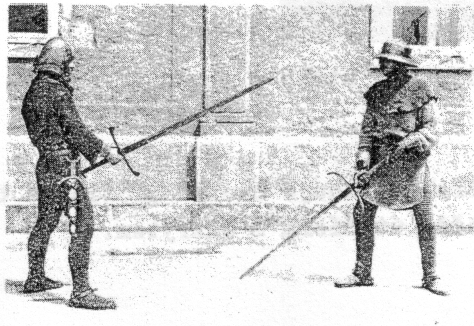
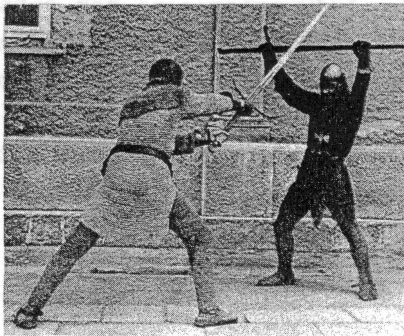
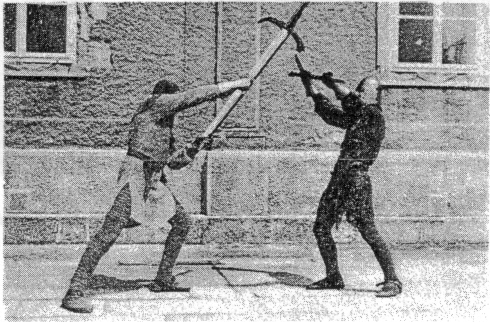
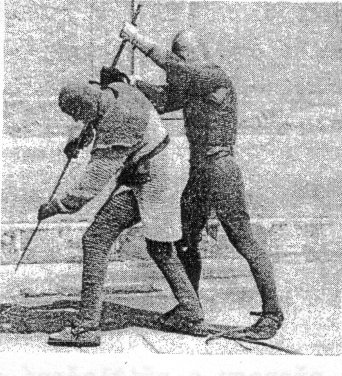
Thank you very much! Well, theoretically, the German martial arts line was never broken. It is still alive. Both the German Academic Fencing (Mensurfechten) and the classical German Theatrical Fencing are both still practiced (although the latter is on its way to become extinct, since the Hollywood styles of fencing have become more fashionable in Europe). It always confused me why the Fechtbücher are hold in such high regard, while the existing lines are almost completely ignored. The Huten (or Leger) are still used in classical German Theatrical Fencing! A Czech author made some photos of classical German Theatrical Fencing in the 1950s. I am sure that you will find the stances quite familiar:
http://jentak.sandbox.cz/books/plch/gfx/obr090.jpg
http://jentak.sandbox.cz/books/plch/gfx/obr097.jpg
http://jentak.sandbox.cz/books/plch/gfx/obr102.jpg
http://jentak.sandbox.cz/books/plch/gfx/obr108.jpg
I don't like Wikipedia as a source, but even Wikipedia alludes to the fact that the German School of Fencing survived in the German Theatrical Fencing:
https://en.wikipedia.org/wiki/Germa.....ool_of_fencing
Do you have an explanation, why historical martial arts practitioners do not care at all about this immensely valuable source of information about medieval martial arts? I do understand that Theatrical Fencing and actual Fencing are different, but it is an excellent source which is just ignored. It is also a unbroken line since the days of the original Fencing masters. People seem frustrated that the line was broken, but this isn't true at all. It is still alive. Well, it is on the brink of extinction, because nobody seems to care about it, but still: the tradition is alive.
http://jentak.sandbox.cz/books/plch/gfx/obr090.jpg
http://jentak.sandbox.cz/books/plch/gfx/obr097.jpg
http://jentak.sandbox.cz/books/plch/gfx/obr102.jpg
http://jentak.sandbox.cz/books/plch/gfx/obr108.jpg
I don't like Wikipedia as a source, but even Wikipedia alludes to the fact that the German School of Fencing survived in the German Theatrical Fencing:
https://en.wikipedia.org/wiki/Germa.....ool_of_fencing
Do you have an explanation, why historical martial arts practitioners do not care at all about this immensely valuable source of information about medieval martial arts? I do understand that Theatrical Fencing and actual Fencing are different, but it is an excellent source which is just ignored. It is also a unbroken line since the days of the original Fencing masters. People seem frustrated that the line was broken, but this isn't true at all. It is still alive. Well, it is on the brink of extinction, because nobody seems to care about it, but still: the tradition is alive.

Interesting! Yes, some of the stances I clearly recognise - there's a lot of halfswording there too. Now that you mention theatrical fencing... if my memory serves right, the master (slovak) of my fencing master (german) was responsible for quite some fencing choreographies in our theaters and movies years ago, so there might be some connection after all - albeit loose.
The name of our fencing school - Klopffechters Erben - and the focus on mostly "Schaukampf" may be connected to this line, although I never researched this further. See, I could go and ask my fencing master about it, maybe I get some interesting answers!
From what I understand, theatrical fencing (that's equivalent to Schaukampf, isn't it?) and what we now know as HEMA (Historical European Martial Arts) have a distinct difference - HEMA is competitive, and not always the best technique wins. But then again, if it works, then it works!
In Schaukampf there are sometimes some techniques, which are, erm, not as lethal as they could be. Targeting the torso instead of the head for training and such. Naturally.
If there is one thing I don't like, it's the general "hollywood fencing". I guess I know why they do what they do, but... real fencing is oftentimes also extremely visually pleasing, so why bother with bad technique?
The name of our fencing school - Klopffechters Erben - and the focus on mostly "Schaukampf" may be connected to this line, although I never researched this further. See, I could go and ask my fencing master about it, maybe I get some interesting answers!
From what I understand, theatrical fencing (that's equivalent to Schaukampf, isn't it?) and what we now know as HEMA (Historical European Martial Arts) have a distinct difference - HEMA is competitive, and not always the best technique wins. But then again, if it works, then it works!
In Schaukampf there are sometimes some techniques, which are, erm, not as lethal as they could be. Targeting the torso instead of the head for training and such. Naturally.
If there is one thing I don't like, it's the general "hollywood fencing". I guess I know why they do what they do, but... real fencing is oftentimes also extremely visually pleasing, so why bother with bad technique?
I agree! Hollywood fencing comes from 19th century sports fencing. I always thought that it looks stupid to portray rapiers and smallswords as hacking weapons instead of thrusting swords. I find it interesting that your fencing master apparently is aware of the connections between stage fencing and the German school of fencing. I can give you an address, if you want to find out more about classical German theatrical fencing! I think it should be important to keep this line alive, because it would give HEMA (as you call it) both valuable information as well as a direct, unbroken line which can be traced back to the Liechtenauer fencers of the late medieval period! I am no expert, but I don't think that the Klopffechter practiced a form of Liechtenauer's German school of fencing. It is actually more likely that people assimilated real fencing techniques and methods into theatrical plays, to make the combat scenes more believable. Many people in the audience back then were probably quite accomplished fencers, and bad fencing or unconvincing fencing techniques on the stage would have probably been met with with laughter. Either way, this line is threatened by extinction. It would be fantastic if HEMA practitioners could save it!
Sure, I'm curious! For me it's "just a hobby" but who knows, contacts on people who are directly "at the source" are always good! I don't know which school exactly was practiced by the real Klopffechter back in the day, we go - more or less - after Joachim Meyer, who was significantly later than Liechtenauer and I get the feeling that already then the fencing in the manuals was a bit more sport than actual combat. After all the book deals mostly with duels, not with large unit tactics!
I can imagine they even took the fencing techniques one to one to theatrical plays, just with blunt weapons. I see no problem with that - when it can be done today on various Mittelaltermärkte, I'm sure they did it also 400 years ago!
I can imagine they even took the fencing techniques one to one to theatrical plays, just with blunt weapons. I see no problem with that - when it can be done today on various Mittelaltermärkte, I'm sure they did it also 400 years ago!
There is a Gentleman named Kai-Uwe Palm, who works at the university of Rostock. He is an expert on this subject. We only talked a bit and I doubt that he would remember me. Anyway, his field of expertise were honor based duels in the Holy Roman Empire. He even wrote his dissertation about the subject and knows several of the people who still teach the old, German school of theatrical fencing. I can give you his E-Mail address, if you like.

Comments