
 FA+
FA+ Shop
Shop
812
Views
Views
47
Favorites
Favorites
Category
All / All
Species Unspecified / Any
Size 1000 x 663
File Size 202.4 kB
Report this content
More from G. Wolfe


Listed in Folders

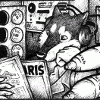
Avro Lancaster B.III W4991 TD-D 'Dog', 'City of Winnipeg' or simply 'Winnie'
Built by Metropolitan-Vickers Ltd., Manchester, October 1942, C/N B69275/40
TOC December 1942, B flight, No. 445 Sqn RCAF
FTR 31 April / 1 May 1944 Against Essen, 61st mission
She was nicknamed 'Lucky Winnie' for a very brief period following completion of her 2nd tour
Built by Metropolitan-Vickers Ltd., Manchester, October 1942, C/N B69275/40
TOC December 1942, B flight, No. 445 Sqn RCAF
FTR 31 April / 1 May 1944 Against Essen, 61st mission
She was nicknamed 'Lucky Winnie' for a very brief period following completion of her 2nd tour
Category All / All
Species Unspecified / Any
Size 1000 x 663px
File Size 202.4 kB


Thanks B. TOC means Taken on Charge, time when something or somebody, from typewriter to heavy bombers, officially entered RAF inventory. It is opposite of Struck off Charge, time when said something or somebody ceased to exist in useful form to the RAF, in this case Winnie Failed to Return, FTR, from her 61st mission against Essen.


That included a lot of aircraft of that era... the ME-109 had no power anything, nor control tabs. In fact, it was Howard Hughes who invented the yaw damper for The Spruce Goose. In an article I read recently, (a lady speaking of her father who was a tail gunner on a Lancaster and had been shot down) she mentioned that the tail gunner position had NO communications with the rest of the ship.
So much history has been lost.
V.
So much history has been lost.
V.
http://history.nasa.gov/monograph12/ch6.htm
Fortunately we can still access some of such history. Linked above is a good paper from NASA (then NACA) regarding this issue, a very good read I say.
Regarding the tail gunner position, there must have been some errors in the article. It is true that they are isolated from the rest of the crew throughout the sortie, but they still maintained communication via intercom. Remember that 6 o'clock position is the most vulnerable part of any military plane especially lancaster bombers which operates mainly in the dark of night, in this case tail gunners act as aircraft's rear outpost and look out for enemy night fighter coming from the rear or below (which is where they come from all the time), he must warns the pilot of such danger and advise him when and where to take evasive maneuver ("corkscrew").
Fortunately we can still access some of such history. Linked above is a good paper from NASA (then NACA) regarding this issue, a very good read I say.
Regarding the tail gunner position, there must have been some errors in the article. It is true that they are isolated from the rest of the crew throughout the sortie, but they still maintained communication via intercom. Remember that 6 o'clock position is the most vulnerable part of any military plane especially lancaster bombers which operates mainly in the dark of night, in this case tail gunners act as aircraft's rear outpost and look out for enemy night fighter coming from the rear or below (which is where they come from all the time), he must warns the pilot of such danger and advise him when and where to take evasive maneuver ("corkscrew").
I agree... the article was about a woman in America remembering her father on Remembrance Day. She said the idea of her father trapped in a burning bomber because he would not have heard the bail out order for lack of this communication. As a little girl, perhaps, this was what she remembered.
V.
V.
Thanks, and take into consideration, that 'men' flying this instrument of war, then a pinnacle of human ingenuity designed and and produced for the sole purpose of wholesale slaughter, were mostly 19-20 years old from all walks of life. Most haven't yet learned how to drive a car yet they brought this machines through the storm of flak and back home. Some poor lads flew them just for a few sorties. Some for one, even two tours of duty. That certainly took more than physical strength

Comments