
 FA+
FA+ Shop
Shop
1393
Views
Views
21
Favorites
Favorites
Category
All / All
Species Mammal (Other)
Size 1160 x 792
File Size 281.9 kB
Report this content
More from Karno


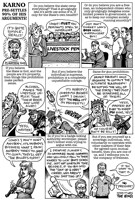


I had this sheet of paper, on which I had drawn stuff for the day job. As I hadn't posted anything for a couple of days, I thought I'd scan and post it, just for lulz. And don't plotz - the pig-men, there, qualify it as anthropomorphic.
Category All / All
Species Mammal (Other)
Size 1160 x 792px
File Size 281.9 kB



Heh... the various pics remind me of my stance on unions.
I can see unions being beneficial in most cases.
Most cases.
There's several situations where unions aren't helping out and are leading towards killing the jobs they're "trying" to protect. One of those situations is transit, and I worked there for 8 years, in a rather unique position. If Karno were to draw it out as a short funny, it would be the unions squeezing from the left... and politicians, who don't want to pay for even repairing roads, squeezing on the right. Eventually the entire system goes pop.
I can see unions being beneficial in most cases.
Most cases.
There's several situations where unions aren't helping out and are leading towards killing the jobs they're "trying" to protect. One of those situations is transit, and I worked there for 8 years, in a rather unique position. If Karno were to draw it out as a short funny, it would be the unions squeezing from the left... and politicians, who don't want to pay for even repairing roads, squeezing on the right. Eventually the entire system goes pop.



In the first place, one has to assume a union that isn't under mobster or other kind of corrupt influence. The history of the Teamsters, the Longshoremen, certain garment unions, and so forth show that those unions, under baleful influence, are run for the benefit of the criminals, and neither the employees nor the employers. Mercifully, this is not nearly as common as it was in the 1950s, thanks to certain disclosure laws, and repeated cleanup efforts.
In some cases, it is deeply questionable whether or not the entrenched management of certain unions truly represents the folks they purport to represent. It's quite noticeable that when certain Wisconsin state entities went from "closed shop" (where union membership is required) to "open shop" (where it is not), union membership declined dramatically. Were there a "value proposition" on the part of the union, you wouldn't have seen such dramatic drops. This tends to be more prevalent in unions that are vigorously engaged in activities that go somewhat beyond wages and workplace condition representation.
(There is, of course, the kind of militant unionism parodied in "I'm All Right, Jack," that was self-defeating in the long term, in terms of general support. Arthur Scargill may have been a union man to his core, but he had a tin ear for public relations, and ended up destroying his union -- though the green movement likely would have destroyed it, anyway.)
In some cases, and this happened in a lot of the heavy industry in not only the U.S., but in many European countries, the high-cost structure and sluggish ability to move imperiled many firms; combined with very onerous defined-benefit (as opposed to defined contribution) plans, some firms totally collapsed (e.g. Bethlehem Steel) or went through long waves of painful cuts (e.g. Ford, GM). Management misjudgements played a definite role (especially at GM), but the role of unions was a factor.
One of the ironies is that a central prop and purpose of unionism -- workplace conditions -- was largely taken over by government regulation, e.g. OSHA. The kinds of conditions where brakemen lost legs, or miners risked cave-ins, drove unionism for many years, but with those roles now done by government, as I say, some of the purpose behind unions is gone.
The other thing, of course, that affects unionism is the globalization of products. in 1920, it wasn't as easy to get products or resources from half-way around the world, like it is today. Consumers might "Buy American" and then again, they might not.
In some cases, it is deeply questionable whether or not the entrenched management of certain unions truly represents the folks they purport to represent. It's quite noticeable that when certain Wisconsin state entities went from "closed shop" (where union membership is required) to "open shop" (where it is not), union membership declined dramatically. Were there a "value proposition" on the part of the union, you wouldn't have seen such dramatic drops. This tends to be more prevalent in unions that are vigorously engaged in activities that go somewhat beyond wages and workplace condition representation.
(There is, of course, the kind of militant unionism parodied in "I'm All Right, Jack," that was self-defeating in the long term, in terms of general support. Arthur Scargill may have been a union man to his core, but he had a tin ear for public relations, and ended up destroying his union -- though the green movement likely would have destroyed it, anyway.)
In some cases, and this happened in a lot of the heavy industry in not only the U.S., but in many European countries, the high-cost structure and sluggish ability to move imperiled many firms; combined with very onerous defined-benefit (as opposed to defined contribution) plans, some firms totally collapsed (e.g. Bethlehem Steel) or went through long waves of painful cuts (e.g. Ford, GM). Management misjudgements played a definite role (especially at GM), but the role of unions was a factor.
One of the ironies is that a central prop and purpose of unionism -- workplace conditions -- was largely taken over by government regulation, e.g. OSHA. The kinds of conditions where brakemen lost legs, or miners risked cave-ins, drove unionism for many years, but with those roles now done by government, as I say, some of the purpose behind unions is gone.
The other thing, of course, that affects unionism is the globalization of products. in 1920, it wasn't as easy to get products or resources from half-way around the world, like it is today. Consumers might "Buy American" and then again, they might not.






Comments