
 FA+
FA+ Shop
Shop
361
Views
Views
13
Favorites
Favorites
Category
Artwork (Digital) / All
Species Unspecified / Any
Size 1200 x 1200
File Size 49.1 kB
Report this content
More from spikeheila


Listed in Folders


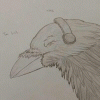
Argentavis magnificens sunbathing. Yes it's doing something other than looking imposing.
=v= my friends didn't give me any papers on it, and I'm 500% certain the size of the head and neck is too big. (Unless I make it out to be a juvie I guess)
=v= my friends didn't give me any papers on it, and I'm 500% certain the size of the head and neck is too big. (Unless I make it out to be a juvie I guess)
Category Artwork (Digital) / All
Species Unspecified / Any
Size 1200 x 1200px
File Size 49.1 kB
Listed in Folders

Oh I found where did I read that, you can call my source biased ^.^
http://ark.gamepedia.com/Argentavis
"Argentavis does not have the stooped neck typical of modern buzzards and vultures. It is unknown if it adapted this stronger neck to deal with predators on the island, or if its lineage comes from before the stooped neck became common in carrion-eating birds."
I met them in game in the very early days while their AI were bugged, swarmed by 2-3 'Tavis and then you punch lagged them to death XD asdf priceless buggy game
http://ark.gamepedia.com/Argentavis
"Argentavis does not have the stooped neck typical of modern buzzards and vultures. It is unknown if it adapted this stronger neck to deal with predators on the island, or if its lineage comes from before the stooped neck became common in carrion-eating birds."
I met them in game in the very early days while their AI were bugged, swarmed by 2-3 'Tavis and then you punch lagged them to death XD asdf priceless buggy game

ARK's animals are crap and I wouldn't trust them as a source, period. I mean they have a Titanoboa with a -feathered- neck. And their deinonychosaurs are poorly feathered and have pronated hands,their pterosaurs are missing a HUGE chunk of their wings, among a slew of other things.
Oh, finally got some papers.
Vidal, P. P., W. Graf, and A. Berthoz. 1986. The orientation of the cervical vertebral column in unrestrained awake animals. Experimental Brain Research 61: 549-559.
Graf, W., C. de Waele, and P. P. Vidal. 1995. Functional anatomy of the head-neck movement system of quadrupedal and bipedal animals. Journal of Anatomy 186: 55-74.
Taylor, M. P., M. J. Wedel, and D. Naish. 2009. Head and neck posture in sauropod dinosaurs inferred from extant animals. Acta Palaeontologica Polonica 54: 213-220.
There you go. All about animal necks.
Also an excerpt from elsewhere.
"It seems that all nonmarine tetrapods generally hold their necks in a S shape when awake and alert, and not engaging in an activity requiring use of their necks (e.g., feeding, some forms of locomotion). In such postures, the neck base is angled up, the midlength is held more or less straight, and the anterior neck bones are flexed somewhat downward (Vidal et al. 1986; Graf et al. 1995; Taylor et al. 2009). This may seem counterintuitive when we consider the appearance of some of the pets and livestock that we are familiar with, but x-rays of these animals reveal that their neck soft tissues are obscuring the same basic configuration seen in all other nonmarine tetrapods (this also includes your neck, by the way). Given how ubiquitous this neck posture is across modern, distantly related tetrapods, it seems likely that it is a deeply rooted trend of tetrapod evolution[...]"
Vidal, P. P., W. Graf, and A. Berthoz. 1986. The orientation of the cervical vertebral column in unrestrained awake animals. Experimental Brain Research 61: 549-559.
Graf, W., C. de Waele, and P. P. Vidal. 1995. Functional anatomy of the head-neck movement system of quadrupedal and bipedal animals. Journal of Anatomy 186: 55-74.
Taylor, M. P., M. J. Wedel, and D. Naish. 2009. Head and neck posture in sauropod dinosaurs inferred from extant animals. Acta Palaeontologica Polonica 54: 213-220.
There you go. All about animal necks.
Also an excerpt from elsewhere.
"It seems that all nonmarine tetrapods generally hold their necks in a S shape when awake and alert, and not engaging in an activity requiring use of their necks (e.g., feeding, some forms of locomotion). In such postures, the neck base is angled up, the midlength is held more or less straight, and the anterior neck bones are flexed somewhat downward (Vidal et al. 1986; Graf et al. 1995; Taylor et al. 2009). This may seem counterintuitive when we consider the appearance of some of the pets and livestock that we are familiar with, but x-rays of these animals reveal that their neck soft tissues are obscuring the same basic configuration seen in all other nonmarine tetrapods (this also includes your neck, by the way). Given how ubiquitous this neck posture is across modern, distantly related tetrapods, it seems likely that it is a deeply rooted trend of tetrapod evolution[...]"


Comments