
 FA+
FA+ Shop
Shop
264
Views
Views
1
Favorites
Favorites
Category
Artwork (Digital) / Animal related (non-anthro)
Species Unspecified / Any
Size 1280 x 1011
File Size 181.7 kB
Report this content
More from CassMutt


Grycabbits are a CLOSED species!! You CANNOT make your own!!
OPEN FOR GRYCABBIT CUSTOMS!! DESCRIPTIONS OF SPECIES AND BREEDS ARE BELOW COMMON/UNCOMMON/RARE CHARTS AND PRICES!!
Price varies depending on what you want:
Common:
• Knife-Tailed Grycabbits (w/ a single straight horn)
• Spike-Tailed Grycabbits (w/ a single antler-like horn)
• Stripes being identical on both the horn and the skin-part of the tail
• Over bite or under bite
• Saber teeth on over bite or under bite
• Varieties of colors
Uncommon:
• No stripes on both horn and tail
• Stripes on tail but no stripes on horn / stripes on horn but no stripes on tail
• Knife or spikes being colors other than shades of gray
• Claws that never sheath
Rare:
• Orb-Tailed Grycabbits (w/ a single short, stubby horn)
• Two-Horned Grycabbits (same as knife-tailed but two horns that are stubby but long)
• Spike-Tailed Grycabbits with spikes that run along entire tail
• Wings for flight
• Herbivore Grycabbits
• Grycabbits that prefer sweets such as candies over their carnivore nature
• Heterochromia eyes
• Non-bilateral symmetry in the design
Never:
• Horns in the center of the head like a unicorn
• Herbivore teeth
• Domesticated Grycabbits ((although maybe in the future))
Starting Price for Common Breed w/ Common Features: $5.00
Starting Price for Common Breed w/ Uncommon Features: $7.00
Starting Price for Common Breed w/ Rare Features: $10.00
Starting Price for Rare Breed w/ Rare Features: $20.00
Starting Price for Rare Breed w/ Uncommon Features: $15.00
Starting Price for Rare Breed w/ Common Features: $12.00
Starting Price for Common Breed w/ BOTH Uncommon and Rare Features: $20.00
Starting Price for Rare Breed w/ BOTH Uncommon and Common Features: $10.00
***
Grycabbits:
Grycabbits are a man-eating species that resides in places of the world that are undiscovered. They sometimes show themselves if they're scavenging through garbage, but that's on rare occasions. Grycabbits are about as tall as a Great Dane. They feast mainly on the meat of large animals that are carnivorous such as bears, wolves, eagles, etc., and tend to befriend smaller meat that are mostly herbivorous or omnivorous such as mice, rabbits, squirrels, deer, etc.. Unlike normal mammals, Grycabbits lay eggs instead of give live birth, keeping the eggs in a nest usually on higher grounds and carefully protected by one of the mates as the other hunts. Grycabbits use their tails as defense mechanisms and also as hunting weapons. The way they hunt is described in their breed descriptions below.
Knife-Tailed Grycabbits:
Knife-Tailed Grycabbits, one of the most common breeds of Grycabbit, have a horn that's straight and slightly curverd. It almost looks like a thin dorsal fin, but the horn is round. It is rare for their to be two horns on the head of a Knife-Tailed Grycabbit, or any Grycabbit for that matter, but Knife-Tails tend to disown their children who have two horns instead of one. Their tail contains a blade, which is why they are given the name "Knife-Tailed Grycabbits." Their tail is used as a defense mechanism and also as a hunting weapon, and they use it by doing a somersault in midair, be-heading their enemy/prey.
Spike-Tailed Grycabbits:
Spike-Tailed Grycabbits, a common breed but not as common as the Knife-Tailed, have a horn that is more like an antler than a horn, and it is slightly curved the same way a Knife-Tailed Grycabbit's horn works. It is rare for Spike-Tailed Grycabbits to have spikes running along entire tail, and is looked down upon by many Spike-Tailed, who tend to disown their children who have spikes like that. Their tail contains a row of spikes on either side of the tail. Small-spiked Grycabbits have a small spike at the tip, a large spike in the center, and a small spike at the end of their row, whereas Large-spiked Grycbabits have a small spike at the tip, a large spike in the center, and an even larger spike at the end of their row. Their tail is used as a defense mechanism and also as a hunting weapon, and they use it by aggressively waving it side to side, cutting open their enemy/prey.
Orb-Tailed Grycabbits:
Orb-Tailed Grycabbits, the most rare breed of Grycabbit, have a horn that is short and stubby, and is also just barely curved the same way a Knife-Tailed and Spike-Tailed Grycabbits horns work. Orb-Tails have never had any known mutations so far, so they care for their offspring a lot better than the more common species have cared for their offspring. Their tail contains an orb of light, which conducts electricity as a defense mechanism or as a hunting weapon. When hunting, they stalk their prey, but backwards, so that their tail slowly creeps over to their victim. Once they're close enough, they electrocute the prey to death. As a defense mechanism, they wrap the tail around them and zap electricity if they're about to be given a fatal blow.
Two-Horned Grycabbits:
Two-Horns are a sub-breed of Grycabbit that was created from mutated offspring of the Knife-Tailed Grycabbit. Two-horns have the same type of tail as the Knife-Tails, but they have two horns instead of one. Two-Horns are abandoned at an early age, and most of them die due to being too young to survive on their own. Those who survive try to breed with a Knife-Tailed Grycabbit or another Two-Horn, but it's never easy. Knife-Tails try to avoid Two-Horns at all costs, so it's very rare for a Two-Horn to mate with a Knife-Tail. Two-Horned Grycabbits have the same tail as a Knife-Tail, so they use the same defense mechanism and hunting weapon, and hunt the same way.
***
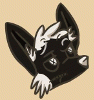
I'm finally doing it!! I'm selling customs of my little species :rose: It took me so long to make their bio's, it actually took me over a year to complete them and make them an actual species to sell. I did sell them as adoptables before (hence all the pictures used in this submission, which are the adoptables I have all sold), but I never really completed them until now. I hope I sell some of these... I've put so much time and effort into making this species that I don't want it to all go to waste.
Enjoy~
Grycabbits© CassMutt
MOVED TO TOPDogStudios
OPEN FOR GRYCABBIT CUSTOMS!! DESCRIPTIONS OF SPECIES AND BREEDS ARE BELOW COMMON/UNCOMMON/RARE CHARTS AND PRICES!!
Price varies depending on what you want:
Common:
• Knife-Tailed Grycabbits (w/ a single straight horn)
• Spike-Tailed Grycabbits (w/ a single antler-like horn)
• Stripes being identical on both the horn and the skin-part of the tail
• Over bite or under bite
• Saber teeth on over bite or under bite
• Varieties of colors
Uncommon:
• No stripes on both horn and tail
• Stripes on tail but no stripes on horn / stripes on horn but no stripes on tail
• Knife or spikes being colors other than shades of gray
• Claws that never sheath
Rare:
• Orb-Tailed Grycabbits (w/ a single short, stubby horn)
• Two-Horned Grycabbits (same as knife-tailed but two horns that are stubby but long)
• Spike-Tailed Grycabbits with spikes that run along entire tail
• Wings for flight
• Herbivore Grycabbits
• Grycabbits that prefer sweets such as candies over their carnivore nature
• Heterochromia eyes
• Non-bilateral symmetry in the design
Never:
• Horns in the center of the head like a unicorn
• Herbivore teeth
• Domesticated Grycabbits ((although maybe in the future))
Starting Price for Common Breed w/ Common Features: $5.00
Starting Price for Common Breed w/ Uncommon Features: $7.00
Starting Price for Common Breed w/ Rare Features: $10.00
Starting Price for Rare Breed w/ Rare Features: $20.00
Starting Price for Rare Breed w/ Uncommon Features: $15.00
Starting Price for Rare Breed w/ Common Features: $12.00
Starting Price for Common Breed w/ BOTH Uncommon and Rare Features: $20.00
Starting Price for Rare Breed w/ BOTH Uncommon and Common Features: $10.00
***
Grycabbits:
Grycabbits are a man-eating species that resides in places of the world that are undiscovered. They sometimes show themselves if they're scavenging through garbage, but that's on rare occasions. Grycabbits are about as tall as a Great Dane. They feast mainly on the meat of large animals that are carnivorous such as bears, wolves, eagles, etc., and tend to befriend smaller meat that are mostly herbivorous or omnivorous such as mice, rabbits, squirrels, deer, etc.. Unlike normal mammals, Grycabbits lay eggs instead of give live birth, keeping the eggs in a nest usually on higher grounds and carefully protected by one of the mates as the other hunts. Grycabbits use their tails as defense mechanisms and also as hunting weapons. The way they hunt is described in their breed descriptions below.
Knife-Tailed Grycabbits:
Knife-Tailed Grycabbits, one of the most common breeds of Grycabbit, have a horn that's straight and slightly curverd. It almost looks like a thin dorsal fin, but the horn is round. It is rare for their to be two horns on the head of a Knife-Tailed Grycabbit, or any Grycabbit for that matter, but Knife-Tails tend to disown their children who have two horns instead of one. Their tail contains a blade, which is why they are given the name "Knife-Tailed Grycabbits." Their tail is used as a defense mechanism and also as a hunting weapon, and they use it by doing a somersault in midair, be-heading their enemy/prey.
Spike-Tailed Grycabbits:
Spike-Tailed Grycabbits, a common breed but not as common as the Knife-Tailed, have a horn that is more like an antler than a horn, and it is slightly curved the same way a Knife-Tailed Grycabbit's horn works. It is rare for Spike-Tailed Grycabbits to have spikes running along entire tail, and is looked down upon by many Spike-Tailed, who tend to disown their children who have spikes like that. Their tail contains a row of spikes on either side of the tail. Small-spiked Grycabbits have a small spike at the tip, a large spike in the center, and a small spike at the end of their row, whereas Large-spiked Grycbabits have a small spike at the tip, a large spike in the center, and an even larger spike at the end of their row. Their tail is used as a defense mechanism and also as a hunting weapon, and they use it by aggressively waving it side to side, cutting open their enemy/prey.
Orb-Tailed Grycabbits:
Orb-Tailed Grycabbits, the most rare breed of Grycabbit, have a horn that is short and stubby, and is also just barely curved the same way a Knife-Tailed and Spike-Tailed Grycabbits horns work. Orb-Tails have never had any known mutations so far, so they care for their offspring a lot better than the more common species have cared for their offspring. Their tail contains an orb of light, which conducts electricity as a defense mechanism or as a hunting weapon. When hunting, they stalk their prey, but backwards, so that their tail slowly creeps over to their victim. Once they're close enough, they electrocute the prey to death. As a defense mechanism, they wrap the tail around them and zap electricity if they're about to be given a fatal blow.
Two-Horned Grycabbits:
Two-Horns are a sub-breed of Grycabbit that was created from mutated offspring of the Knife-Tailed Grycabbit. Two-horns have the same type of tail as the Knife-Tails, but they have two horns instead of one. Two-Horns are abandoned at an early age, and most of them die due to being too young to survive on their own. Those who survive try to breed with a Knife-Tailed Grycabbit or another Two-Horn, but it's never easy. Knife-Tails try to avoid Two-Horns at all costs, so it's very rare for a Two-Horn to mate with a Knife-Tail. Two-Horned Grycabbits have the same tail as a Knife-Tail, so they use the same defense mechanism and hunting weapon, and hunt the same way.
***
I'm finally doing it!! I'm selling customs of my little species :rose: It took me so long to make their bio's, it actually took me over a year to complete them and make them an actual species to sell. I did sell them as adoptables before (hence all the pictures used in this submission, which are the adoptables I have all sold), but I never really completed them until now. I hope I sell some of these... I've put so much time and effort into making this species that I don't want it to all go to waste.
Enjoy~
Grycabbits©
 CassMutt
MOVED TO
 TOPDogStudios
 Category Artwork (Digital) / Animal related (non-anthro)
Species Unspecified / Any
Size 1280 x 1011px
File Size 181.7 kB

Comments