
 FA+
FA+ Shop
Shop


1225 submissions



P-73 and P.1001 action
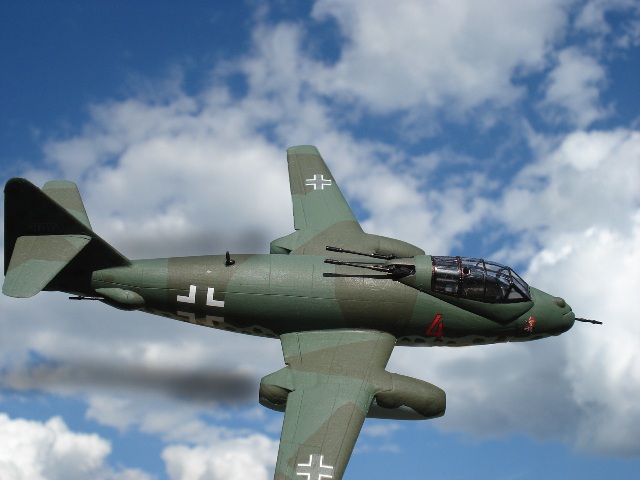
Two of my own designs for a "Luft'46" scene. The P-73 was designed as a very long range, high altitude bomber escort, powered by a turbo'ed Allison V1710. The P.1001 was intended as a Bf109 replacement, though had design flexibility for larger DB603 or Jumo 213 engines, this one being Jumo powered. The scan contrast is a bit off from the actual art
Category Artwork (Traditional) / Miscellaneous
Species Unspecified / Any
Size 771 x 576px
File Size 165.1 kB


Do you mean multiple engines driving a common propellor? Actually done a few times around the world, I seem to recall something about some WWI bombers with multiple engines in the fuselage driving big props on the wings being the first to do so, then there were all kinds of ganged-up engine to prop concepts drawn up. During WWII, there were a few efforts to actually couple engines (quickie way of making bigger engines) to a common drive, some working better than others. The British "Brabazon" airliner project used two engines per propellor in the middle four props of the six prop design and was about the last ganged-up piston type. Later, there were all kinds of turbo-props using two jet turbines per propellor.

Technically, yeah, along those lines. Russians were trying to makesuper-bomber\assault plane which could have turrets, bear troops, used diesel engines and even attempted to make glider tank to by towed by it. Crazy idea, prototype could fly and even demostrated (to German delegation, lol), but always was showing overheating issues. Design leaned toward those insane super-planes from "Wolfenstein:New order" game. Using long, row or V scheme of engines , is about same thing as usage of dual engines on common propeller, if technology and instrumentation allows to hold enough precision to make engines with that many cylinders (tolerances are the.issue, right?) and strong enough crank shafts (that's metallurgy, machining and welding tech).
The problem with longer engines often was often matters of vibration harmonics (damaging vibration) on the one hand, and problems with strength/weight (insufficently stiff) on the other. So V-12 s or straight 8s were as big as most in-line engines got, with the exception of the various flat horizontally opposed engines, (sideways)H-24s worked pretty well. The various combined engines were mostly just two engines set side-by-side and only the final gear group in common. Radial engines had their own issues, but still got very big, several very powerful 18 cylinder 9x2 were very successful, and even a 28 cylinder 7x4 did well. The largest concept build and run, but not put into production was a 36 cylinder 4x9 (nine sets of four in-line banks) and a couple of 24 cylinder 4x6 (six sets of four in-line). Germany had some pretty good aviation diesels and late in WWII, attempted to combine in-line banks of six into a box arrangement of 6x4 but only prototypes were attempted.
Yeah vibration is also issue,and cyclic strength. I had impression that radials were most optimal weight-wise for certain span of time (easier to optimize?)
Germans weren't using diesels much, even for tanks, right? Panther had mainly petrol engine, although diesel variant existed (similar, there were petrol variants of T-34 and I remeber, it was partly issue of fuel availability.
And reuse of engines in in different vehicles ,a s well as armamnet was just production issue - why not to use what we already have produced in series? So Shermans used aircraft radials, T-34 - bmber diesels, IS tanks were using ship artillery guns..
Germans weren't using diesels much, even for tanks, right? Panther had mainly petrol engine, although diesel variant existed (similar, there were petrol variants of T-34 and I remeber, it was partly issue of fuel availability.
And reuse of engines in in different vehicles ,a s well as armamnet was just production issue - why not to use what we already have produced in series? So Shermans used aircraft radials, T-34 - bmber diesels, IS tanks were using ship artillery guns..
Germany has a family of aviation diesels that worked pretty well for very long endurance seaplanes, very fuel efficent, but were kind of heavy. Never got ground vehicle diesels going all that much, especially nothing for tanks. Lots of equipment got re-purposed elements, navy guns or anti-aircraft guns for tanks, aircraft engines for tanks and boats, even little odd things, like the wheels on the Sherman and earlier US tanks were standard industrial caster wheels.
In-lines had to harmonize long crankshafts and the firing order along the long banks, while radials had everything in a tight group and didn't have the long heavy crank case and cylinder banks for weight. Some later V-12s got to better than 1 to 1 power/weight, but radials did it earlier/better.


The design was something of an absurdist concept, the multiple 30mm Mk103s in flexible remote turrets would have been crazy heavy and pretty pointless for defensive fire, being big. slow moving mounts with slow cycling fire. Perhaps they were intended as a fire-in-passing scheme at bombers. And the big fat fuselage seems way out of proportion to the wings, standard Me262 units.
Yeah, that's what I meant about the wings as they don't appear to fit with the pods and body. It would be entertaining to see the scratch drawings for the first run designs of many aircraft, or vehicles for that matter. Yesterday I was looking at the preproduction concept drawings of the GMC motorhome with several of them looking like futuristic spaceships.




From what I can find online (however slim), the Me p.1001 seems to have been a child of the Jägernotprogramm or Emergency Fighter Program. I found a little more about the p.1101, all one of them ever started (about 80% complete when our guys found it) and which found its way to Buffalo and Bell's jet fighter program. I can't find anything about the P-73. What I have found links it to the Hughes D-2, but that was a twin fuselage design that really never got off the ground, not the sleek swept-wing shown here. Another source says that the F-73 and F-74 designations were never used so Fisher could have F-75. Anyway, I suspect these are a couple of beautiful, but rare birds that never really flew.
The "P." designation was an in-factory designation used by various companies, so one could have any number of "P." items out there. Several companies indexed the number agains the beginning of the Nazi era, so in this case, the project was started in 1943. (Italy seems to have more formally refer to many dates as "year X of the Fascist Era")
This P.1001 was developed by a sub-contractor who wanted to get into the design and general construction biz. The initial test articles were actually very clever, in that the middle of the fuselage was simply load-carrying rails, that the wings and engine could be mounted on at various positions to accomodate CG issues. The production version would be set by the test experiance, as well as still having some adjustablity to accomodate alternate engines.
The Hughes project fleetingly had the F-73 designation, maybe, as well as an A for attack number as well. A version was built and flown but destroyed under mysterious circumstances. The later XF-11 was the final larger version of the general concept. P-74 seems to have never been applied to anything.
I hope you're just being thurough rather than missing my opening comment about these being my own designs?
This P.1001 was developed by a sub-contractor who wanted to get into the design and general construction biz. The initial test articles were actually very clever, in that the middle of the fuselage was simply load-carrying rails, that the wings and engine could be mounted on at various positions to accomodate CG issues. The production version would be set by the test experiance, as well as still having some adjustablity to accomodate alternate engines.
The Hughes project fleetingly had the F-73 designation, maybe, as well as an A for attack number as well. A version was built and flown but destroyed under mysterious circumstances. The later XF-11 was the final larger version of the general concept. P-74 seems to have never been applied to anything.
I hope you're just being thurough rather than missing my opening comment about these being my own designs?
Nerp. I seem to have glossed over that entirely -- or rather, misinterpreted it. Well, that and I love doing the research. Anyway, both of these are prettier than anything real that came out of the 1940s.
I wasn't aware of the Nazi numbering system, but it makes perfect sense now that you mentioned it. Japan did the same thing, but they keyed off the reign of the current Emperor. My brother has a modest collection of WWII-era Japanese small arms, and the numbers reflect who was sitting on the Chrysanthemum Throne, an when.
I wasn't aware of the Nazi numbering system, but it makes perfect sense now that you mentioned it. Japan did the same thing, but they keyed off the reign of the current Emperor. My brother has a modest collection of WWII-era Japanese small arms, and the numbers reflect who was sitting on the Chrysanthemum Throne, an when.



Ooh btw this might be something you would like to See
http://www.youtube.com/watch?v=Y9wyJNsATXE
http://www.youtube.com/watch?v=Y9wyJNsATXE

Didn't we discuss the flight characteristics of the P-73/74 a few years ago? As for the P1001, that's a new one for me. I like the design as it looks like it could be cobbled together from the WW II stuff in my German Model Planes scrap boxes. I believe I've got some parts left over from a 1/32nd scale Do 335...
Revisiting this one, still beautiful a/c... but I have always wondered about the P-73s' configuration. The lack of any kind of a rear control surface makes me wonder about pitch control with that long tail. With the power plant that far back, just where is the CG? That's assuming that the Allison is in the back, otherwise, why the long tail? THE COLONEL

Stray thought---twin 1710 s with the prop setup like the Douglas "Mixmaster. HMMM WCJ The interesting thing about that set up was that either engine could be shut down and the prop feathered. and the front prop was something like 3 inches larger than the rear , turbulence considerations, supposedly. WCJ
The larger P-74 would have a pair of P&W R1830s in the wings and swinging a contraprop. A weird thing I noticed about the Tu95's props, the front and rear props are not geared together, at least not initially. Saw some vid that showed the props swinging free from each other as the Bear was getting ready to start up.
The engines themselves were a big part of the problem there. The P-75 seems to have worked. The B-35 had accusations back and forth about the gearing versus insuffiscently stiff mounting. On the other hand, contraprop Griffins worked well for the Brits, as well as the turboproped Wyverns
Don't forget the Gannet with the Double Mamba. One of the few times that a coupled engine set up actually worked well.
It does make one wonder about what would have happened if the "corncob" Wasp Major had the kinds of problems that some of the other large radials had. What would the B-35 and B-36 looked like with coupled engine setups ? Say a up sized v-3420? With a larger Turbo setup, even the 3420 could have approached the 3500 to 4000 HP range.
THE COLONEL
It does make one wonder about what would have happened if the "corncob" Wasp Major had the kinds of problems that some of the other large radials had. What would the B-35 and B-36 looked like with coupled engine setups ? Say a up sized v-3420? With a larger Turbo setup, even the 3420 could have approached the 3500 to 4000 HP range.
THE COLONEL
Oops. 3420. Coupled 1710. The propose C version would have had a couple big blower options for output up to 4800 WEP. On the other hand and across the waves, the Russians did their own version of the Jumo222 configuration and got over 4000hp out of it for the Tu85. The French did a H (?) configuration using four Jumo 213 cylinder banks. And there was the huge Lycoming R7755.
the turbo-compound 1710 [v-1710-E22 got up to 2320 hp with wep rating of 3030 with alcohol injection [http://www.pilotfriend.com/aero_engines/aero_allison_v1710.htm] . besides being a "Plumbers nightmare" a a doubled version of this would have required a very husky gearbox. the prop required to absorb this much power [on the order of 4500/5000 hp] would have been large even in a contra-prop design. look at the props on the Bear. Allison stopped working on these ideas because turbines were more attractive. Of course then they came up with the At-40! LOL
THE COLONEL
P.S. visuarizing a B-36 with 19 foot diameter contra-props.
THE COLONEL
P.S. visuarizing a B-36 with 19 foot diameter contra-props.
When I first started noodling on the design, back in 1974, it was not much more than a mutant BD5. Then, over the years, I made some more serious design considerations. Similar to Dornier, but more compact, intended to be a replacement of the Bf 109 with the same engine and similar weight, though that quickly escalated to something more Fw190 size. But was intended to take the Jumo or DB series engines with minimal fuss between them. The initial weapon fit was just two Mg151/20, though a second pair could be fitted, but at the cost of some fuel volume. Like the Ta183, the design was to have a symetrical airfoil and most of the wing was flippable to either side, only the root and wheel well area were handed.
More recently, I've been noodling on a Do concept similar to an original, contraporp tail prop, two engines, the drive of the forward engine going through the motor cannon shaft of the rear one.
More recently, I've been noodling on a Do concept similar to an original, contraporp tail prop, two engines, the drive of the forward engine going through the motor cannon shaft of the rear one.
So a tandem engine setup like the French Arsenal 12H [post war french Jumo 213's] tandem? I had a thought of turning the one engine around so as tobe back to back with the front shaft running through both engines. the extension shaft would then be co-axial and would not need any extra reduction gearing[ already on engines] ... shafts would be in a torque tube with pressure lube system???? front engine runs rear prop, rear the front.. somewhat like the "Mixmaster" [B-42] another advantage would be that both units superchargers would be togeather in the middle...simpler intake plumbing.
just a bright thought. BTW am now using this pic as my wallpaper. WCJ
just a bright thought. BTW am now using this pic as my wallpaper. WCJ
Ah, the BD-5...that's why the P-1001 looked so familiar! Jim Bedes' little "pocket rocket" esp. the "J".
Funny story--- one day, on a run from L.A. to the east, on one of the ridges on I-40 between Barstow and Needles, there came a call over the CB if any one had a couple of gallons of oil on the westbound side. As I topped the ridge, on the side of the road was a BD-5 sitting on the shoulder. Seems that he had broken an oil line and had pulled of a landing on the interstate, and a driver stopped to help out. As the story went, they were able to fix the leak and needed some more oil than he had on hand to get the motor running well enough to fly the thing out of there. supposedly a couple of westbounders supplied enough oil to get it going, and gone before the CHP showed up. Fun day for all involved. The take ofF should have easy enough, nice downgrade and about a mile or so of nice straight road. At least that is what I heard later. THE COLONEL
Funny story--- one day, on a run from L.A. to the east, on one of the ridges on I-40 between Barstow and Needles, there came a call over the CB if any one had a couple of gallons of oil on the westbound side. As I topped the ridge, on the side of the road was a BD-5 sitting on the shoulder. Seems that he had broken an oil line and had pulled of a landing on the interstate, and a driver stopped to help out. As the story went, they were able to fix the leak and needed some more oil than he had on hand to get the motor running well enough to fly the thing out of there. supposedly a couple of westbounders supplied enough oil to get it going, and gone before the CHP showed up. Fun day for all involved. The take ofF should have easy enough, nice downgrade and about a mile or so of nice straight road. At least that is what I heard later. THE COLONEL

Comments